
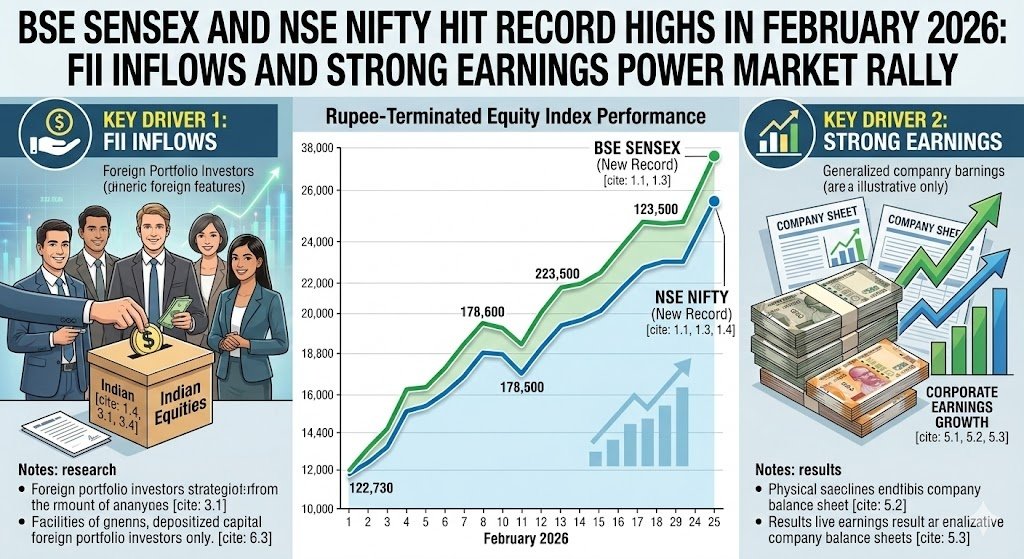
Indian stock markets delivered a stellar performance in February 2026, with the BSE Sensex and NSE Nifty 50 both hitting record highs, driven by strong corporate earnings, renewed foreign institutional investor (FII) inflows, and improving macroeconomic indicators. Investor sentiment has turned decidedly bullish as India’s economic fundamentals strengthen.
The BSE Sensex climbed significantly to touch fresh all-time highs, crossing the 84,000 mark during intraday trading on February 28, while the Nifty 50 surged above the 25,600 resistance zone – a level closely watched by technical analysts. The rally was broad-based, with mid-cap and large-cap indices both participating in the upswing.
Key drivers behind the rally include robust Q3 FY26 corporate earnings, with banking, FMCG, and infrastructure sectors posting better-than-expected results. Foreign institutional investors, who had been net sellers for much of the past few months, returned as significant buyers, injecting nearly ₹5,000 crore in a single session. Domestic institutional investors (DIIs) also continued their steady buying, providing a floor to any potential downside.
Bank Nifty showed particular strength, with the index maintaining its relative outperformance. Analysts attribute banking sector strength to stable credit growth, improving asset quality, and strong retail lending numbers. HDFC Bank, ICICI Bank, and State Bank of India were among the top contributors to the rally.
Experts advise investors to focus on quality stocks with strong fundamentals in this environment. The upcoming RBI Monetary Policy Committee meeting in April 2026 will be closely watched, with market participants anticipating a potential rate cut given falling inflation numbers. Investors should maintain a disciplined approach and avoid chasing momentum blindly in this elevated market environment.
For retail investors, systematic investment plans (SIPs) remain the recommended route for equity exposure during such market peaks, ensuring cost averaging over time.