
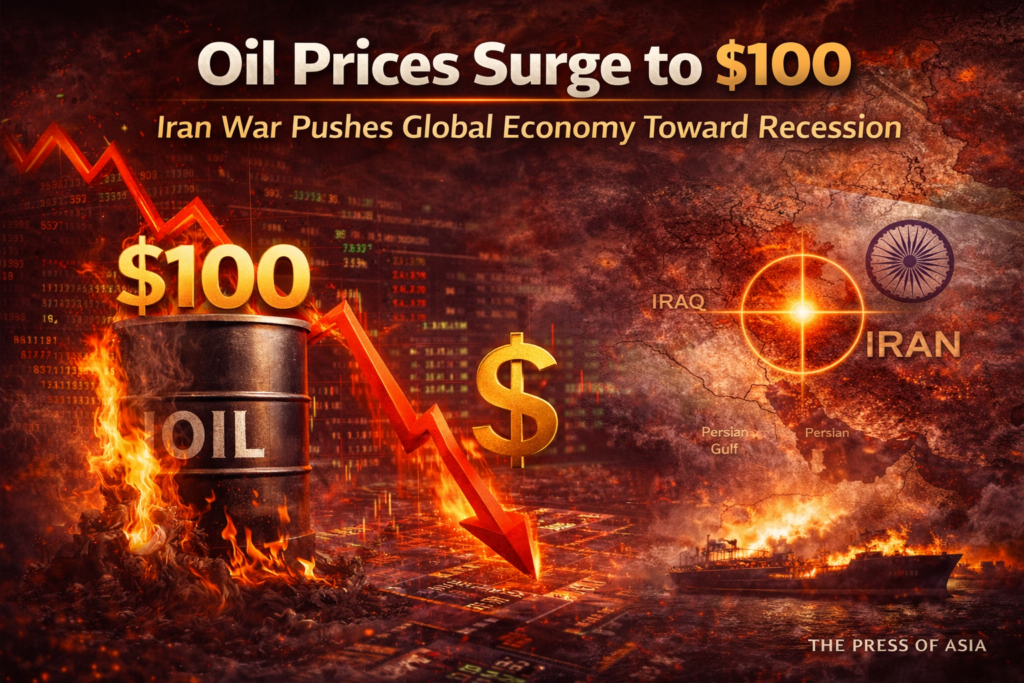
Global oil prices crossed the psychologically significant $100 per barrel mark on March 7, 2026 for the first time since 2022, driven by the escalating Iran-US military conflict and Houthi attacks on UAE infrastructure. Brent crude reached $101.50 per barrel while WTI crude touched $98.70, sending shockwaves through global financial markets, airlines, shipping companies, and emerging market economies. The surge in oil prices comes at a particularly vulnerable moment for the global economy, which was already grappling with post-pandemic debt levels and slowing growth. Economists are now warning that if oil prices remain above $100 for more than 60 days, the global economy could tip into recession by the third quarter of 2026.
Why Oil Prices Are Surging: The Iran War Factor
The primary driver of the oil price surge is the ongoing US-Israel military campaign against Iran’s nuclear facilities and military infrastructure. Iran is OPEC’s third-largest producer, pumping approximately 3.2 million barrels per day before the conflict began. US and Israeli strikes have severely damaged Iran’s oil export infrastructure, including the Kharg Island oil terminal that handles 95% of Iran’s crude exports. Iran has responded by threatening to block the Strait of Hormuz, through which approximately 20% of global oil supplies transit daily. Even though Iran has not yet fully blocked the Strait, tanker companies and insurers have sharply increased war risk premiums, effectively reducing the flow of oil through the Gulf. OPEC+ held an emergency meeting on March 6 but failed to agree on increasing production to offset Iran’s supply losses.
Impact on India: Fuel Prices and Economy
India is among the countries most severely impacted by the oil price surge, as it imports approximately 85% of its crude oil requirements. The Indian rupee has weakened 3% against the dollar since the oil surge began, reflecting increased pressure on India’s current account. Petrol prices in India are expected to rise by Rs 7-10 per litre in the next price revision cycle if crude prices remain elevated, adding to inflationary pressures in the country. India’s oil import bill, which was projected at $130 billion for FY2026-27, could now balloon to $160-170 billion at current prices. The Indian government is under pressure to either absorb the cost through fuel subsidies (which would strain the fiscal deficit) or pass it on to consumers (which would fuel inflation already running at 5.8%). Airlines including IndiGo and Air India have announced surcharges on domestic and international flights as aviation turbine fuel prices have surged 35%.
Global Markets React: Stocks Fall, Inflation Rises
Global equity markets have responded sharply to the oil price surge. The Dow Jones Industrial Average fell 2.3% on March 7, the Nasdaq declined 2.8%, and European markets shed 2-3% across major indices. Emerging market currencies have weakened broadly against the dollar, with the Indonesian Rupiah, Pakistani Rupee, Sri Lankan Rupee, and Egyptian Pound all hitting new lows. Bond yields have spiked in several emerging markets as investors price in higher inflation and reduced fiscal space for governments facing higher import bills. The World Bank has issued an emergency advisory warning that 20 low-income countries that rely heavily on oil imports could face severe economic stress if prices remain elevated. Consumer price inflation in the Eurozone is expected to re-accelerate to 4% from 2.3% if oil prices sustain at current levels, complicating the European Central Bank’s monetary policy path.
OPEC+ Response and Oil Market Dynamics
The OPEC+ alliance is in a difficult position amid the Iran crisis. Saudi Arabia, the de facto leader of OPEC, has both economic interests in higher oil prices and geopolitical concerns about the spread of the Iran conflict to the broader Middle East. Saudi Arabia has 3 million barrels per day of spare capacity that it could deploy to offset Iran’s supply losses, but has declined to do so without a formal commitment from consuming nations to reduce oil demand. Russia, the other key OPEC+ player, has expressed sympathy for Iran and has urged Saudi Arabia not to provide oil to the US military’s logistics chains. Non-OPEC producers like the US (now producing a record 14 million barrels per day), Canada, and Brazil are ramping up production but cannot fully compensate for the 2-3 million barrel per day supply disruption from Iran in the short term.
Recession Risk: Economic Forecasts Revised
Major economic institutions have sharply revised their global growth forecasts in response to the oil price surge. The IMF has cut its 2026 global GDP growth forecast from 3.2% to 2.6%, warning that a sustained $100+ oil price environment would trim global growth by a further 0.8%. Goldman Sachs has assigned a 35% probability to a global recession in 2026, up from 15% before the Iran war escalated. Countries most at risk include Pakistan, Sri Lanka, Bangladesh, Egypt, and several sub-Saharan African nations that already have thin fiscal buffers. Even developed economies face significant headwinds, with the US growth forecast cut from 2.1% to 1.4% for 2026 as higher fuel costs crimp consumer spending. The aviation industry globally is expected to report combined losses of $28 billion in 2026 if oil remains at current levels, threatening the recovery of airlines still paying down pandemic-era debts.
Energy Transition: Renewable Energy Gets a Boost
The oil price surge has paradoxically accelerated interest in renewable energy globally. Solar panel orders have surged 40% since the Iran war began, as governments and corporations accelerate plans to reduce fossil fuel dependency. Electric vehicle sales in India and China have jumped sharply as consumers calculate the long-term savings from oil price independence. In India, the government has fast-tracked approvals for 50 GW of new solar capacity and has offered additional incentives for EV adoption. The International Energy Agency has revised upward its forecast for renewable energy capacity additions in 2026, expecting 650 GW of new solar and wind capacity to be installed globally. While the energy transition cannot provide immediate relief from high oil prices, it represents the structural long-term solution to oil price volatility.
Conclusion
The crossing of the $100 per barrel threshold by oil prices on March 7, 2026 represents a major economic shock that will reverberate through the global economy for months to come. For oil-importing developing nations like India, Pakistan, and Bangladesh, the impact will be particularly severe in terms of inflation, currency depreciation, and fiscal pressure. The outcome depends heavily on whether the Iran-US conflict can be de-escalated quickly enough to restore Iranian oil exports to global markets. Every additional week of conflict and supply disruption adds to the permanent economic damage being inflicted on vulnerable economies worldwide. Press of Asia will continue to provide analysis on oil market developments and their impact on India and Asia.