
By The Press of Asia | March 15, 2026
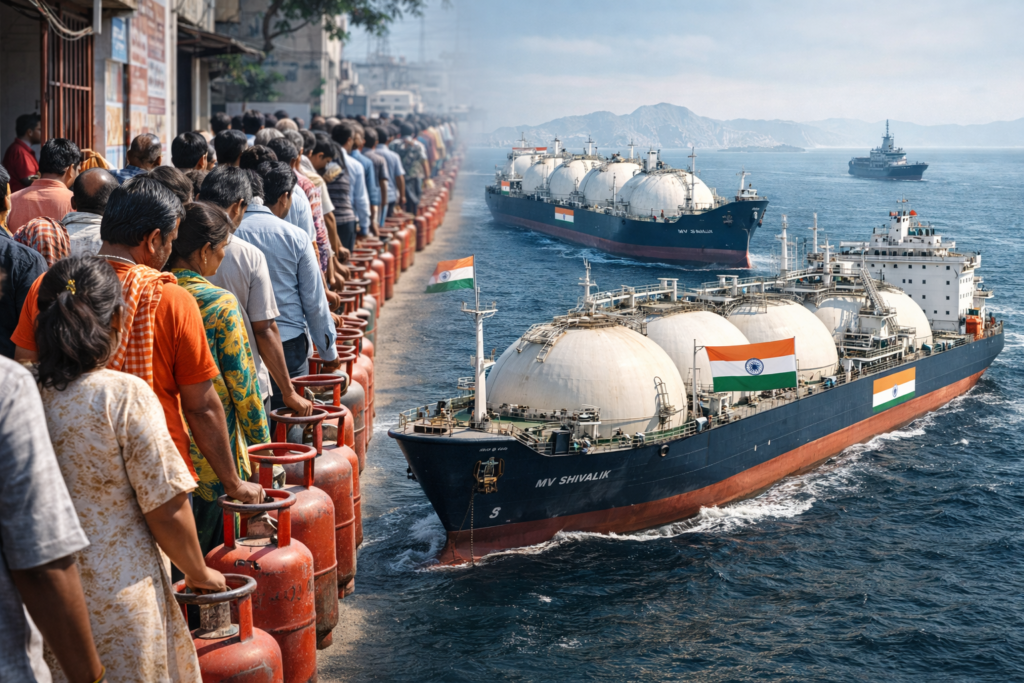
In a major relief for India amid the ongoing West Asia war, two India-flagged LPG tankers — MV Shivalik and MV Nanda Devi — have successfully crossed the Strait of Hormuz after Iran granted them safe passage on Saturday. The vessels are expected to reach Indian shores within two to three days, offering hope that the acute LPG shortage gripping several states may ease soon. However, India’s energy officials have warned that 10 to 12 more LPG carriers remain stuck at the Strait, and it could take considerable time before they reach Indian shores.
India-Tehran Diplomatic Deal
The two tankers crossed the strait following a quiet diplomatic deal struck between New Delhi and Tehran, according to sources familiar with the matter, though neither the Indian Ministry of External Affairs nor Iranian officials have formally confirmed the agreement. Ship-tracking data confirms that MV Shivalik had already cleared the strait after loading at Ras Laffan in Qatar. The passage is being described as a significant diplomatic and maritime breakthrough, given that the Strait of Hormuz has been effectively closed to most commercial shipping for nearly two weeks since the US-Iran conflict escalated.
Indian Navy on Standby to Escort Ships
The Indian Navy has been placed on standby to escort commercial vessels, including LPG tankers, through the Strait of Hormuz. The conflict between the United States, Israel and Iran has created severe risks for cargo ships transiting the narrow waterway. While Iran allowed the two Indian LPG carriers to pass on Saturday, officials cautioned that the situation remains fragile and that future passages cannot be guaranteed. The Indian government has been in active diplomatic contact with all parties involved to ensure safe passage for its vessels and protect its critical energy supply chains.
India is the world’s second-largest importer of LPG and relies on the Middle East for approximately 90 percent of its supply — almost entirely through the Strait of Hormuz. Unlike crude oil, India does not maintain strategic LPG reserves of comparable scale, making any disruption to Hormuz flows directly and immediately felt by consumers.
LPG Shortage Hits Multiple States
The LPG shortage has triggered long queues outside gas agencies across several Indian states, with residents lining up from as early as 3 AM to secure cylinders. States including Maharashtra, Karnataka, Rajasthan, Uttar Pradesh, Andhra Pradesh, Bihar, Odisha and Delhi have reported widespread scarcity.
In Gorakhpur, Uttar Pradesh, a consumer told news agency ANI: “We have been standing in line since 3 AM. The situation has been like this for 10 days. Around 400-500 people are in the queue.” Similar scenes were reported in Noida, Lucknow, Delhi’s Tilak Nagar and Lajpat Nagar, Bhubaneswar, and parts of West Bengal and Kolkata.
Hotels, restaurants, catering businesses and small eateries have been among the hardest hit, with Karnataka officials warning that commercial establishments may need to wait up to 10 days for their cylinder stocks to be replenished. In some areas, black-market cylinders are reportedly being sold at nearly three times the official price.
To manage demand, the government has also extended the minimum LPG booking cycle from 21 days to 25 days, a move aimed at preventing panic-booking and ensuring equitable distribution.
Government Crackdown: 1,483 Raids, 24 FIRs, 6 Arrested
In response to the crisis, authorities have conducted raids at around 1,483 locations at suspected hoarding sites, including godowns and illegal storage facilities across multiple states. A total of 24 FIRs have been registered and 6 people arrested for LPG hoarding and black marketing.
In Uttar Pradesh alone, surprise checks were conducted at approximately 1,400 locations, with 20 FIRs registered and prosecution launched against 19 people. In Chhattisgarh, raids at 102 locations led to the seizure of 741 LPG cylinders. Several state governments have deployed police personnel at gas agencies to maintain order and prevent panic buying.
Government Response: Supply Stabilising
The Ministry of Petroleum and Natural Gas stated that domestic LPG production has increased by 30 percent since March 5, with refineries working to strengthen supply chains and maintain regular deliveries to households, hospitals and educational institutions. The government confirmed that commercial LPG distribution is now underway in 29 states.
Government advisories have encouraged households connected to the Piped Natural Gas (PNG) network to rely on their existing PNG connections wherever available, in order to redirect limited LPG cylinder supplies toward households that depend exclusively on cylinders. Oil marketing companies have been instructed to prioritise cylinder deliveries once the two LPG tankers — MV Shivalik and MV Nanda Devi — dock at Indian ports.
Digital booking solutions, including WhatsApp-based LPG booking services, have also been promoted to reduce the need for consumers to visit distributors in person and ease the rush at gas agencies.
What Comes Next
With the US-Israel-Iran war showing no signs of de-escalation and the Strait of Hormuz remaining a critical flashpoint, energy security experts warn that India must fast-track its plans to diversify LPG procurement routes and build strategic LPG buffer stocks. Until then, government agencies say, strict enforcement, domestic production ramp-up and transparent distribution will be the primary tools to ensure that cylinders reach genuine consumers at official prices.
For the latest updates on India’s energy security and the West Asia conflict, stay with The Press of Asia — your trusted source for international news.