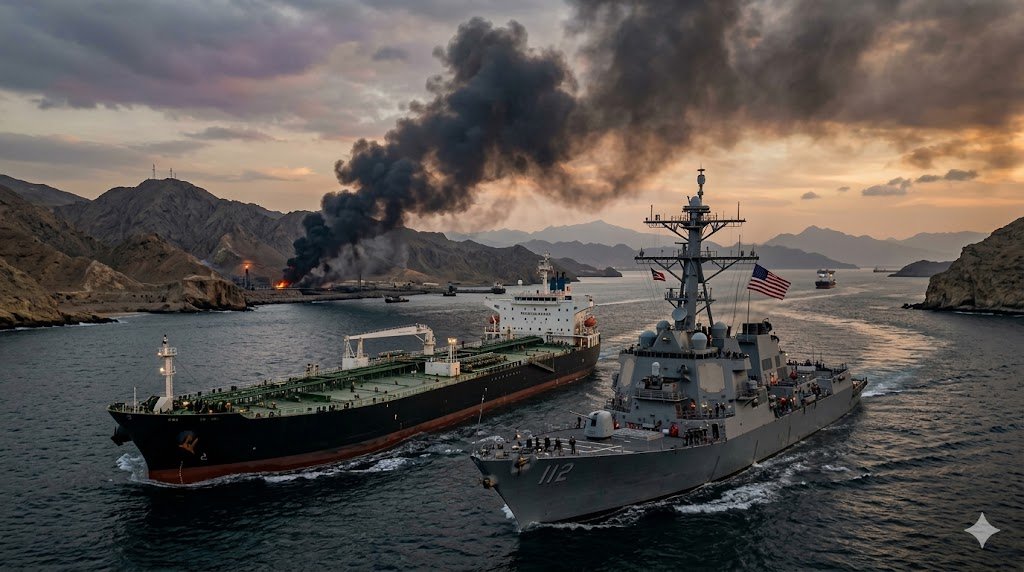
the Strait of Hormuz, the world’s most important oil transit chokepoint, has been pushed to the centre of the global energy crisis as the US-Israel-Iran war enters its third week. The conflict has dramatically raised fears of a sustained disruption to oil flows, sending Brent crude prices surging past $110 per barrel and prompting the United States to announce that its Navy will begin escorting oil tankers through the strait “very soon.” Energy markets worldwide are on edge as diplomats, military commanders and oil traders watch one narrow waterway that controls the fate of global energy supply.
Why Hormuz Matters
The Strait of Hormuz is a narrow waterway located between Iran and Oman, approximately 33 kilometres wide at its narrowest point. Despite its modest width, it is the single most important maritime chokepoint in the world for energy trade. It is the only sea route linking the Persian Gulf oil exporters — including Saudi Arabia, the UAE, Kuwait, Iraq and Iran itself — to the global market.
Roughly 20 to 21 million barrels of oil pass through the strait every single day, accounting for approximately 20 percent of total global petroleum consumption. An additional 4 billion cubic feet of liquefied natural gas (LNG) also transits through Hormuz daily, much of it bound for energy-hungry markets in Asia and Europe.
If the strait were blocked — even temporarily — it would cause an immediate and severe global oil supply shock. There is no easy alternative. The only bypass routes, such as the Petroline pipeline across Saudi Arabia, can handle only a fraction of normal Hormuz traffic. A sustained closure would push oil prices to record highs within days and trigger fuel shortages across Asia, Europe and beyond.
Iran Threatens to Close the Strait
Iran has repeatedly threatened to close the Strait of Hormuz in retaliation for US strikes on its oil infrastructure, including Kharg Island — the terminal that handles over 90 percent of Iran’s crude oil exports. Iranian military officials have warned in stark terms that if the United States continues to target Iranian energy assets, Tehran will use its naval and missile capabilities to halt all oil exports from the Persian Gulf region.
Iran’s Islamic Revolutionary Guard Corps (IRGC) has significant firepower positioned along the strait, including anti-ship missiles, fast attack boats and submarine capabilities. Military analysts note that Iran does not need to physically block the waterway to cause severe disruption — simply threatening and attacking vessels passing through the strait is enough to drive up insurance costs, force tanker operators to reroute, and cause oil prices to spike sharply.
This threat alone has already been enough to spike oil prices on international markets and cause insurance premiums for vessels transiting the Gulf to rise by as much as 300 percent in recent days.
US Navy to Escort Tankers
The United States has responded firmly by announcing that the US Navy will start escorting oil tankers through the Strait of Hormuz to prevent disruption to global energy supplies. President Donald Trump stated publicly that the US would restore and protect oil exports through the waterway, calling it a matter of national and global economic security.
The Pentagon has deployed additional naval assets to the region, including aircraft carriers and guided-missile destroyers, to reinforce its presence in the Persian Gulf. Britain has said it is “intensively looking” at ways to contribute naval resources to the multinational escort effort, with Royal Navy vessels potentially joining US forces within days.
India’s Navy has also been placed on standby. Two Indian LPG tankers already successfully crossed the strait after Iran granted passage — a sign that some civilian shipping is still moving, but only under careful diplomatic coordination. New Delhi has activated its strategic petroleum reserves and is exploring alternative supply routes to reduce its dependence on Gulf oil in the short term.
Global Economic Impact
Brent crude oil prices have risen sharply since the conflict escalated, crossing $110 per barrel — levels not seen since the energy crisis of recent years. Some analysts are warning that a full closure of the Strait of Hormuz could send prices above $150 per barrel within weeks, triggering a global recession.
Higher oil prices feed directly into inflation, transport costs and food prices. Nations that depend heavily on Gulf oil imports — including India, China, Japan, South Korea and much of Europe — are now scrambling to diversify supply sources and draw down strategic petroleum reserves to cushion the blow.
India is among the most exposed countries. India imports approximately 85 percent of its oil needs, and a large portion comes from Gulf nations whose only export route passes through Hormuz. A sustained disruption would push petrol and diesel prices higher across India, increasing the cost of transport, logistics and food within weeks.
The International Energy Agency (IEA) has issued an emergency advisory calling on all member nations to coordinate their responses, release strategic reserves in a controlled and unified manner, and prevent panic buying and speculative trading from amplifying the supply shock further.
What Happens Next
The fate of the Strait of Hormuz is now one of the most consequential open questions in the global economy. Three scenarios are being actively discussed by analysts and governments:
- Best case: Diplomatic back-channel negotiations lead to a ceasefire and tanker traffic continues with naval escorts — oil prices stabilise around $100–110 per barrel.
- Middle case: Sporadic Iranian attacks on tankers continue, insurance costs remain extremely high and some shipping companies avoid the route — prices stay elevated but the global supply system holds.
- Worst case: Iran formally closes or mines the strait and the US responds militarily — a scenario that could push oil prices above $150 per barrel and cause widespread economic damage globally.
As long as military operations continue near the waterway, global energy markets will remain on edge, and consumers worldwide — from Delhi to Tokyo to London — will face higher costs for fuel, transport and everyday goods.
For the latest updates on the US-Iran conflict and global energy markets, stay with The Press of Asia — your trusted source for international news.