The Press of Asia | March 16, 2026
The United States is facing a convergence of crises that is testing the limits of President Donald Trump’s domestic and foreign policy at the same time.
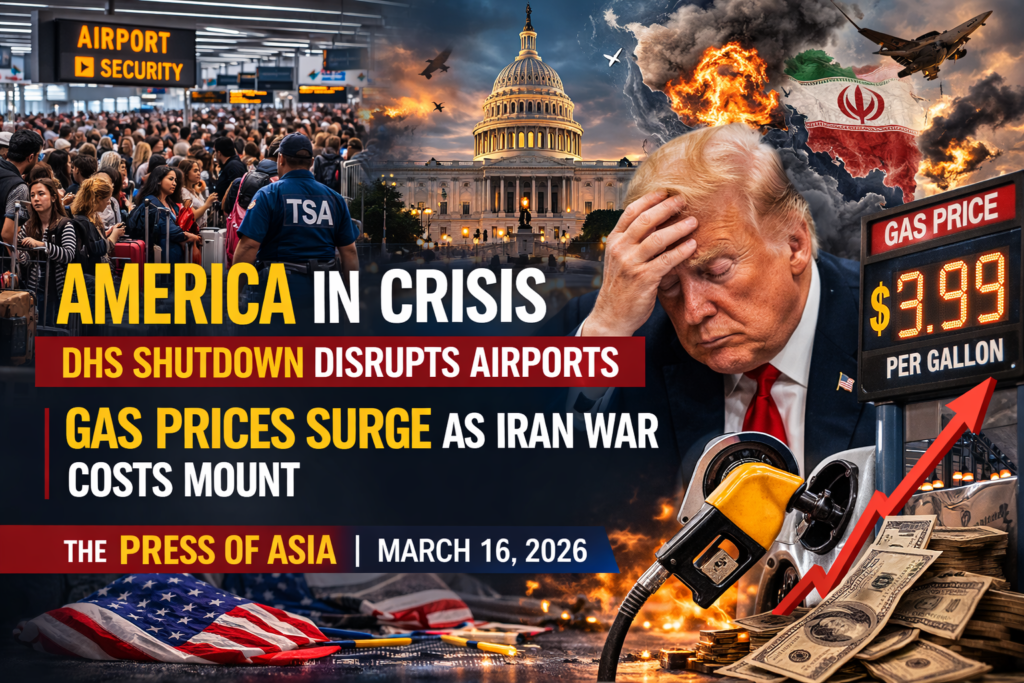
A partial government shutdown centered on the Department of Homeland Security, now in its fifth consecutive week, has left tens of thousands of TSA officers working without full pay and has contributed to long airport security lines during one of the busiest spring travel periods of the year.
At the same time, the U.S.-Iran war has pushed oil and fuel prices sharply higher, with gasoline prices climbing nationwide and approaching $4 per gallon in some forecasts.
In Congress, lawmakers from both parties are questioning the president’s war powers as the conflict’s human and financial costs keep rising.
America, in the spring of 2026, is being stretched in several directions at once.
Ordinary Americans are feeling the pressure at airport checkpoints, at gas stations and in a widening national debate over who has the authority to send the country deeper into war.
The Shutdown That Won’t End
The partial DHS shutdown began after funding lapsed on February 14, 2026, following a standoff in Washington over immigration and Homeland Security policy.
Because the shutdown is focused on DHS agencies rather than the entire federal government, its effects have been especially visible in airport screening, border operations and travel-related services.
The most visible pressure point has been the Transportation Security Administration.
Around 50,000 TSA officers have been affected by the funding lapse, and many workers received a zero-dollar paycheck on March 13 as the shutdown dragged on.
That moment intensified concerns about morale, staffing and retention just as spring-break travel volumes increased across the country.
Reports from major U.S. outlets have described long waits at security checkpoints, with some airports facing delays that stretched well beyond normal screening times.
Travel and airline groups have urged Congress to restore Homeland Security funding quickly, warning that continued strain could worsen congestion and damage travel reliability.
President Trump’s comments have done little to calm tensions around the shutdown.
Coverage from USA Today and other outlets showed the administration pressing workers to continue reporting as frustration mounted among employees who had gone weeks without regular pay.
Spring Travel Chaos
The timing of the shutdown could hardly be worse for American travelers.
Spring break is one of the busiest periods of the U.S. travel calendar, and airport systems already under pressure are being pushed further by heavy passenger volumes.
Trusted-traveler programs were also disrupted during the standoff.
Global Entry was suspended on February 22 as DHS shifted personnel and resources, but the program was restarted on March 11 after pressure from the travel industry and growing concern over airport congestion.
That means it is accurate to say the shutdown disrupted Global Entry, but not accurate to say the program remains suspended as of mid-March.
The broader concern from aviation groups is that disruption can spread quickly once staffing falls and travel demand rises at the same time.
That is why airlines and travel associations have been lobbying Congress to act before airport bottlenecks grow into a larger national travel problem.
Gas Prices Surge
Americans are also feeling the effects of the Iran war every time they stop to refuel.
Reuters reported on March 2 that the national average gasoline price had already moved above $3 per gallon, and later March reporting placed the U.S. average in the mid-$3 range.
By March 9, Bloomberg reported a U.S. average of about $3.46 per gallon, while subsequent market coverage showed prices continuing to rise as the fighting in the Persian Gulf unsettled energy markets.
Because of that rapid increase, it is fair to say gas prices are approaching $4 per gallon, especially in forecasts and in some regions.
A safer formulation than “highest in two years” is that prices are near a two-year high, or at their highest level since mid-2024.
Oil market volatility is central to the story.
Reuters reported Brent crude near $77 per barrel on March 2, while later March coverage showed oil surging toward and above $100 by mid-March as fears over the Strait of Hormuz intensified.
That means the most accurate timeline is that oil crossed $100 per barrel by mid-March, not immediately within days of the initial strikes.
Analysts have also warned that more domestic drilling cannot quickly shield Americans from a global oil shock triggered by war in one of the world’s most important energy corridors.
As long as the Strait of Hormuz remains a source of tension, fuel prices are likely to remain politically and economically sensitive in the United States.
The War Powers Showdown in Congress
Beyond the economic fallout, the war has triggered a serious constitutional fight in Washington.
Lawmakers in both parties have questioned whether the president should continue military operations against Iran without explicit congressional authorization, and war-powers measures have been introduced or pushed in both chambers.
Reuters reported that the House rejected one war-powers resolution early in March, but debate inside Congress has continued as the conflict has grown more costly and politically difficult.
Some Republicans have also voiced discomfort, arguing that a prolonged conflict sits uneasily with the “America First” foreign-policy message that helped define Trump’s political base.
The financial burden has escalated quickly.
Reporting on Pentagon estimates said the first six days of the war had already cost the United States about $11.3 billion.
That means the description of the conflict costing “over $10 billion” is supported by current reporting and may actually understate the scale of the spending.
Casualties have added to the political pressure.
By early March, multiple outlets had reported American service-member deaths linked to the conflict, including losses tied to a refueling aircraft crash in Iraq.
Those deaths have sharpened demands from lawmakers who want a fuller accounting of the war’s purpose, scope and legal basis.
The Broadcast Regulator’s Threat
Another flashpoint has emerged in the media landscape.
FCC Chair Brendan Carr warned that broadcasters airing what he described as distorted or misleading Iran-war coverage could face consequences at license-renewal time.
Critics and press-freedom advocates have described that move as an attempt to pressure television networks during a live military conflict.
This is stronger than a routine advisory or a general complaint about negative coverage.
Current reporting supports describing it as a threat involving broadcasters’ licenses, not simply as a vague warning to the media.
The Political Arithmetic
As the United States moves deeper into 2026, the overlap between shutdown politics, rising fuel costs and war abroad is creating a volatile political environment.
If Congress restores DHS funding, some travel disruption could ease, but continued instability in the Middle East would still keep pressure on prices and on the administration’s foreign-policy credibility.
At the same time, separate reporting has raised new scrutiny over a strike that may have hit a girls’ elementary school in Minab, Iran, causing mass civilian casualties.
Because those findings have been described in preliminary reporting, that episode should be framed cautiously rather than as a final adjudicated conclusion.
Trump has tried to keep attention on domestic economic messaging, but the combination of airport disruption, higher gas prices, war spending and casualty reports has complicated that effort.
For now, the crisis is being felt most clearly in places Americans see every day: at airport checkpoints, at gas stations and in the intensifying debate over war powers in Washington.
Report by The Press of Asia | pressofasia.com