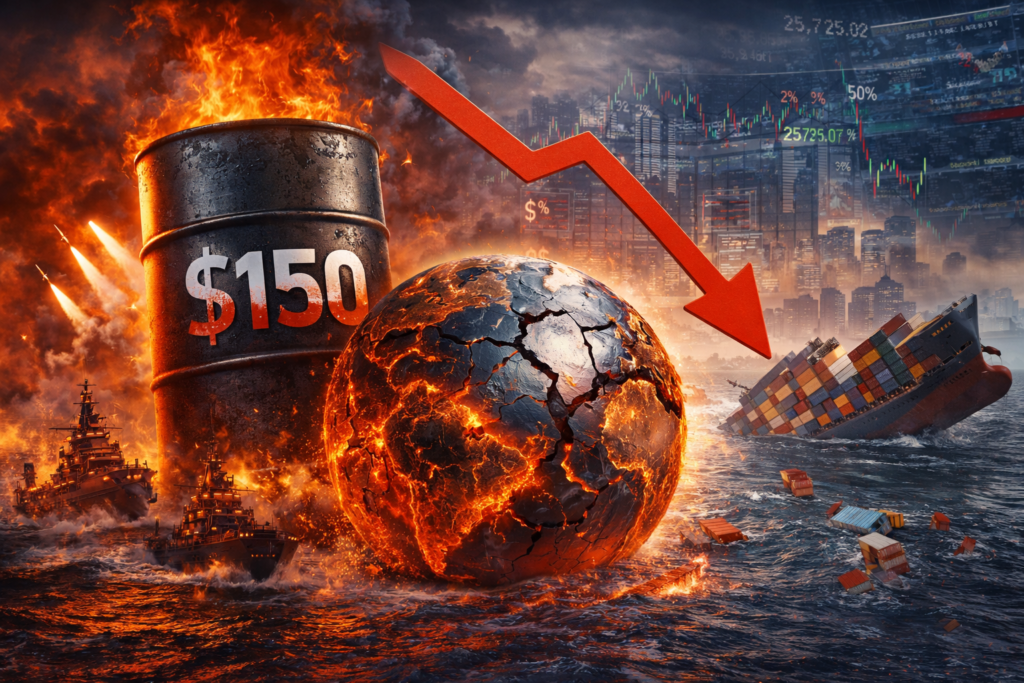
The question being asked in every major financial capital in the world on March 17, 2026 is no longer “will the Iran war hurt the global economy?” — it is “will it trigger a full-scale global recession?” With crude oil prices surging past $110 per barrel and analysts warning of a potential spike to $150, the financial damage from the US-Iran war is now threatening to undo years of post-pandemic economic recovery across multiple continents.
Oil Prices: How Bad Could It Get?
When the US and Israel launched their strikes on Iran on February 28, Brent crude oil was trading at approximately $78 per barrel. By March 17 — just 17 days later — prices had surged past $110 per barrel, driven by the near-closure of the Strait of Hormuz, which handles 21 million barrels of daily oil traffic.
Kayanat Chainwala, Assistant Vice President at Kotak Securities, said: “Global crude prices may touch $120 per barrel in the near term and could climb to $150 per barrel if the conflict extends beyond a month and tensions in West Asia remain high”. A price of $150 per barrel would be the highest level since the oil shock of 2008 and would almost certainly trigger a global economic contraction.
The UAE — OPEC’s third-largest producer — has had to cut production by more than half due to security threats, significantly tightening global supply. Saudi Arabia has ramped up output to compensate, but the additional Saudi barrels cannot replace what is being lost through the Hormuz disruption.
The IEA’s Historic Intervention
In an attempt to calm markets, the International Energy Agency — representing 32 member nations — committed to releasing 400 million barrels of crude oil from strategic reserves in what it called the largest intervention in the agency’s 50-year history. Additional releases are being discussed, with IEA Director Fatih Birol warning that “the global energy system is under severe stress.”
Yet analysts say these reserve releases are a stopgap, not a solution. Strategic reserves are designed to last 90 days in a major supply crisis — enough time for wars to end or alternative supplies to come online. If the US-Iran war drags on beyond that window, the world faces a supply cliff that no amount of reserve releases can bridge.
Sri Lanka, Philippines: Smaller Nations Hit Hardest
While the world’s attention is on major economies, it is the developing world that is suffering most acutely from the oil shock. Sri Lanka, still recovering from its catastrophic 2022 economic collapse, has already announced a shorter work week to conserve scarce fuel reserves, in anticipation of a prolonged Gulf war. The government has instituted emergency rationing and suspended non-essential electricity use in government offices.
The Philippines has implemented emergency measures to manage fuel shortages, with the government setting up price controls on petroleum products and activating its strategic petroleum reserve. In Southeast Asia, Thailand, Vietnam, and Indonesia — all heavily dependent on Middle Eastern oil — are facing rising inflation and slowing economic growth.
For Africa, the picture is equally grim. Sub-Saharan nations that import oil are facing currency crises as their import bills surge, while food prices are rising sharply due to higher transportation costs and fertiliser prices (which are linked to natural gas, also disrupted by the war).
Risk of Global Recession: What Economists Are Saying
Al Jazeera’s Counting the Cost, in a special broadcast on March 17, examined whether the Iran war could trigger a global recession. The consensus among economists interviewed was stark:
- If the war ends within 30 days: The global economy will experience a painful but manageable energy shock, with GDP growth slowing in most regions but recession avoided
- If the war lasts 60-90 days: A global recession becomes increasingly likely, particularly in Europe and Asia-Pacific, where energy import dependence is highest
- If the war extends beyond 90 days: A severe global recession is almost certain, comparable in depth to the 2008 financial crisis
TIME Magazine’s March 16 analysis identified the countries most at risk: India, Thailand, South Korea, Taiwan, Japan, and European nations like Germany and Italy — all of which import the majority of their energy from the Gulf.
Stock Markets React
Despite the gloom, US stock markets actually closed higher on March 17, rebounding from the 2026 trough hit earlier in the month. The reason: crude oil prices saw a slight decline on the day, driven by the IEA reserve release announcement and Saudi Arabia’s production increase. Investors are betting that the war will end before a true recession sets in.
But market volatility remains extreme. The VIX — Wall Street’s “fear index” — remains at levels last seen during the COVID-19 pandemic. Corporate earnings forecasts are being slashed across energy-intensive industries including aviation, shipping, manufacturing, and chemicals.
For ordinary people around the world, from Sri Lanka to Germany to the Philippines, the Iran war is not an abstract geopolitical event — it is higher fuel bills, costlier food, threatened jobs, and an uncertain economic future. How long this war lasts will determine whether the world economy escapes with bruises or is plunged into its deepest downturn in nearly two decades.