

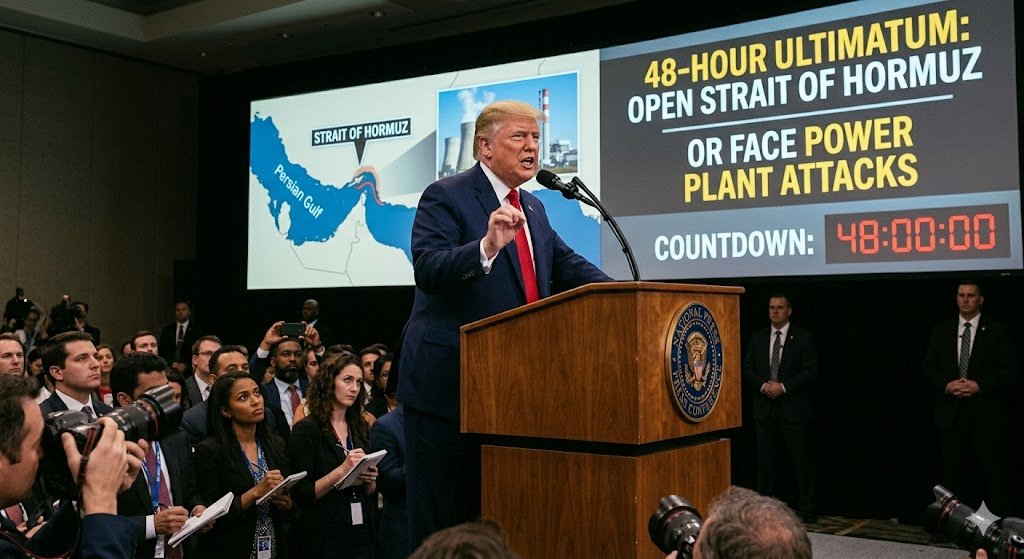
In a dramatic escalation of the Iran-US-Israel conflict, President Donald Trump has issued a stark 48-hour ultimatum to Tehran: fully reopen the Strait of Hormuz or face devastating attacks on Iranian power plants, including the nation’s largest nuclear facility at Bushehr. The threat, delivered via Truth Social on March 22, 2026, marks day 23 of a war that has already claimed over 1,500 lives and sent global energy markets into turmoil.
Trump’s Ultimatum: ‘Obliterate’ Power Infrastructure
In his characteristically blunt post, Trump warned: “Iran doesn’t FULLY OPEN the Strait of Hormuz within 48 HOURS from this exact time, the United States of America will target and obliterate various POWER PLANTS, STARTING WITH THE BIGGEST ONE FIRST!”
The reference to “the biggest one” is widely understood to mean the Bushehr Nuclear Power Plant, Iran’s sole operational nuclear facility. Such a strike would represent an unprecedented move in modern warfare, as nuclear power plants have historically been considered off-limits due to the catastrophic environmental and humanitarian consequences of damaging them.
According to Bloomberg, Trump added that the US is “weeks ahead of schedule” in degrading Iranian military capabilities and claimed Washington has no interest in negotiations given Iran’s weakened state.
The Strait of Hormuz Crisis: Global Energy at Risk
The Strait of Hormuz, a narrow waterway between Iran and Oman, is one of the world’s most critical energy chokepoints, carrying approximately 20% of global oil and gas shipments. Iran’s closure of the strait has triggered a severe supply shock, with Brent crude futures surging to $112.19 per barrel on Friday, March 21.
Shipping through the strait has nearly ground to a halt, with major energy companies suspending tanker movements amid fears of Iranian naval and air attacks. The closure has sent ripple effects through global markets:
- Oil prices have jumped over 35% since the war began on March 1
- European natural gas futures have spiked by 42%
- Asian economies dependent on Gulf energy are facing supply disruptions
- Insurance premiums for Gulf shipping have increased tenfold
Trump’s demand for Iran to reopen the strait reflects the growing economic pressure on Western allies and the broader global economy.
Iran’s Defiant Response
Tehran has shown no signs of capitulating to Trump’s threats. Instead, Iranian officials have vowed to retaliate against any strikes on energy infrastructure by targeting the energy assets of US allies in the Gulf.
Iranian Foreign Ministry spokesperson Nasser Kanaani stated on Saturday: “Any attack on our civilian energy infrastructure will be met with irreversible damage to the energy and desalination facilities of those who support American aggression.”
This threat is particularly ominous for Saudi Arabia and the United Arab Emirates, both of which rely heavily on desalination plants for drinking water and have extensive oil production facilities.
Meanwhile, IRGC Aerospace Force chief Seyed Majid Moosavi claimed that Iran now “dominates the skies” over Israeli territory and warned that upcoming attacks would intensify. On day 23, Iran launched over 60 drones toward Saudi Arabia’s Eastern Province, the kingdom’s energy heartland, though most were intercepted.
Shifting US Rhetoric: From ‘Winding Down’ to Escalation
Trump’s aggressive ultimatum stands in stark contrast to his comments just 48 hours earlier, when he suggested the US military campaign might be “winding down.” This abrupt shift has left global leaders, markets, and even US allies confused about Washington’s strategic objectives.
Foreign policy analysts point out that Trump’s initial expectation was for Iran to capitulate within the first week, as evidenced by his March 6 demand for “unconditional surrender.” With Iran showing continued resistance after three weeks of intense bombardment, the administration appears to be recalibrating its approach.
US Central Command (CENTCOM) reiterated on Saturday that American forces remain focused on degrading Iran’s ability to project military power across the region. The Pentagon reported that over 2,400 Iranian military sites have been struck, including:
- 187 missile production and storage facilities
- 94 naval assets, including fast-attack craft and coastal batteries
- 312 air defense installations
- 68 drone manufacturing and launch sites
Despite these claims, Iran continues to launch drone and missile attacks on Saudi Arabia, Israel, and US military bases in the region.
Global Reactions and Concerns
The threat to strike the Bushehr nuclear plant has drawn alarm from international bodies. The International Atomic Energy Agency (IAEA) expressed “grave concern” over any military action that could compromise nuclear safety.
“An attack on a nuclear power facility could have catastrophic consequences far beyond the immediate conflict zone,” IAEA Director General Rafael Grossi said in a statement. “We urge all parties to exercise maximum restraint.”
European leaders have also voiced concern. French President Emmanuel Macron called for “immediate de-escalation,” while German Chancellor Olaf Scholz warned that targeting civilian infrastructure, including power plants, could constitute war crimes under international law.
China and Russia, both of which have maintained diplomatic and economic ties with Iran, condemned Trump’s ultimatum. Chinese Foreign Ministry spokesperson Wang Wenbin stated that “threatening attacks on civilian infrastructure violates the principles of proportionality and distinction under international humanitarian law.”
What Happens Next?
As the 48-hour deadline approaches, the world watches anxiously to see whether Iran will comply or whether Trump will follow through on his threat. Several scenarios are possible:
- Limited Strait Reopening: Iran might allow partial resumption of shipping under international oversight, buying time for diplomatic efforts.
- US Strikes on Conventional Power Plants: Trump could target non-nuclear power facilities to demonstrate resolve while avoiding the catastrophic risks of hitting Bushehr.
- Full-Scale Attack on Nuclear Facility: Though unprecedented and internationally condemned, a strike on Bushehr would represent the most dramatic escalation yet.
- Diplomatic Intervention: Last-minute mediation efforts by Qatar, Oman, or other neutral parties could broker a temporary ceasefire.
For now, oil markets remain on edge, with traders bracing for further volatility. The closure of Hormuz has already cost the global economy an estimated $18 billion in the first three weeks of war, and a prolonged shutdown could trigger recession in energy-import-dependent nations.
Conclusion: A Dangerous Moment
Trump’s 48-hour ultimatum to Iran represents the most dangerous moment yet in a conflict that has already spiraled far beyond initial expectations. The threat to attack the Bushehr nuclear plant crosses red lines that have held for decades and raises the specter of environmental catastrophe alongside military destruction.
With Iran showing no signs of backing down and Trump facing domestic pressure to deliver a decisive victory, the next two days could determine whether this conflict escalates into a full-scale regional war or finds an off-ramp toward de-escalation. The world holds its breath as the deadline ticks closer.