
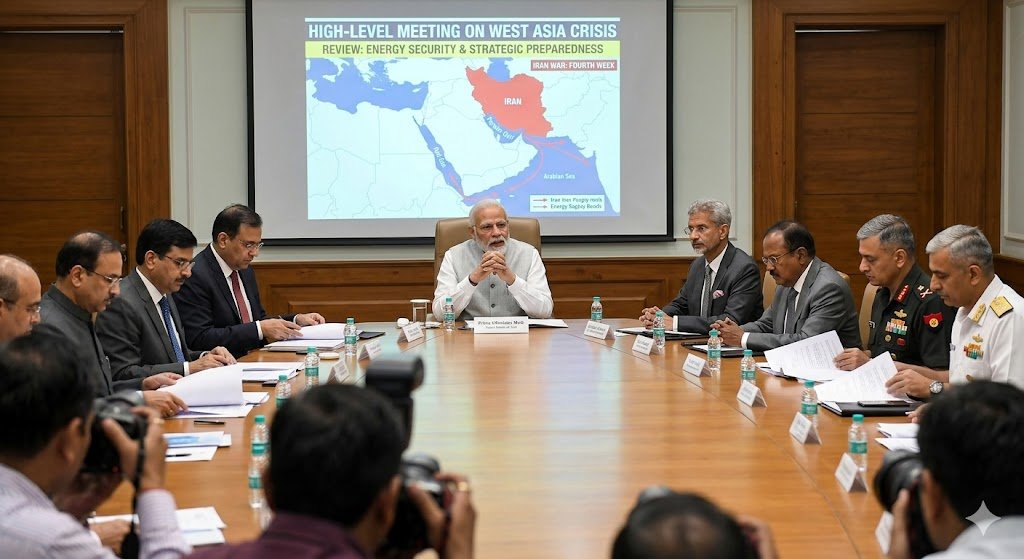
Prime Minister Narendra Modi on Sunday (March 22, 2026) convened a crucial high-level meeting to assess India’s preparedness in dealing with the escalating West Asia crisis, which has now entered its fourth week. The review focused on critical sectors including petroleum, crude oil, natural gas, power, and fertilisers—areas that form the backbone of India’s energy security and economic stability.
The Meeting’s Agenda: Securing India’s Lifeline
The meeting, held at the Prime Minister’s Office in New Delhi, brought together senior government officials from the Ministry of Petroleum and Natural Gas, the Ministry of Power, and the Ministry of Chemicals and Fertilisers. Home Minister Amit Shah, BJP President J.P. Nadda, and Petroleum Minister Hardeep Singh Puri were also in attendance, underlining the seriousness of the situation.
Officials presented Prime Minister Modi with a comprehensive briefing on:
- Current supply levels of crude oil, natural gas, and liquefied petroleum gas (LPG)
- Preparedness plans to address potential disruptions from the Strait of Hormuz closure
- Alternative sourcing options from non-Middle Eastern suppliers
- Status of India’s strategic petroleum reserves
- Impact assessment on domestic fuel prices and inflation
- Contingency measures for uninterrupted power generation
- Fertiliser availability for the upcoming agricultural season
The Prime Minister directed officials to maintain constant vigilance over developments in the region and provide regular updates. He emphasized that ensuring the country’s energy security remains a top priority and that all efforts must be made to minimize the burden on Indian citizens, particularly farmers and low-income households dependent on subsidized LPG.
The West Asia Context: Why This Meeting Matters
The conflict in West Asia erupted on February 28, 2026, when joint US-Israeli airstrikes killed 86-year-old Iranian Supreme Leader Ayatollah Ali Khamenei, Iran’s defense minister, and several senior military commanders. The strikes also resulted in significant civilian casualties, including schoolchildren in Minab.
In retaliation, Iran launched missile and drone attacks on US military bases and allied nations in the Gulf, including:
- 92 drones targeting Saudi Arabia, with 51 intercepted over the Eastern Province
- Strikes on the UAE, resulting in 8 deaths and 158 injuries
- Attacks on Qatar, Kuwait, and Bahrain
- Closure of the Strait of Hormuz, a critical chokepoint for global oil supplies
As of March 22, 2026, the conflict has claimed over 1,500 lives in Iran alone, with more than 20,984 injured. The humanitarian toll continues to rise, while global oil prices have surged past $112 per barrel, creating a ripple effect across economies worldwide.
India’s Energy Vulnerability
India imports approximately 85% of its crude oil requirements, with the Middle East—particularly the Gulf countries—historically accounting for a significant portion of these supplies. The closure of the Strait of Hormuz, through which about 21 million barrels of oil pass daily (roughly 20% of global petroleum supply), poses a direct threat to India’s energy security.
The situation is further complicated by:
- Rising aviation turbine fuel (ATF) costs, which have already forced airlines to impose fuel surcharges
- Increased freight and insurance costs due to rerouted shipping through longer alternate routes
- Pressure on India’s foreign exchange reserves due to higher import bills
- Potential disruptions to fertiliser supplies, which could impact the agricultural sector
India’s Diplomatic Balancing Act
Prime Minister Modi’s meeting comes on the heels of a telephonic conversation with Iranian President Masoud Pezeshkian on March 21, 2026. During that call, President Pezeshkian called on the India-chaired BRICS grouping to play an independent role in “halting aggressions” against Iran.
The Iranian leader told PM Modi that “the aggressor, without any justification, logic, or legal basis, launched military attacks against Iran during ongoing nuclear negotiations,” referring to the strikes that killed Supreme Leader Khamenei.
PM Modi’s response has been carefully calibrated:
- He strongly condemned attacks on energy infrastructure, warning that such actions threaten global food and energy security
- He stressed the need to ensure the security of the Strait of Hormuz and uphold freedom of navigation in the Persian Gulf
- He reiterated that “war serves no one’s interest” and urged all parties to move toward peace
- He appreciated Iran’s continued support for the safety and security of Indian nationals in Iran
However, India has notably avoided explicitly condemning the US-Israeli strikes on Iran, a stance that has drawn criticism from opposition parties, particularly the Indian National Congress. Critics argue that India’s refusal to condemn the breach of Iran’s sovereignty undermines its long-standing principle of respecting territorial integrity.
Alternative Supply Strategies
In response to the crisis, India has been diversifying its oil and gas import sources:
- Increased purchases from the United States
- Expanded sourcing from Russia, which has become a major supplier following Western sanctions
- Enhanced imports from African nations, including Nigeria and Angola
- Exploring agreements with Latin American producers like Venezuela and Brazil
The government is also considering tapping into India’s Strategic Petroleum Reserves (SPR), which currently hold approximately 5.33 million tonnes of crude oil across three underground facilities in Visakhapatnam, Mangalore, and Padur. This reserve can meet about 9.5 days of India’s crude oil requirements.
Domestic Impact: From Fuel to Food
The West Asia crisis is already having tangible effects on Indian consumers:
- Aviation Sector: Air India has imposed fuel surcharges ranging from ₹399 for domestic flights to ₹2,299 for long-haul international routes. Other carriers are expected to follow suit now that fare caps have been lifted.
- LPG Prices: The government is monitoring LPG (cooking gas) prices closely, as any significant increase would disproportionately affect low-income households and could have political ramifications.
- Fertilisers: India imports substantial quantities of fertilisers, particularly urea and di-ammonium phosphate (DAP), from West Asian suppliers. Any disruption could impact the upcoming kharif (monsoon) sowing season, potentially affecting food production.
- Power Generation: Many of India’s gas-based power plants rely on imported LNG. Supply disruptions could lead to power shortages, particularly during peak summer demand.
Cabinet Committee on Security’s Earlier Review
This isn’t the first high-level meeting on the West Asia crisis. On March 2, 2026, Prime Minister Modi chaired a meeting of the Cabinet Committee on Security (CCS) to review the evolving situation following the initial airstrikes on Iran.
That meeting expressed serious concern over the safety and security of the large Indian expatriate community in the Gulf region, estimated at over 8.5 million people. The Indian government has been in constant touch with its missions in the region to ensure the well-being of Indian nationals.
Opposition Criticism and Political Fallout
The opposition Indian National Congress has criticized the Modi government for what it calls “strategic ambiguity” that leans too heavily toward the United States and Israel. Congress leaders have argued that:
- India should have condemned the strikes on Iran as a violation of sovereignty
- The government’s silence contrasts with its quick condemnation of attacks on UAE and other Gulf allies
- India’s position risks alienating Iran, a traditional partner and key player in the region
- The lack of a clear stance undermines India’s credibility as a potential mediator
However, government supporters argue that India’s balanced approach reflects “strategic autonomy”—maintaining relationships with all sides while prioritizing India’s national interests, particularly the safety of its citizens abroad and energy security at home.
The Road Ahead: Monitoring and Mitigation
As the conflict shows no signs of immediate resolution, India’s challenge will be to:
- Maintain Supply Continuity: Ensure uninterrupted flow of energy resources through diversified sourcing and strategic use of reserves.
- Price Stability: Protect consumers from excessive price shocks, particularly for essential items like LPG and fertilisers.
- Diplomatic Engagement: Continue consultations with all stakeholders—Iran, Gulf countries, the US, and multilateral forums like BRICS and the UN—to advocate for de-escalation.
- Expatriate Safety: Ensure the safety and, if necessary, evacuation of Indian nationals from conflict zones.
- Economic Resilience: Prepare for potential economic headwinds from higher energy costs, including impact on inflation, trade balance, and fiscal deficits.
Conclusion: India Walks a Tightrope
Prime Minister Modi’s March 22 meeting underscores the seriousness with which the Indian government is treating the West Asia crisis. As the conflict enters its fourth week with no clear end in sight, India finds itself navigating a complex geopolitical and economic landscape.
The government must balance competing priorities: maintaining energy security, managing domestic price pressures, preserving strategic relationships across multiple camps, and ensuring the safety of millions of Indians in the Gulf.
While India has so far managed to avoid taking sides explicitly, the prolonged nature of the conflict may eventually force harder choices. For now, the focus remains on preparedness, diversification, and diplomatic engagement—a strategy that seeks to protect India’s interests while the storms of war rage across West Asia.