
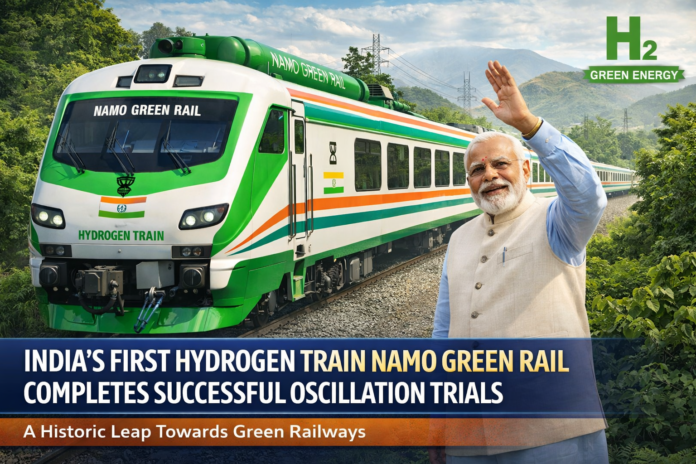

New Delhi, March 30, 2026: In a landmark achievement that marks a turning point for Indian Railways and the country’s clean energy ambitions, India’s first hydrogen-powered train — the Namo Green Rail — has successfully completed its oscillation trials. This milestone clears the way for the train to be cleared for passenger services on the historic Jind-Sonipat route in Haryana. The successful trials make India the fifth country in the world to achieve operational hydrogen train capability, joining Germany, France, Sweden, and China in this elite league of green railway nations.
What Are Oscillation Trials and Why Do They Matter?
Oscillation trials are one of the final and most critical stages in the certification of any new train design. During these trials, the train is run at its maximum designed speed on a designated test track to assess ride quality, stability, vibration levels, and the safety of the bogie (wheel assembly) design. For the hydrogen train, these trials were conducted on the Jind-Sonipat route in Haryana — a 90-kilometre corridor that has been specially prepared for this purpose. The completion of oscillation trials means that the Namo Green Rail has demonstrated its mechanical integrity and safety at operational speeds, a crucial precondition for commercial passenger service.
The Namo Green Rail is designed to run at speeds of up to 150 kilometres per hour. With 2 driver power cars and 8 passenger coaches, the train was jointly developed by Indian Railways, the Research Designs and Standards Organisation (RDSO), and Spanish partner Green H. The successful completion of trials is the result of years of meticulous engineering and collaborative effort between Indian and international teams.
How India’s Hydrogen Train Works: The Technology Behind Namo Green Rail
The Namo Green Rail is powered by cutting-edge hydrogen fuel cell technology. Hydrogen and oxygen undergo an electrochemical reaction inside the fuel cells to generate electrical power, which then drives the train’s electric motors. The only byproduct of this process is water vapour — making the train completely zero-emission at the point of use. This is in sharp contrast to diesel-powered locomotives, which are major contributors to air pollution and carbon emissions.
One of the most remarkable aspects of the technology is its extraordinary efficiency. Just 900 grams of hydrogen, generated from 9 kilograms of water through an electrolysis process, can run the train for 1 kilometre. The hydrogen can be produced using renewable energy sources such as solar or wind power, making the full lifecycle of the train potentially carbon-neutral. The hydrogen is stored in high-pressure tanks onboard the train, and the entire system has been designed with multiple layers of safety mechanisms to prevent leaks or accidents.
India’s Green Railway Vision: Hydrogen for Heritage Routes
The hydrogen train is a flagship project under Indian Railways’ ambitious “Hydrogen for Heritage” programme, which envisages running 35 hydrogen trains on India’s famous heritage and hill railway routes. These routes, which include iconic destinations like Darjeeling, Ooty, Matheran, Kalka-Shimla, and Kangra Valley, are currently operated by diesel locomotives that are costly to run and highly polluting. Replacing them with hydrogen trains would not only dramatically cut carbon emissions but also reduce the operating cost per kilometre, as hydrogen fuel becomes increasingly cost-competitive with diesel.
Each hydrogen train is estimated to cost approximately Rs 80 crore, while the necessary ground infrastructure for each route costs around Rs 70 crore. While these initial capital costs are higher than conventional trains, the long-term operational savings and environmental benefits are expected to make the investment highly worthwhile. The government has also expressed interest in building domestic hydrogen production and supply chain capabilities to reduce import dependence and drive down costs over time.
India’s Climate Commitments and the Role of Green Transport
The successful hydrogen train trials come at a moment when India’s climate commitments are under scrutiny. India has pledged to reach net-zero carbon emissions by 2070, and the transport sector — one of the largest contributors to greenhouse gas emissions — is central to this target. Indian Railways, which operates the world’s fourth-largest rail network and transports approximately 23 million passengers every day, is one of the country’s largest single consumers of energy and emitters of carbon dioxide.
Indian Railways has already made significant strides in electrification, with over 95 percent of its broad-gauge route-kilometres now electrified. The hydrogen train programme takes this commitment to a new level, targeting routes where electrification is difficult or commercially unviable. By combining electrification with hydrogen power, Indian Railways aims to achieve complete net-zero operations by 2030 — a target that would make it one of the greenest railway systems in the world.
Global Context: Who Else Is Running Hydrogen Trains?
India’s achievement places it in a select group of nations at the forefront of hydrogen rail technology. Germany was the world pioneer, commercially operating hydrogen-powered Coradia iLint trains on passenger routes in Lower Saxony since 2018. France has been conducting hydrogen train trials on its network and has committed to deploying commercial hydrogen trains in the coming years. Sweden and China have also made significant advances in this space. With the Namo Green Rail, India has demonstrated that it can develop and deploy this complex technology indigenously, in partnership with international experts, at a scale suited to Indian operating conditions.
What Happens Next: Path to Commercial Operations
Following the successful completion of oscillation trials, the Namo Green Rail will undergo additional safety and performance tests as part of the full certification process overseen by the Commission of Railway Safety (CRS). Once all clearances are obtained, the train is expected to be formally inaugurated for passenger service, with Prime Minister Narendra Modi likely to flag off the inaugural run. The Jind-Sonipat route in Haryana will be the first to see hydrogen train operations, serving as a model for subsequent roll-outs on other heritage and hill routes across India.
The milestone also assumes special significance in the context of India’s broader energy strategy. With the Iran-US war sending oil prices soaring past $116 per barrel and threatening energy security across import-dependent nations like India, the urgency of transitioning to domestic renewable energy sources has never been greater. The hydrogen train represents not just a technological achievement, but a strategic imperative — reducing India’s dependence on imported fossil fuels while demonstrating leadership in the global clean energy transition. For Indian Railways, for the climate, and for India’s energy security, the Namo Green Rail is a train whose time has truly come.