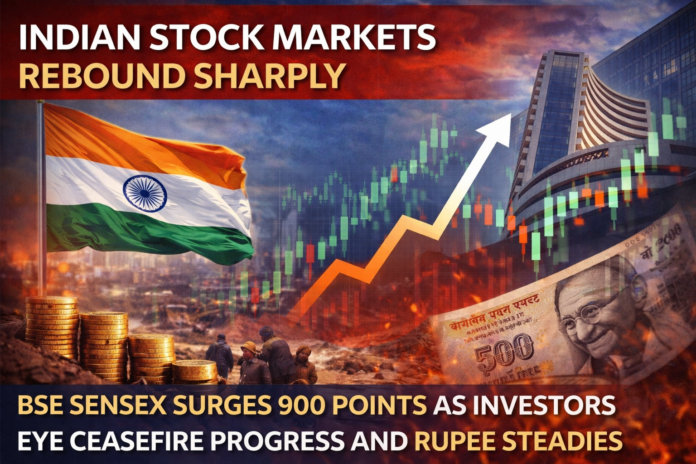

Mumbai / New Delhi, April 12, 2026 — Indian stock markets staged a strong recovery on Saturday, April 12, with the BSE Sensex surging approximately 900 points — gaining 1.20% from the previous session — to close at around 77,550 points, as investors drew cautious optimism from the ongoing ceasefire in the Middle East and fresh signs that India’s economy retains fundamental resilience despite the severe external headwinds it has been navigating since the outbreak of the US-Iran conflict in late February.
The rally, which was broad-based across most sectors, provided welcome relief to investors who had watched the Sensex tumble sharply in recent weeks, losing over 10% in a single month as the Middle East oil shock hammered sentiment and pushed the country’s trade deficit, inflation, and currency all in adverse directions simultaneously. The Indian rupee, which had slipped to 92.68 against the US dollar — a depreciation of 17 paise in a single session — also showed signs of stabilising, though it remained under pressure from the elevated oil import bill and cautious global risk sentiment.
The Rally in Context: What Drove the Markets Higher
The April 12 Sensex recovery built on an earlier bounce on April 10 — the last trading session before the weekend — when the index had gained 1.20% as the onset of the US-Iran ceasefire and the commencement of peace talks in Islamabad generated tentative optimism. The two-day rally cumulatively erased a significant portion of the losses accumulated during the peak of the oil shock, though the Sensex remained well below its pre-crisis highs and technically in correction territory from its record peaks.
Several specific factors drove the Saturday session’s gains. Energy stocks, which had been under pressure as investors worried about the impact of high oil prices on India’s refining sector and the potential for further oil import curbs, rebounded sharply as Brent crude eased slightly from its most extreme levels. Banking and financial services stocks, which had been sold off on concerns about credit quality and the impact of potential RBI rate hikes, also attracted buying as investors reassessed the probability of monetary tightening given the government’s stated commitment to supporting economic growth.
Infrastructure and construction stocks outperformed during the session, benefiting from continued government capital expenditure commitments despite the fiscal pressures of the oil shock. The Indian government has maintained its infrastructure investment programme even amid the crisis, prioritising long-term economic development over short-term fiscal austerity, a stance that has attracted positive commentary from international investors who view India’s infrastructure drive as a fundamental growth driver.
Information technology stocks, which had been under pressure globally as US tech budgets faced scrutiny amid the economic slowdown, also participated in the rebound, with investors noting that many large Indian IT companies have diversified their client base away from US financial services and energy clients toward sectors less directly exposed to the Middle East conflict.
India’s Petroleum Minister Heads to Qatar: Securing Gas Supply
In a significant development that has been welcomed by both the markets and analysts, India’s Petroleum Minister is set to visit Qatar in the coming days amid ongoing concerns about the country’s energy supply in the wake of the Middle East conflict. The visit underlines the urgency with which New Delhi is approaching the twin challenges of securing adequate energy supply and managing the costs of that supply in a highly disrupted global market.
Qatar is one of the world’s largest exporters of liquefied natural gas (LNG), and India has been working to diversify its energy imports away from the Persian Gulf crude routes that have been disrupted by the Strait of Hormuz crisis. LNG imports from Qatar, which flow around the Arabian Peninsula and can bypass the most directly affected zones of the conflict, have gained renewed strategic importance as India looks for ways to reduce its exposure to the oil price shock.
The ministerial visit to Qatar is also expected to cover discussions about long-term energy supply contracts, which could provide India with greater price certainty and supply security in an era of heightened geopolitical risk. India has been working to build a portfolio of long-term energy supply agreements with multiple suppliers as part of a broader strategy to diversify away from the concentration of oil imports from the Middle East, which currently account for the majority of India’s crude oil purchases.
The combination of diplomatic energy outreach, cautious market optimism about the ceasefire, and underlying fundamental strength in the Indian economy all contributed to the positive market sentiment on April 12. However, analysts cautioned that the rally’s durability depends critically on developments in the Iran-US diplomatic channel, with the Islamabad talks’ collapse casting a shadow over the outlook.
RBI Policy and the Road Ahead for Indian Markets
The Reserve Bank of India’s Monetary Policy Committee is scheduled to meet in the coming weeks, and its deliberations will be watched extremely closely by markets, businesses, and the government. The central bank faces a genuinely difficult task: on one hand, inflation has risen sharply as imported oil price increases have passed through to consumer prices, with fuel and transportation costs leading the way. On the other hand, economic growth has been slowing as the global headwinds intensify, and there is a strong argument for maintaining or even easing monetary conditions to support the economy.
Most analysts expect the RBI to hold rates steady in the near term, taking a wait-and-see approach as the geopolitical situation evolves. But if oil prices remain elevated and inflation continues to rise, pressure for a rate hike could intensify. The rupee’s depreciation to 92.68 against the dollar adds another dimension to the RBI’s challenge: a weaker rupee makes oil imports more expensive in rupee terms, compounding the inflationary impact of rising dollar-denominated oil prices.
For retail investors and the broader Indian middle class, the Sensex rally of April 12 provides some reassurance that the worst-case scenario — a sustained market collapse mirroring the depth of the oil crisis — may not materialise. Domestic institutional investors, including mutual funds and insurance companies, have been providing crucial support to the market through disciplined buying on dips, a pattern that has helped buffer the Indian market from some of the more extreme volatility seen in smaller Asian markets.
India’s India Petroleum Minister’s upcoming visit to Qatar, the government’s unwavering commitment to infrastructure spending, and the underlying strength of domestic consumption all point to an economy that retains significant buffers against the external shocks it is absorbing. The BSE Sensex rally on April 12, 2026 — however cautious and conditional — reflects a market that, for now at least, continues to believe in India’s long-term story.