
By The Press of Asia | March 14, 2026
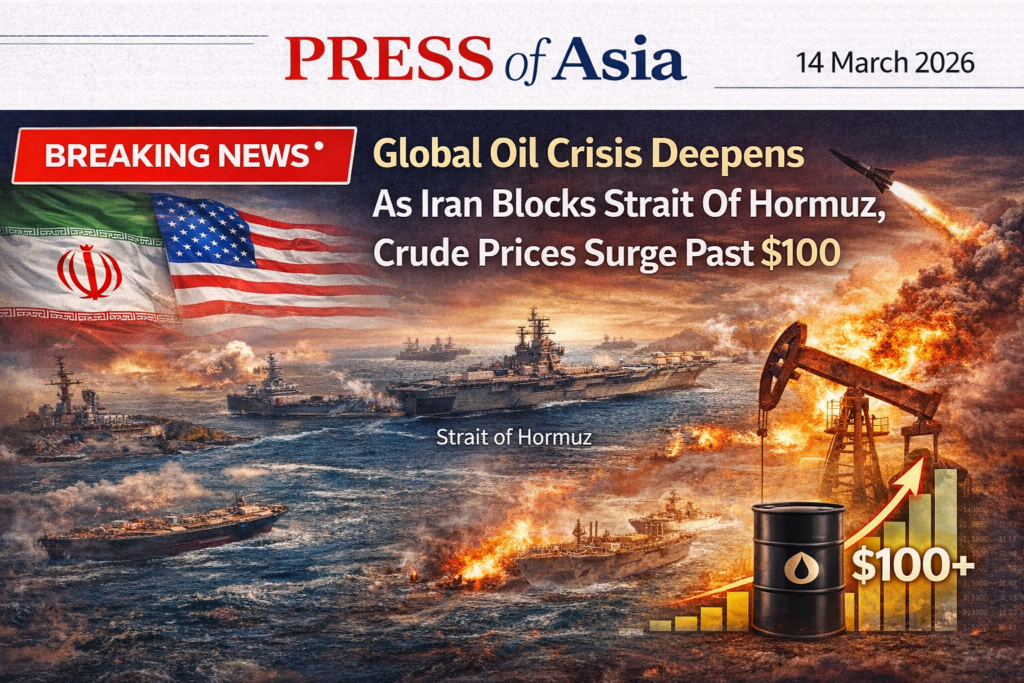
The global energy market has entered a period of extreme volatility as tensions around the Strait of Hormuz intensify, pushing crude oil prices above $100 per barrel. The surge comes amid growing concerns that disruptions to shipping in the Persian Gulf could severely impact global energy supplies.
Brent crude, the international oil benchmark, has climbed above the $100 mark for the first time in several years as geopolitical tensions surrounding Iran and Western powers escalate. Analysts warn that if shipping disruptions continue, oil prices could rise even further in the coming weeks.
Strait of Hormuz: The World’s Most Critical Energy Chokepoint
The Strait of Hormuz remains one of the most strategically important maritime passages in the world. Located between Iran and Oman, the narrow waterway connects the Persian Gulf with the Arabian Sea and serves as the main export route for major oil-producing nations.
Approximately 20 percent of the world’s oil supply and large volumes of liquefied natural gas (LNG) pass through this corridor each day.
Recent security incidents and rising military tensions have significantly reduced tanker traffic through the region, with several shipping companies delaying or rerouting vessels to avoid potential risks.
Energy analysts say even partial disruption in the strait can immediately impact global oil markets due to the massive volume of crude oil transported through the passage.
Oil Prices Surge Above $100
The escalating tensions have triggered a sharp reaction in global commodity markets. Brent crude futures recently crossed the $100 per barrel mark, while US benchmark WTI crude approached the $98 level.
Financial markets are increasingly pricing in the risk of prolonged disruption to Middle Eastern oil exports.
Some analysts warn that if tanker movement remains restricted for several weeks, prices could potentially rise toward $120–$150 per barrel, a level that could trigger inflationary pressure across global economies.
Shipping Disruptions and Tanker Delays
Shipping activity in the Strait of Hormuz has slowed dramatically in recent days. Many international tanker operators are either waiting offshore or rerouting vessels due to rising security concerns.
Reports indicate that hundreds of vessels have been forced to anchor outside the Gulf as insurance costs and risk assessments for entering the strait have increased sharply.
The disruption has also forced several oil-producing countries to temporarily reduce exports or redirect shipments through alternative routes.
Impact on Global Economy
The surge in oil prices is already sending shockwaves through global financial markets.
Higher energy costs could push inflation higher in many countries, particularly those heavily dependent on imported fuel. Asian economies such as India, Japan, and South Korea are considered especially vulnerable to supply disruptions from the Middle East.
Economists warn that prolonged instability in the Persian Gulf could slow global economic growth and increase the risk of a broader financial downturn.
Impact on India
India imports more than 85 percent of its crude oil requirements, making the country highly sensitive to fluctuations in global oil prices.
A prolonged energy crisis could significantly increase India’s import bill, potentially affecting fuel prices, inflation, and the national fiscal balance.
Indian authorities are reportedly monitoring the situation closely while exploring alternative supply sources to stabilize domestic fuel markets.
Strategic Oil Reserves and Emergency Measures
In response to the growing crisis, several countries have begun discussing emergency measures to stabilize the market.
The International Energy Agency (IEA) has also considered releasing oil from strategic reserves to cushion the impact of supply disruptions.
However, analysts caution that such measures can only provide temporary relief if geopolitical tensions in the region continue to escalate.
Conclusion
The Strait of Hormuz crisis has once again demonstrated how vulnerable the global economy remains to geopolitical tensions in the Middle East.
With nearly one-fifth of the world’s oil supply flowing through the narrow waterway, even limited disruptions can trigger major shocks in global energy markets.
As diplomatic efforts continue to prevent further escalation, the coming weeks will be critical in determining whether oil markets stabilize or move toward a deeper global energy crisis.