

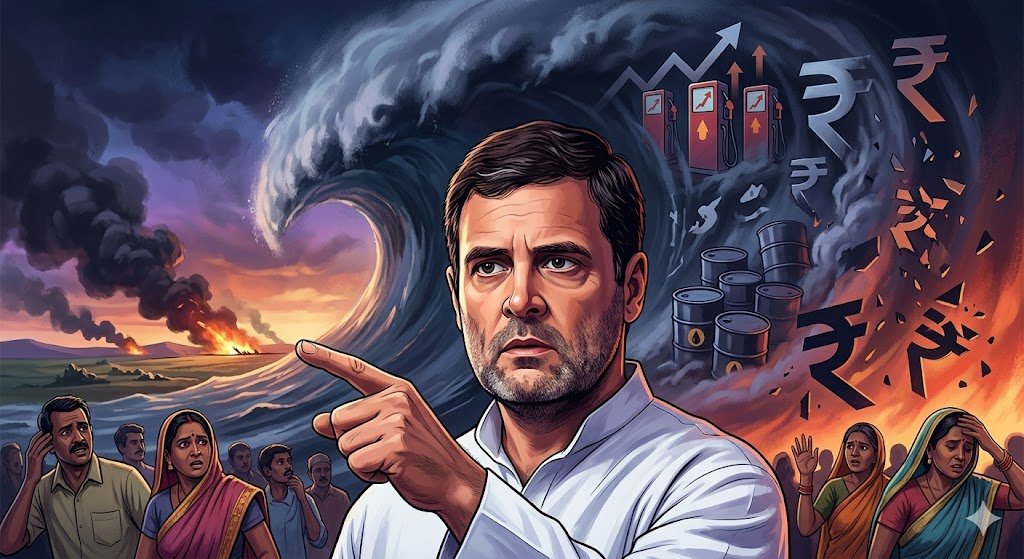
Leader of Opposition Rahul Gandhi on Saturday (March 21, 2026) sounded the alarm over looming inflation in India, warning that the weakening rupee and surging industrial fuel prices are clear harbingers of economic hardship ahead. In a strongly worded post on social media platform X (formerly Twitter), Gandhi predicted that the government will raise prices of petrol, diesel, and LPG immediately after the ongoing assembly elections—a move he says will hit every Indian household hard.
The Rupee Crisis: Heading Toward 100
The Indian rupee has been under severe pressure in recent weeks, dropping to a record low of 93.12 against the US dollar on Friday, March 20, 2026. Currency analysts predict it could breach the psychologically significant 100-mark in coming weeks if current trends continue.
Gandhi seized on this development, stating: “The rupee weakening against the dollar and heading towards 100, coupled with a sharp rise in industrial fuel prices—these aren’t just numbers; they’re clear signals of inflation ahead.”
The rupee’s depreciation is largely attributed to:
- Foreign institutional investors (FIIs) pulling out capital from Indian markets amid global uncertainty
- India’s widening trade deficit as energy import costs surge
- Dollar strengthening globally as investors seek safe-haven assets
- Concerns over India’s fiscal position and rising public debt
- Pressure from the ongoing Iran war disrupting energy supply chains
While the Reserve Bank of India (RBI) has intervened in forex markets to defend the rupee, depleting foreign exchange reserves in the process, the currency continues to slide. India’s forex reserves have dropped by approximately $48 billion since the Iran war began on February 28, 2026.
Industrial Fuel Prices Surge: A Cascading Impact
Even as the government has kept prices of regular petrol and diesel unchanged ahead of elections in West Bengal, Assam, Kerala, Tamil Nadu, and Puducherry, industrial and premium fuel prices have shot up dramatically:
- Premium (power) petrol: Increased by ₹2 per litre
- Industrial diesel: Up by approximately ₹22 per litre (about 25% increase)
- Aviation Turbine Fuel (ATF): Surged by over 30% since late February
- Liquefied Natural Gas (LNG) for industry: Up 40-45%
Oil companies—Indian Oil Corporation, Hindustan Petroleum, and Bharat Petroleum—have attributed these hikes to rising international crude prices (now above $112 per barrel) and the closure of the Strait of Hormuz, which has forced longer shipping routes and higher freight costs.
Gandhi’s Warning: The Cascading Economic Impact
In his social media post, the Congress leader outlined the ripple effects that currency depreciation and fuel price increases would have across India’s economy:
- Higher Production Costs
Manufacturing costs will rise as industrial fuel becomes more expensive, affecting everything from steel and cement to textiles and electronics.
- Increased Transportation Expenses
Logistics companies are already passing on fuel surcharges to customers. This will raise prices of goods across the supply chain, from farm produce to finished consumer products.
- MSMEs Bear the Brunt
Micro, Small, and Medium Enterprises (MSMEs), which form the backbone of India’s economy and employ over 110 million people, will be “hit the hardest,” according to Gandhi. Many MSMEs operate on thin margins and cannot easily absorb sharp cost increases.
- Rising Prices of Everyday Items
From groceries to medicines, from clothing to household goods—prices are expected to climb as both production and transportation costs escalate.
- Stock Market Pressure from FII Outflows
Foreign investors have already pulled out approximately ₹1.2 lakh crore from Indian equity markets since the Iran war began. Gandhi warned this trend would “accelerate,” putting further pressure on the stock market and the rupee.
“Post-Election Price Hikes Are Inevitable”
Gandhi’s most pointed accusation was that the Modi government is artificially suppressing fuel price increases until after the assembly elections conclude in late April 2026.
“And it’s just a matter of time—after the elections, prices of petrol, diesel, and LPG will be hiked too,” Gandhi wrote, referring to the pattern of price freezes during election periods that have been observed in the past.
His claim rests on historical precedent:
- In 2022, petrol and diesel prices remained frozen for over 130 days ahead of state elections in Uttar Pradesh and four other states, only to be raised immediately afterward
- LPG cylinder prices have often been adjusted post-election to avoid voter backlash
- The current freeze on retail petrol/diesel prices has been in effect since mid-February 2026, just before election dates were announced
Industry sources have privately acknowledged that oil marketing companies are under “implicit pressure” from the government to hold prices steady despite mounting losses (estimated at ₹8-10 per litre on diesel and ₹5-6 per litre on petrol at current international prices).
LPG Crisis: Supply Pressures Mount
Beyond price concerns, India is also facing an LPG supply crunch due to the Iran war’s disruption of global energy markets.
Recent developments include:
- Ministry of Petroleum and Natural Gas urging commercial LPG users to switch to piped natural gas (PNG) where available
- Reports of panic buying and long queues at LPG depots in several states
- Kerala particularly affected, with restaurants and hotels temporarily shutting operations earlier in March due to gas shortages
- Government assurances of “adequate stock” not fully assuaging public concern
The 19-kg commercial LPG cylinder price has already increased by ₹150-200 in many cities, forcing small eateries and roadside vendors to either absorb costs or pass them to customers.
Government’s Response: “Everything is Normal”
The Modi government has downplayed concerns, with senior ministers asserting that India has sufficient strategic reserves and alternative supply arrangements in place.
Petroleum Minister Hardeep Singh Puri stated earlier this week that India has diversified its oil imports, with increased purchases from the United States, Russia, and African nations reducing dependence on the Middle East.
However, critics point out that:
- Diversification takes time; immediate supply gaps remain
- Alternative routes (around Africa instead of through Suez) add 10-15 days to shipping time and significant cost
- India still imports about 85% of its crude oil requirements; any global price surge hits hard
- Strategic Petroleum Reserves (SPR) hold only about 9.5 days’ worth of consumption
Political Ramifications: Election Battleground
Gandhi’s intervention is clearly aimed at making inflation and fuel prices a central issue in the ongoing assembly elections.
The Congress party has been raising these concerns for weeks:
- On March 20, Congress spokesperson Pawan Khera demanded the government cut taxes on fuel, citing the ₹26 lakh crore collected from petroleum taxes over the past 12 years
- Party spokesperson Supriya Shrinate coined the phrase “Chickens come home to roost,” suggesting the government’s foreign policy failures (by not condemning the US-Israel strikes on Iran) are now creating economic pain at home
- State Congress units in poll-bound states have made fuel prices a key campaign plank
The BJP has countered by:
- Highlighting that international crude prices are beyond India’s control
- Pointing to the Modi government’s welfare schemes (free rations, housing, etc.) as buffers against inflation
- Accusing Congress of “politicizing” a global crisis
What Economists Say
Independent economists largely agree with Gandhi’s broad assessment, though they differ on timelines and magnitudes.
Dr. Arvind Subramanian, former Chief Economic Adviser, noted: “The combination of rupee depreciation and energy cost escalation is indeed a recipe for imported inflation. The government faces a difficult tradeoff between fiscal prudence (absorbing oil company losses through subsidies) and price stability (keeping fuel affordable).”
Raghuram Rajan, former RBI Governor, warned in a recent interview: “India’s twin deficits—fiscal and current account—are being exacerbated by the energy crisis. Without significant policy intervention, we could see inflation breaching 8% by mid-2026.”
The household budget impact is projected to be substantial:
- If petrol/diesel increase by ₹10-15 per litre (as expected), a typical middle-class family could see monthly fuel expenses rise by ₹800-1,200
- LPG cylinder price increases of ₹100-150 would add another ₹200-300 per month (for families using 2-3 cylinders)
- Food inflation driven by higher transport costs could push grocery bills up 10-15%
- Overall household budget stress estimated at 8-12% for middle and lower-income groups
Gandhi’s Broader Critique: Lack of Economic Strategy
Beyond immediate price concerns, Rahul Gandhi leveled a broader accusation at the Modi government: “The Modi government has neither direction nor strategy—just empty rhetoric. The question isn’t what the government is saying; it’s what’s left on your plate.”
This framing seeks to position the economic fallout from the Iran war as symptomatic of deeper governance failures:
- Failure to build adequate strategic reserves despite years of warnings
- Over-dependence on volatile Middle East energy markets
- Inadequate investment in renewable energy and energy self-sufficiency
- Lack of proactive diplomacy to de-escalate the West Asia conflict
- Short-term electoral considerations trumping long-term economic planning
The Road Ahead: Brace for Impact
Regardless of political positioning, the economic realities are stark. India faces a multi-front challenge:
- Managing Inflation: The RBI may be forced to raise interest rates further, potentially slowing economic growth.
- Protecting the Rupee: Continued forex interventions will deplete reserves, limiting India’s ability to weather future shocks.
- Balancing Fiscal Constraints: Subsidizing fuel to protect consumers would widen the fiscal deficit, potentially triggering credit rating concerns.
- Maintaining Growth Momentum: Higher input costs and tighter monetary policy could dampen the economic recovery that was underway.
- Political Stability: Sustained high inflation has historically been politically destabilizing in India.
Conclusion: A Storm Brewing?
Rahul Gandhi’s stark warning—”Inflation is coming”—resonates with the anxiety many Indian households are already feeling. The convergence of a weakening rupee, soaring energy costs, and geopolitical uncertainty in a critical oil-producing region creates a perfect storm for economic stress.
Whether the Modi government will indeed raise fuel prices immediately after the elections, as Gandhi predicts, remains to be seen. But the economic fundamentals suggest that some form of price adjustment is inevitable unless international crude prices collapse or the Iran war ends swiftly—neither of which appears likely in the near term.
For ordinary Indians, the message is clear: prepare for higher costs of living. For policymakers, the challenge is to navigate this crisis without triggering a broader economic slowdown or social unrest. And for political parties, fuel prices and inflation have once again emerged as the battlefield where elections—and governments—can be won or lost.