Situation Overview (As of March 1, 2026)
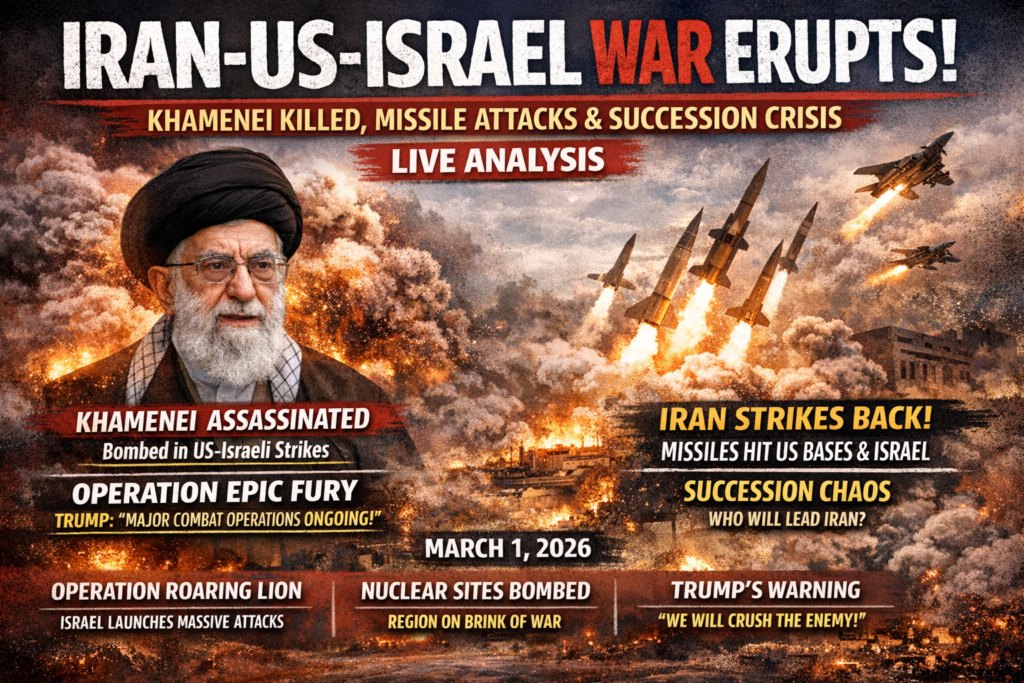
The Iran–US–Israel conflict has escalated into what analysts describe as a full-scale regional war, following reported US-Israeli precision strikes deep inside Iran and subsequent large-scale Iranian missile retaliation across the Middle East.
Multiple regional and international media outlets claim that Iran’s Supreme Leader Ayatollah Ali Khamenei may have been killed during coordinated airstrikes targeting senior leadership locations in Tehran. Iranian authorities have not yet issued a formal confirmation, while state media remains partially silent amid communication disruptions.
Meanwhile, Iran has launched waves of ballistic missiles and drones toward Israel and several US military installations across the Gulf region, sharply raising fears of a prolonged and widening war.
US–Israel Military Operations
According to Israeli and Western defense sources, Israel initiated its largest air campaign to date, deploying nearly 200 fighter jets against approximately 500 military targets in western and central Iran. These reportedly included:
- Ballistic missile launch facilities
- Air-defense systems
- Nuclear-linked infrastructure
- Command and control centers
The United States, under President Donald Trump, confirmed participation in “major combat operations,” stating that the strikes were intended to neutralize imminent threats to US forces and allies.
Israeli Prime Minister Benjamin Netanyahu described the operation as a “pre-emptive necessity” amid growing concerns over Iran’s weapons capabilities and proxy attacks.
Iran’s Missile Retaliation Across the Region
Within hours, Iran responded with what it termed “Truthful Promise 4”, launching missiles and drones toward:
- Israel (including the Tel Aviv metropolitan area)
- US bases in Iraq, Jordan, Bahrain, Kuwait, Qatar, UAE, and Saudi Arabia
Air-defense systems intercepted many incoming projectiles, though confirmed impacts were reported at several Gulf installations. Air raid sirens sounded across central Israel, and limited civilian casualties were reported.
Iranian military figures vowed further retaliation, warning that US and Israeli interests would remain targets if strikes continue.
Leadership Vacuum and Succession Crisis
If confirmed, Khamenei’s death would mark the first killing of a sitting Iranian Supreme Leader, creating an unprecedented constitutional and political crisis.
Iran’s Assembly of Experts is legally tasked with appointing a successor, but analysts note:
- No universally accepted heir is in place
- Senior leadership losses have weakened decision-making
- The IRGC retains decentralized missile authority
Speculation over possible successors ranges from clerical figures to IRGC-aligned power brokers, raising concerns of military dominance over civilian governance.
Global Reaction and Economic Fallout
- The UN Security Council has called an emergency session
- The IAEA is reviewing potential nuclear-site damage
- Russia and China condemned the strikes as escalatory
- European states urged restraint while backing non-proliferation efforts
Global markets reacted sharply:
- Oil prices jumped nearly 15% on fears of a Hormuz Strait closure
- Stock indices across Asia and Europe declined
- Airlines suspended Middle East routes as regional airspace closed
Analysis: Is This the Start of a Wider Middle East War?
Security analysts warn that this conflict could reshape the Middle East balance of power. While Iran’s retaliation has so far been less intense than previous mass barrages, continued leadership instability may lead to:
- Escalation involving Hezbollah or Houthi forces
- Long-term disruption of global energy supplies
- Internal unrest inside Iran amid economic and political pressure
President Trump’s messaging suggests no immediate diplomatic off-ramp, indicating that military operations may continue for days — or longer.
Bottom Line
With missiles in the air, leadership uncertainty in Tehran, and global powers reacting cautiously, March 1, 2026 begins under extreme geopolitical volatility. Confirmation of leadership casualties and the next phase of retaliation will determine whether this crisis stabilizes — or spirals into a multi-front regional war.