
New Delhi, March 31, 2026: Exactly one month after the United States and Israel launched devastating joint airstrikes on Iran on February 28, 2026, India continues to grapple with the severe economic and energy security consequences of the conflict. As the Iran war enters its second month, India — which had maintained a careful policy of neutrality — is being hit hard by soaring oil prices, a growing LPG supply crisis, rising inflation, and an unprecedented threat to the $50 billion in annual remittances sent home by the nine million Indians living and working in the Gulf region.
The war began when US-Israeli forces conducted massive coordinated strikes targeting Iran’s nuclear infrastructure, military command centers, and top leadership, resulting in the death of Iran’s Supreme Leader Ali Khamenei in the initial wave of attacks. Iran’s retaliation has included missile barrages, drone attacks, and an attempted blockade of the Strait of Hormuz — one of the world’s most critical shipping lanes through which approximately 20% of global oil supply passes.
India’s Energy Vulnerability Exposed
India imports over 80% of its crude oil needs, and the Persian Gulf accounts for a major share of that supply. More critically, India depends on Gulf nations for 91% of its Liquefied Petroleum Gas (LPG) imports — the cooking fuel used by hundreds of millions of Indian households. The Iran war has caused a sudden and severe disruption in this supply chain, leading to fears of a cooking gas shortage across India.
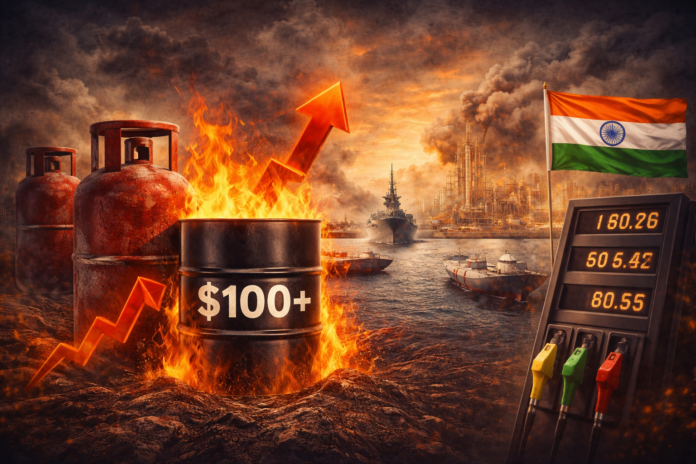
Oil prices have crossed $100 a barrel since the conflict began, adding significant pressure on India’s import bill. A sustained increase in crude prices directly impacts India’s fuel prices, inflation, current account deficit, and overall economic growth. The Reserve Bank of India and the Finance Ministry are monitoring the situation closely.
LPG Supply Crisis: India’s Diplomatic Victory in March
In a significant development on March 13, 2026, India secured a key diplomatic breakthrough when it reportedly reached an understanding with Iran allowing Indian LPG tankers safe passage through the Strait of Hormuz. The tanker MV Shivalik, carrying 40,000 metric tons of LPG, was given clearance and was expected to arrive at Indian shores within seven days of the agreement. A second tanker, BW TYR, is proceeding towards Mumbai with an expected arrival on March 31, while BW ELM is en route to New Mangalore with an estimated arrival on April 1.
This was hailed as a major diplomatic achievement by Indian officials, demonstrating India’s ability to navigate complex geopolitical situations while protecting its national interests. However, the deal remains fragile given the ongoing volatility of the conflict.
$50 Billion Remittances Under Threat
India receives the largest remittances in the world, and the Gulf region — comprising Saudi Arabia, UAE, Kuwait, Qatar, Bahrain, and Oman — accounts for a massive share of that inflow. According to Al Jazeera, the US-Israel war on Iran has put approximately $50 billion in annual remittances at risk, as nine million Indian expatriates in the Gulf face uncertainty about their employment and safety.
With the region gripped by war anxiety, several Gulf nations have issued travel advisories and implemented emergency protocols. Indian nationals in conflict-adjacent zones face difficulties with job continuity, banking, and movement. If the conflict escalates further, India could face a large-scale return of Gulf migrants, creating pressure on domestic employment and a sharp reduction in the remittance inflow that supports millions of Indian families, especially in Kerala, Andhra Pradesh, Tamil Nadu, and Uttar Pradesh.
India’s Neutral Stance: Walking a Geopolitical Tightrope
India has officially maintained neutrality in the Iran war, declining to condemn either the US-Israeli strikes or Iran’s retaliatory actions. This careful balancing act reflects India’s complex geopolitical relationships: India is a member of the Quad (with the US, Japan, and Australia), but also has deep ties with Iran through the Chabahar port agreement and historical cultural connections.
India’s neutrality has allowed it to negotiate energy supply agreements with both Iran and Gulf Arab states simultaneously. However, this position also limits India’s ability to call for a ceasefire or play a mediating role at the international level. The Ministry of External Affairs has been working overtime to ensure the safety of Indian nationals and the continuity of energy supplies.
Economic Shocks: Inflation and Growth at Risk
The World Socialist Web Site reported on March 31, 2026 that India is being roiled by economic fallout from the Iran war, with the LPG supply disruption being the most immediate impact but with broader economic consequences spreading across the economy. Inflation has begun to creep upward due to rising fuel and transportation costs. The Indian rupee has come under pressure against the US dollar, although Finance Minister Nirmala Sitharaman has stated that India’s economic fundamentals remain strong.
Fitch Ratings had projected India’s economy to grow at 7.5% in FY26, and India’s GDP grew at 7.8% in Q3 FY26. However, sustained high oil prices and supply disruptions could potentially shave 0.5 to 1 percentage point off growth projections if the conflict continues beyond April 2026.
Key Numbers: Iran War Impact on India at a Glance
- Oil prices: Crossed $100 per barrel since conflict began
- India’s LPG import dependence on Gulf: 91%
- Indian expatriates in the Gulf: 9 million
- Annual remittances at risk: ~$50 billion
- MV Shivalik LPG cargo secured: 40,000 metric tons
- India’s GDP growth (Q3 FY26): 7.8% (new series)
- Iran war start date: February 28, 2026
What Lies Ahead for India
As India heads into the new financial year 2026-27, the Iran war represents one of the biggest external risks to its economic trajectory. The government is pursuing a multi-pronged strategy: securing alternative energy supplies from Russia and the US, expanding strategic petroleum reserves, protecting Indian nationals in the Gulf, and maintaining diplomatic channels with all parties in the conflict.
India’s coal-heavy energy mix — with coal accounting for 79% of energy supply according to MoSPI — provides some insulation from oil price shocks, but the country’s dependence on imported LPG for household cooking remains a critical vulnerability that the government must urgently address through diversification and expanded domestic production.
The Iran war of 2026 is not just a distant Middle Eastern conflict for India. It is a live, ongoing challenge to India’s energy security, economic stability, and the welfare of millions of its citizens living abroad. How India navigates this crisis will be a defining test of its strategic autonomy in an increasingly multipolar and volatile world.