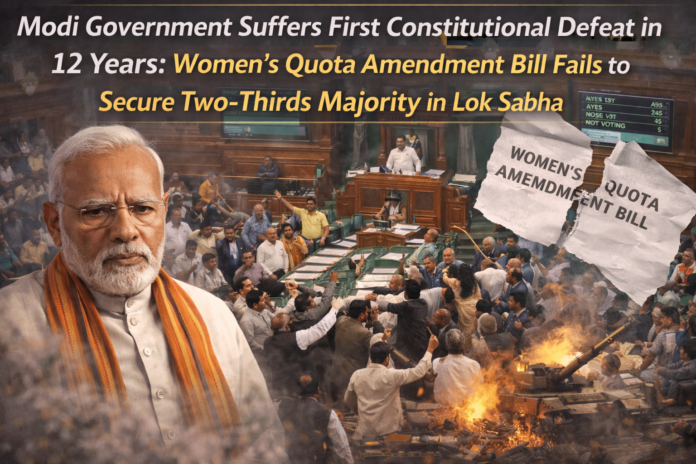

New Delhi, April 18, 2026: In a stunning political setback for Prime Minister Narendra Modi’s government, the Constitution (131st Amendment) Bill, 2026, aimed at expediting the implementation of women’s reservation in Parliament and state assemblies, failed to pass in the Lok Sabha on April 17, 2026. This marks the first time in 12 years that a constitutional amendment bill proposed by the Modi government has been defeated in the Lower House of Parliament.
The bill, which sought to increase the number of seats in the Lok Sabha and state assemblies to facilitate 33% reservation for women, received 298 votes in favor but fell short of the mandatory two-thirds majority required for constitutional amendments. With 528 MPs participating in the division, the legislation needed at least 352 votes to pass. The defeat represents a significant political embarrassment for the government and a major victory for the united opposition.
Background: The Nari Shakti Vandan Adhiniyam and Its Implementation Challenges
The issue of women’s reservation in Indian legislatures has been a contentious political topic for decades. The 106th Constitutional Amendment, passed in 2023 and officially titled the “Nari Shakti Vandan Adhiniyam” (Women’s Power Salutation Act), provides for 33% reservation of seats for women in the Lok Sabha and state legislative assemblies.
However, the implementation of this landmark legislation has been deliberately delayed through legal and procedural mechanisms. Article 334A of the Constitution, as inserted by the 106th Amendment, links the reservation’s implementation to a delimitation exercise that will be conducted after the next Census, which is scheduled for 2027 at the earliest. This means that women’s reservation is unlikely to take effect before 2034, more than a decade after the law was enacted.
Critics have long argued that this delay mechanism was intentionally built into the law to avoid immediate political disruption while allowing the government to claim credit for progressive legislation. The Congress party and other opposition groups have accused the Modi government of paying lip service to women’s empowerment while ensuring that actual representation remains distant.
The 131st Amendment Bill: An Attempt to Accelerate Implementation
The Constitution (131st Amendment) Bill, 2026, was introduced by the Modi government in an apparent attempt to address some of these concerns and demonstrate commitment to women’s political representation. The bill proposed two main changes:
- Increase in Lok Sabha Seats: The bill sought to increase the total number of seats in the Lok Sabha from the current 543 to approximately 700, to accommodate the 33% reservation for women while maintaining representation for existing constituencies.
- Increase in State Assembly Seats: Similarly, the bill proposed increasing the number of seats in state legislative assemblies proportionally to enable the implementation of women’s reservation without significantly altering existing constituency boundaries.
The government argued that these increases were necessary to implement the Nari Shakti Vandan Adhiniyam without waiting for the post-2027 delimitation exercise. Supporters of the bill claimed it would enable women’s reservation to be implemented as early as the 2029 general elections, bringing forward the timeline by at least five years.
However, opposition parties were deeply skeptical of the government’s motives. They argued that the bill was a tactical maneuver designed to distract from the government’s failure to implement the existing women’s reservation law and to create political optics ahead of the 2029 elections without genuine commitment to women’s empowerment.
The Vote: How the Bill Was Defeated
When the Constitution (131st Amendment) Bill, 2026, was put to a vote in the Lok Sabha on April 17, it became clear that the government had miscalculated the political dynamics. Despite the BJP and its National Democratic Alliance (NDA) partners holding a majority in the Lower House, they failed to secure the two-thirds supermajority required for constitutional amendments.
The final tally was 298 votes in favor and 230 votes against. The bill needed 352 votes to pass, meaning it fell short by 54 votes. The opposition parties, led by the Congress and including regional parties such as the Trinamool Congress, Samajwadi Party, DMK, and others, united in voting against the bill.
Several factors contributed to the bill’s defeat:
- Opposition Unity: The INDIA (Indian National Developmental Inclusive Alliance) bloc, formed by opposition parties to counter the BJP, demonstrated unprecedented unity in opposing the bill. Despite their differences on other issues, opposition parties coordinated their strategy and voting behavior effectively.
- Internal Dissent: Reports suggest that some BJP-allied parties and even a few BJP MPs abstained or voted against the bill, either due to concerns about the proposed increase in seats or dissatisfaction with the government’s handling of other issues.
- Poor Whip Management: The government appears to have underestimated the level of opposition resistance and failed to ensure full attendance and voting discipline among its own MPs and allies.
- Strategic Opposition: Opposition parties framed their opposition not as being against women’s reservation per se, but as opposition to what they characterized as a politically motivated and poorly designed bill that would not genuinely advance women’s representation.
Opposition’s Arguments: Why They Voted Against the Bill
Opposition leaders were quick to defend their decision to vote against the bill, emphasizing that they are not opposed to women’s reservation but were against the government’s approach.
Congress President Mallikarjun Kharge stated: “We support women’s reservation wholeheartedly. But this bill is nothing more than a political gimmick. The Modi government had the opportunity to implement the Nari Shakti Vandan Adhiniyam immediately in 2023 but chose to delay it until after 2034. Now, with elections approaching, they bring this half-baked proposal to create an illusion of action.”
Rahul Gandhi, Leader of the Opposition in the Lok Sabha, delivered a fiery speech before the vote, arguing: “This government talks about ‘Nari Shakti’ but has consistently failed to empower women. Increasing the number of seats is not a solution; it’s a distraction. What we need is immediate implementation of the existing law, not more delays hidden behind fancy constitutional amendments.”
Opposition parties also raised concerns about the proposed increase in parliamentary and assembly seats. Critics argued that expanding the Lok Sabha to 700 seats would:
- Increase the financial burden on taxpayers due to higher salaries, allowances, and infrastructure costs for additional MPs.
- Dilute the effectiveness of parliamentary debate and decision-making.
- Create opportunities for gerrymandering and political manipulation during the delimitation process.
- Fail to address the real issue, which is the government’s unwillingness to implement existing laws.
Government’s Response: Strategic Error or Calculated Move?
The defeat of the bill has triggered intense debate within political circles about whether the government’s failure was a genuine strategic error or a calculated political move.
Some analysts suggest that the government miscalculated its ability to secure opposition support or assumed that opposition parties would not risk being seen as opposing women’s reservation. Home Minister Amit Shah defended the government’s intentions, stating: “We brought this bill with the best of intentions to empower women. It is unfortunate that the opposition chose to play politics with such an important issue.”
However, other political observers believe the government may have deliberately brought a bill it knew would fail in order to blame the opposition for blocking women’s empowerment. This would allow the BJP to campaign in future elections on the narrative that it tried to implement women’s reservation but was thwarted by opposition parties.
“The BJP is very clever politically,” noted political analyst Yogendra Yadav. “By bringing a bill they knew would fail, they create a narrative for the 2029 elections: ‘We tried to give women reservation, but the opposition stopped us.’ It’s a classic political maneuver.”
Impact on Women’s Political Representation
The defeat of the bill means that the timeline for implementing women’s reservation remains unchanged. Women will have to wait until at least 2034 before 33% of seats in Parliament and state assemblies are reserved for them.
This continued delay is deeply frustrating for women’s rights activists and organizations that have been campaigning for political representation for decades. India currently ranks among the lowest in the world in terms of women’s representation in Parliament. As of 2026, women hold approximately 14% of seats in the Lok Sabha, far below the global average of around 26%.
Pramila Rani, a women’s rights activist, expressed her disappointment: “Once again, women have been let down by the political system. Whether it’s the government’s fault or the opposition’s fault, the fact is that women continue to be denied their rightful place in decision-making bodies. This is unacceptable in the 21st century.”
Others, however, argue that simply reserving seats is not enough to ensure meaningful women’s empowerment. “Reservation is important, but it’s not a panacea,” said feminist scholar Nivedita Menon. “We need to address deeper issues of patriarchy, violence against women, and economic inequality. Symbolic representation without substantive power doesn’t achieve much.”
Withdrawal of Related Bills: Government Retreats
Following the defeat of the Constitution (131st Amendment) Bill, the government announced that it would withdraw two related bills that were also part of the legislative package:
- The Delimitation Bill, 2026: This bill was intended to establish the framework for redrawing constituency boundaries to accommodate the increased number of seats.
- The Union Territories (Reservation of Seats) Bill, 2026: This bill sought to extend women’s reservation to the legislative assemblies of union territories with legislatures, such as Delhi, Puducherry, and Jammu & Kashmir.
The withdrawal of these bills signals a broader retreat by the government on the issue and raises questions about its legislative strategy going forward.
Political Ramifications: A Rare Defeat for Modi
The defeat of the bill is particularly significant because it represents the first time since Narendra Modi became Prime Minister in 2014 that his government has failed to pass a constitutional amendment. Over the past 12 years, the Modi government has successfully passed several constitutional amendments, often with opposition support.
The failure highlights the changing political dynamics in India. The opposition, which was fragmented and weak for much of Modi’s tenure, has become increasingly united and assertive. The INDIA alliance, though still facing internal challenges, demonstrated its ability to coordinate effectively on key legislative votes.
For the BJP, the defeat is an embarrassment and a warning sign that it can no longer take parliamentary victories for granted, especially on issues requiring supermajorities. It also raises questions about the government’s ability to navigate a more assertive opposition in the run-up to the 2029 general elections.
Social Media and Public Reaction
The bill’s defeat sparked widespread reaction on social media platforms, with users across the political spectrum weighing in. Hashtags like #WomensReservation, #NariShaktiBill, and #LokSabhaVote trended on Twitter throughout the day.
BJP supporters criticized the opposition for blocking what they described as a pro-women bill, while opposition supporters celebrated the defeat as a victory against what they called a “political stunt.”
Public opinion appears divided. While many citizens support women’s reservation in principle, there is widespread skepticism about the sincerity of political parties on both sides of the aisle.
Looking Ahead: What’s Next for Women’s Reservation?
With the 131st Amendment Bill defeated and the related bills withdrawn, the status quo on women’s reservation remains in place. The Nari Shakti Vandan Adhiniyam (106th Amendment) is the law of the land, but its implementation is deferred until after the next Census and subsequent delimitation exercise.
This means that Indian women will have to wait at least until 2034, and possibly longer, before seeing the promised 33% reservation materialize. In the meantime, the issue is likely to remain a contentious political topic, with parties on all sides attempting to claim the moral high ground while avoiding substantive action.
Conclusion: A Missed Opportunity or Political Theater?
The defeat of the Constitution (131st Amendment) Bill, 2026, in the Lok Sabha represents a significant moment in Indian politics. Whether viewed as a genuine attempt to accelerate women’s political empowerment that was thwarted by opposition intransigence, or as a cynical political maneuver designed to create electoral narratives, the outcome is the same: India’s women will continue to wait for meaningful representation in the country’s legislatures.
What is clear is that the issue of women’s reservation has become deeply politicized, with all parties prioritizing electoral calculations over substantive reform. Until political leaders demonstrate genuine commitment to women’s empowerment—backed by concrete action rather than symbolic gestures—Indian democracy will continue to fall short of its promise of equal representation for all citizens.