
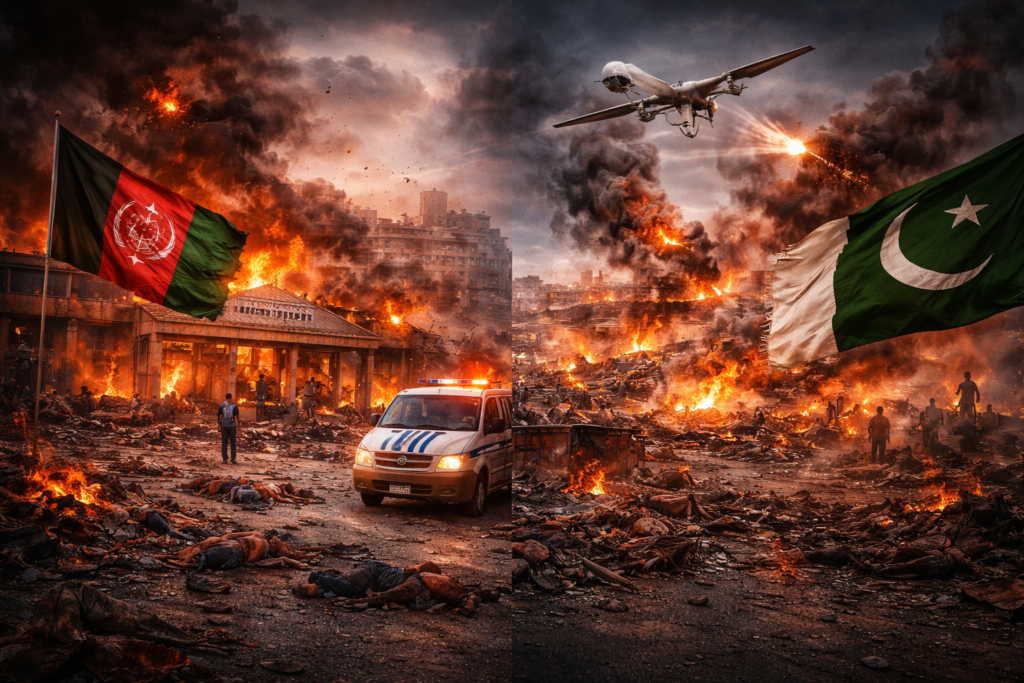
What was once a simmering border dispute between two nuclear-armed neighbours has exploded into a full-scale war. Pakistan and Afghanistan — two countries that have shared one of the world’s most volatile borders for decades — are now engaged in open military conflict, with airstrikes, drone attacks, tank battles, and cross-border artillery shelling becoming daily realities for millions of civilians on both sides. The 2026 Pakistan-Afghanistan war, now in its third week, has already killed hundreds, displaced over 115,000 people, and drawn sharp condemnation from the international community.
How the War Began: A Timeline
The roots of this conflict stretch back years, but the immediate trigger came on February 22, 2026, when Pakistan’s Air Force launched precision airstrikes on seven militant camps in Afghanistan’s Nangarhar and Paktika provinces, targeting hideouts of the Tehreek-e-Taliban Pakistan (TTP) — the Pakistani Taliban — and the Islamic State Khorasan Province (ISIS-K). Pakistan called these “intelligence-based, selective operations,” conducted in retaliation for recent terror attacks in Islamabad, Bajaur, and Bannu that killed dozens of Pakistani civilians.
Afghanistan’s Taliban government, however, called the strikes an unprovoked act of war, claiming that Pakistani missiles had killed 18 civilians including 11 children in Bihsud District. Taliban officials vowed a “calculated response at an appropriate time.”
That response came swiftly. On February 26, the Taliban launched a major retaliatory military operation against Pakistani border positions. Pakistan immediately escalated, launching Operation Ghazab Lil Haq — meaning “Wrath for the Truth” — the largest Pakistani military operation against Afghanistan in history. Pakistan’s Defence Minister Khawaja Asif made the extraordinary announcement on February 27 that Pakistan was now waging “open war” on Afghanistan.
Operation Ghazab Lil Haq: The Scale of Pakistan’s Military Campaign
Pakistan’s military operation has been sweeping and relentless. According to Pakistani officials, as of March 14, 2026:
- 481 Afghan Taliban fighters have been killed, with over 696 wounded
- 226 Taliban border outposts have been destroyed and 35 captured
- Pakistani forces have seized 32 square kilometres of strategic Afghan territory near Kandahar Province — the so-called Ghudwana Enclave near Zhob sector
- The Pakistan Air Force has conducted airstrikes at 56 locations inside Afghanistan
- Pakistani ground troops have crossed into Afghanistan from North Waziristan, capturing Taliban border posts
The Taliban, for their part, have not been passive. Afghan forces claim to have killed over 150 Pakistani soldiers and wounded 200 more, destroyed 40 Pakistani border outposts, and shot down multiple Pakistani surveillance drones in Nangarhar and Kandahar provinces. The Taliban also launched a dramatic airstrike of its own on a Pakistani military base in Balochistan — a stunning escalation that demonstrated the Taliban’s willingness and ability to strike deep inside Pakistan.
Taliban Drones Strike Rawalpindi — Red Line Crossed
In one of the most alarming episodes of the war, Afghan Taliban drones struck three sites inside Pakistan, including areas near Rawalpindi — the city where Pakistan’s military headquarters (GHQ) is located. While Pakistan’s military claimed the drones were “rudimentary and locally made” and were intercepted before reaching their intended targets, falling drone debris injured children in Ketta and Koh, as well as in Rawalpindi itself.
Pakistani President Asif Ali Zardari issued a furious public condemnation, declaring that Afghanistan had “crossed a red line” by attempting to target Pakistani civilians. Pakistan’s military responded the same day with new strikes on Kandahar, targeting a tunnel used by the Taliban to store technical equipment and launch drone attacks.
Pakistan’s military stated bluntly: “Our operations will continue until the Taliban government addresses Pakistan’s core security concerns” — effectively signalling that there is no immediate end in sight to the conflict.
The Kabul Hospital Massacre: 400 Killed
The single most devastating and controversial incident in the war so far occurred on March 13, 2026, when a Pakistani airstrike hit a large hospital facility in Kabul. Afghan officials say the target was a 1,000-bed drug rehabilitation centre, and that the strike killed at least 400 people and wounded approximately 250 more.
Pakistan’s military insisted the operation was a “precision strike” targeting TTP militants who were using the facility as a cover, and categorically denied that it was a civilian hospital. However, Al Jazeera’s on-the-ground reporting on March 17 confirmed that Afghan officials were accusing Pakistan of knowingly striking a drug rehabilitation centre, with graphic footage of the devastated building being broadcast worldwide.
The United Nations immediately condemned the strike, calling it a “potential war crime” if civilian protection rules under international humanitarian law were violated. Amnesty International demanded an independent investigation. The European Union summoned Pakistan’s ambassador for an explanation, while China — one of Pakistan’s closest allies — urged “maximum restraint and protection of civilians.”
Pakistan has rejected all accusations of targeting civilians and says it has “zero tolerance” for civilian casualties. But in a war where both sides are accusing each other of atrocities, the truth is increasingly difficult to verify.
The Human Cost: 115,000 Displaced
The humanitarian toll of the war is staggering. The United Nations Refugee Agency (UNHCR) reported that 115,000 people have been displaced from their homes since the fighting began — primarily Afghan civilians fleeing Pakistani airstrikes and artillery bombardments in southern and eastern Afghanistan. The UN documented 185 civilian casualties in Afghanistan between February and March 5 alone, including 56 deaths from indirect fire and aerial strikes.
Thousands of Afghan families have been forced to flee their villages in Kandahar, Nangarhar, Khost, and Paktika provinces, seeking shelter in Kabul and in camps near the Iranian border. Afghanistan’s healthcare system — already among the weakest in the world — is collapsing under the strain of war casualties, even as hospitals themselves become targets of controversy.
On the Pakistani side, border communities in North Waziristan, Bajaur, and Khyber Pakhtunkhwa have faced Taliban artillery and drone attacks, with local residents living in constant fear. Pakistani authorities have imposed blackouts in several border towns and restricted civilian movement in the conflict zone.
Why Are Two Neighbours at War?
The fundamental cause of this conflict is Pakistan’s long-running struggle with the Tehreek-e-Taliban Pakistan (TTP) — the Pakistani Taliban. The TTP has been waging an insurgency inside Pakistan for nearly two decades, conducting suicide bombings, assassinations, and attacks on Pakistani security forces. Pakistan has long accused the Afghan Taliban government of sheltering TTP fighters on Afghan soil and refusing to hand them over or take action against them.
A fragile Qatar-mediated ceasefire between Pakistan and the Afghan Taliban had been struck in October 2025, but it broke down in early 2026 after a series of TTP attacks inside Pakistan. Pakistan then decided to take direct military action, calculating that years of diplomacy had failed and that only military force would compel the Taliban to act against the TTP.
The Afghan Taliban, for their part, deny harbouring the TTP and view Pakistan’s military operations as a violation of Afghan sovereignty. The Taliban’s legitimacy as a government — already precarious given their human rights record — depends on being seen as defenders of Afghan territory, making any capitulation to Pakistan politically impossible.
Regional and International Reaction
The war is unfolding against the backdrop of the broader US-Iran conflict, which erupted just two days after Pakistan-Afghanistan tensions peaked, diverting global attention and diplomatic bandwidth away from South Asia. Chatham House, the respected UK think tank, warned as early as March 3 that “Afghanistan and Pakistan are facing open war” and that immediate de-escalation was urgently needed.
China, which has deep economic interests in Pakistan through the China-Pakistan Economic Corridor (CPEC) and is also courting Afghanistan for rare earth mining deals, has called for dialogue. Russia and Turkey have offered to mediate. The United States, preoccupied with the Iran war, has issued only boilerplate statements urging “restraint.”
With no ceasefire in sight, both countries locked in mutual accusations of atrocities, and the humanitarian crisis deepening daily, the Pakistan-Afghanistan war of 2026 risks becoming one of the most destructive conflicts in South Asia in a generation — and the world is barely paying attention.