
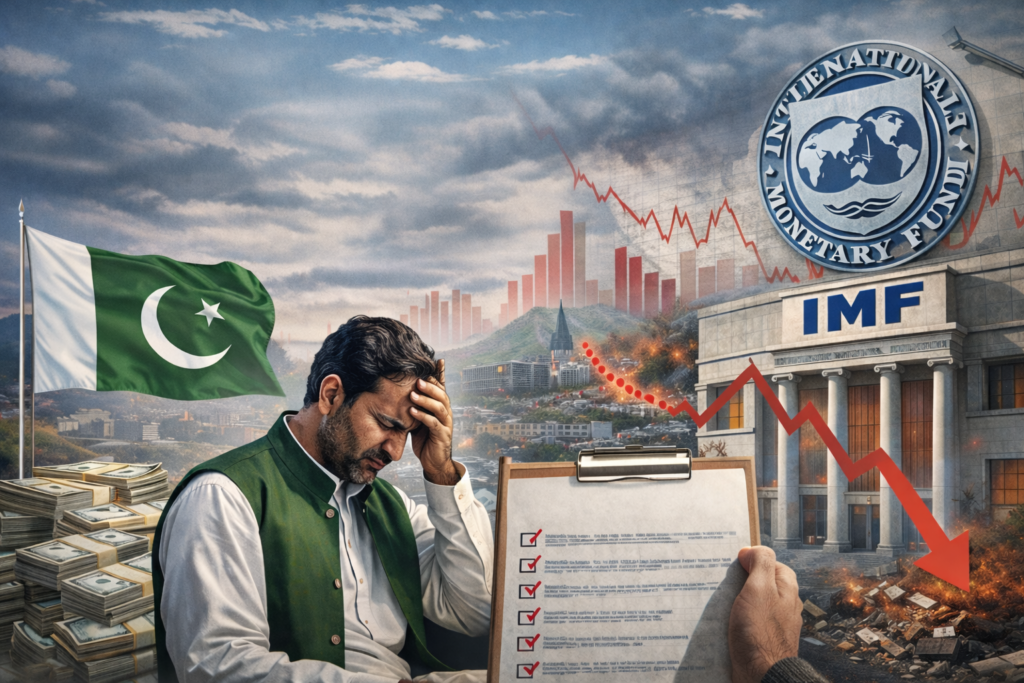
Pakistan is navigating one of its most complex economic recoveries in decades, with the International Monetary Fund (IMF) maintaining strict oversight of Islamabad’s $7 billion Extended Fund Facility (EFF). As of March 2026, the total number of conditions attached to the bailout has reached 64, following the addition of 11 new structural benchmarks during the second programme review. The situation underscores the fragile nature of Pakistan’s economic stabilisation and raises serious questions about long-term fiscal sustainability.
IMF Bailout: A Lifeline with Strings Attached
Pakistan secured its 25th IMF loan in September 2024, with the $7 billion EFF spread over 37 months. The programme aims to rebuild foreign exchange reserves, strengthen the tax base, and reform loss-making state-owned enterprises — particularly in the energy sector. In December 2025, the IMF approved $1.2 billion in disbursements, comprising $1 billion under the EFF and $200 million from a separate climate-focused Resilience and Sustainability Facility (RSF).
With the latest tranche, Pakistan has received approximately $3.3 billion under the bailout programme since late 2024. However, the funds come with an ever-growing list of requirements that critics say are placing enormous pressure on ordinary citizens through higher energy prices and reduced subsidies.
64 Conditions and Counting
The IMF imposed 11 new conditions as part of its second review, bringing the cumulative total to 64 structural benchmarks. These include finalising a detailed tax reform roadmap by December 2025 and fully implementing at least three priority reforms by March 2026. On governance, Islamabad was directed to publish asset declarations of senior federal civil servants and enhance transparency in public financial management.
IMF Deputy Managing Director Nigel Clarke praised Pakistan’s commitment to fiscal targets and flood response but pressed the government to keep monetary policy tight, allow free exchange rate movement, and accelerate overdue energy sector reforms. Pakistan’s energy circular debt — which exceeds $15 billion — remains one of the most critical structural challenges under the programme.
Economy Shows Cautious Signs of Recovery
Despite the steep conditionalities, Pakistan’s macroeconomic indicators have shown marginal improvement. Foreign exchange reserves have climbed to approximately $14.5 billion, inflation has begun easing from historic highs, and GDP growth is projected to recover modestly. Prime Minister Shehbaz Sharif welcomed the December disbursement as recognition of the government’s reform efforts, crediting Finance Minister Muhammad Aurangzeb and Army Chief Gen. Asim Munir for supporting the agenda.
However, IMF progress talks held in March 2026 continued to reflect tensions over energy pricing policies and fiscal discipline. Pakistan has historically struggled to meet IMF benchmarks consistently, having entered and exited multiple IMF programmes over the past three decades.
Outlook and Challenges Ahead
The road ahead remains difficult. With global economic uncertainty driven by geopolitical tensions — including the ongoing US-Israel-Iran conflict and trade disruptions — Pakistan faces external headwinds in addition to domestic structural issues. A senior Pakistani minister stated in January 2026 that the country aims to reduce its dependence on IMF financing within six months, a claim viewed with scepticism by independent economists.
As of March 15, 2026, Pakistan’s third programme review remains ongoing. The IMF is expected to scrutinise progress on tax broadening, energy sector reform, and exchange rate liberalisation before releasing the next tranche. The country’s economic future hinges on whether Islamabad can sustain structural reforms under mounting political and social pressure.