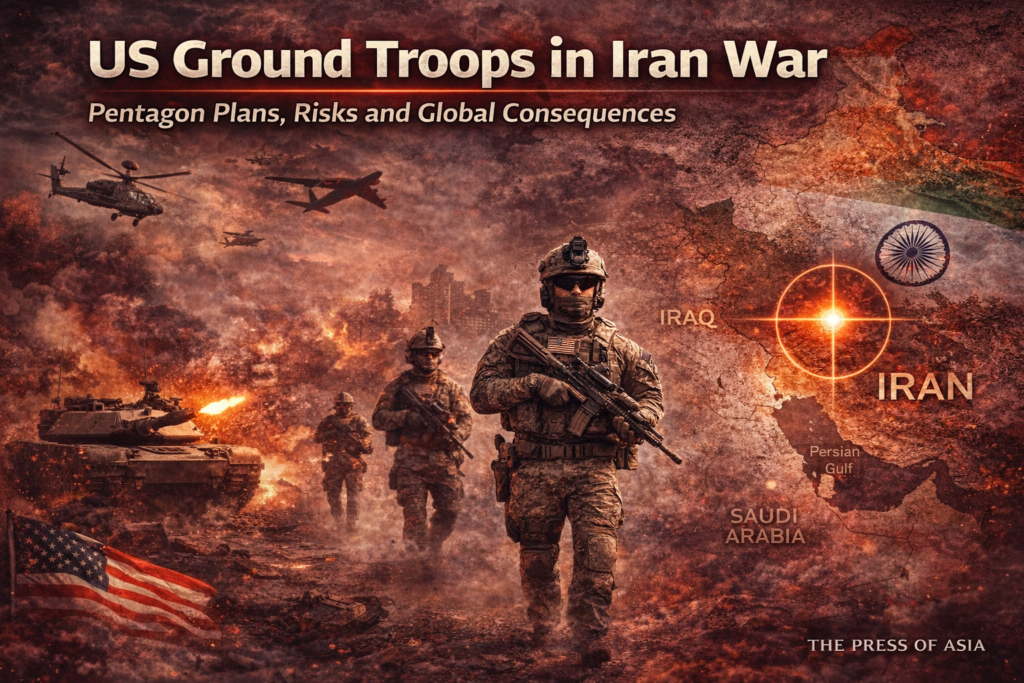
As the Iran-US military conflict enters its second week on March 7, 2026, the Pentagon is reportedly considering the deployment of ground troops to assist Israeli forces in neutralizing Iran’s nuclear facilities buried deep underground. Leaked documents from the US Department of Defense suggest that Secretary of Defense Pete Hegseth has presented three options to President Trump: continued air and naval strikes, a limited special forces ground operation targeting specific nuclear sites, or a full-scale ground invasion to topple the Iranian government. The prospect of US ground troops in Iran has alarmed allies and adversaries alike, threatening to draw the entire Middle East, and potentially nuclear powers China and Russia, into a wider conflagration.
Pentagon War Plans: What the Options Mean
The three military options presented to Trump represent escalating levels of US commitment to the Iran conflict. Option 1, which has been the strategy so far, involves B-2 stealth bombers and Tomahawk cruise missiles targeting Iran’s nuclear facilities, air defense systems, and military command centers. However, US intelligence assesses that Iran’s deepest nuclear enrichment facility at Fordow, buried 80 meters under granite mountains, has not been destroyed by air strikes alone. Option 2, the special forces operation, would involve approximately 5,000-8,000 US Army Rangers and Navy SEALs entering Iran to physically destroy the Fordow facility with tactical nuclear-capable penetrator weapons – a major step up that would constitute a ground invasion. Option 3, supported by neo-conservative hawks in the administration, calls for a full-scale operation to overthrow the Iranian government and install a pro-Western regime, requiring 150,000+ troops and likely taking years to execute.
Congressional Opposition and War Powers Debate
The possibility of ground troops in Iran has triggered fierce debate in the US Congress. Democratic leaders including Senate Minority Leader Chuck Schumer and House Minority Leader Hakeem Jeffries have introduced legislation invoking the War Powers Resolution to limit Trump’s ability to escalate without Congressional authorization. Notably, 23 Republican senators have also joined the opposition, citing the lessons of the Iraq and Afghanistan wars. A bipartisan group of 180 House members has signed a resolution stating that any ground deployment to Iran would require a formal Congressional declaration of war. Trump has dismissed these efforts, arguing that his existing Commander-in-Chief authorities and the 2001 Authorization for Use of Military Force (AUMF) give him sufficient legal basis for any military action he deems necessary.
Iran’s Nuclear Program: What Has Been Destroyed?
After 8 days of intense air strikes, US and Israeli military officials claim to have destroyed 60-70% of Iran’s nuclear production capacity. The uranium enrichment facilities at Natanz and Isfahan have been badly damaged. However, the key Fordow facility remains largely intact. US officials estimate that Iran had accumulated enough highly enriched uranium for 4-6 nuclear weapons before the strikes began. While the centrifuge cascades at surface-level facilities have been destroyed, Iran likely has backup centrifuges stored in multiple undisclosed locations, meaning that even with significant damage, Iran’s nuclear program could be reconstituted within 12-18 months if the conflict ended today. This is why US hardliners argue that without a ground operation to physically destroy Fordow and eliminate the Iranian scientific knowledge base, the air campaign will be ultimately insufficient.
Iran’s Military Response: Capabilities and Threats
Iran has demonstrated surprising military resilience in the face of US and Israeli air strikes. The Iranian Revolutionary Guard Corps (IRGC) has activated its network of proxies across the region, with Hezbollah in Lebanon launching 500+ rockets into northern Israel, Iraqi Shia militias attacking US bases in Iraq and Syria, and Houthi forces targeting Saudi Arabia, UAE, and commercial shipping. Iran has also deployed its Shahab-3 ballistic missiles against Israel, with 12 missiles landing in the Negev desert before being intercepted. Most alarmingly, Iran has threatened to activate sleeper cells in Western countries if the US escalates to ground troops. Iranian cyber forces have launched major attacks on US financial infrastructure, temporarily disrupting trading on the New York Stock Exchange for 4 hours on March 5, 2026.
Russia and China React: Global Nuclear Tensions Rise
The most dangerous dimension of the Iran crisis is the reaction of Russia and China. Russia’s President Vladimir Putin has issued a stark warning that any use of tactical nuclear weapons by the US or Israel in Iran would cross a red line requiring a Russian response. Russia has moved additional nuclear-capable Iskander missile systems to its western territories as a demonstration of resolve. China has recalled its ambassador to Washington and cancelled planned military-to-military talks. The Shanghai Cooperation Organisation (SCO), of which Iran is now a full member, has declared the US military campaign illegal under international law and called for immediate ceasefire. India, which is a member of both the Western-aligned Quad and the Russia-China dominated SCO, finds itself in an extremely delicate diplomatic position as it seeks to balance its strategic partnerships with the US and its traditional relationships with Russia and Iran.
India’s Strategic Dilemma and National Interest
India faces a uniquely complex strategic dilemma as the Iran crisis escalates. India has deep economic ties with Iran through the Chabahar Port project, which provides India with a strategic access route to Afghanistan and Central Asia bypassing Pakistan. India also imports oil from Iran and has longstanding cultural and civilizational ties with the Persian world. At the same time, India values its strategic partnership with the United States, which underpins India’s defence modernization, technology access, and position as an emerging global power. India has abstained from votes condemning the US-Israel military campaign at the UN Security Council while privately pressing Washington for diplomatic off-ramps. Indian Foreign Minister S. Jaishankar has been in constant touch with Iranian, American, and Russian counterparts seeking to facilitate negotiations, positioning India as a potential peace mediator in what would be a historic diplomatic achievement.
Conclusion
The prospect of US ground troops entering Iran represents a potential turning point in the 2026 Middle East conflict with catastrophic global consequences. Unlike air strikes, ground operations would almost certainly trigger wider regional war, drawing in Iranian proxies across the Middle East and risking direct confrontation with Russia and China. The world is watching Washington’s decision-making with extreme anxiety, knowing that the next move could either lead to a ceasefire and negotiated settlement or to an escalation that threatens global security and prosperity. The coming days will be decisive. Press of Asia will continue to provide comprehensive analysis of the US-Iran conflict and its implications for India and the world.