Rising US-Iran Tensions: Why Kharg Island Has Become a Strategic Flashpoint in the Gulf
By The Press of Asia | March 14, 2026
The geopolitical tensions in the Middle East continue to rise as relations between the United States, Israel, and Iran remain extremely fragile. While no full-scale war has been officially declared, the region has witnessed increasing military activity, drone interceptions, naval deployments, and cyber confrontations over the past few weeks.
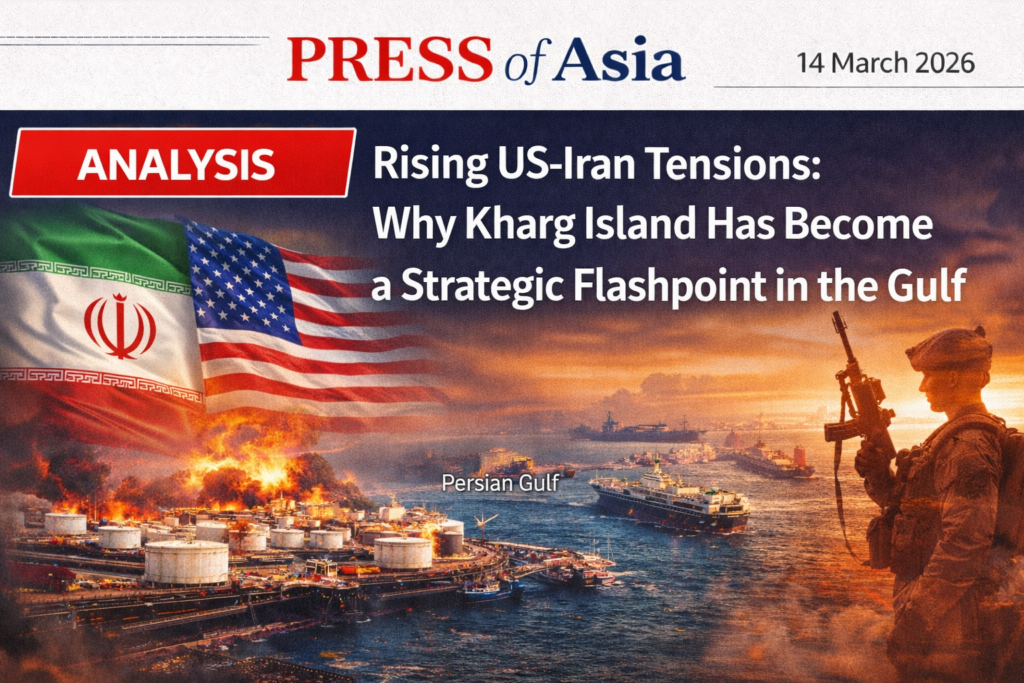
One location that has emerged as a major strategic focal point in the ongoing tensions is Kharg Island, Iran’s most important oil export hub in the Persian Gulf. Analysts warn that any conflict involving this island could have far-reaching consequences for global oil markets and regional stability.
Why Kharg Island Is Strategically Important
Kharg Island lies approximately 25 kilometers off Iran’s southwestern coast in the Persian Gulf and serves as the country’s primary oil export terminal. According to energy analysts, nearly 90 percent of Iran’s crude oil exports pass through facilities located on the island.
The island hosts massive oil storage tanks, loading terminals, and port facilities capable of handling several million barrels of oil exports per day. Because of this critical infrastructure, Kharg Island is often described as the “economic lifeline” of Iran’s energy sector.
Any military action targeting Kharg Island would therefore have immediate global implications, potentially disrupting oil supply chains and causing sharp spikes in international energy prices.
Rising Military Activity in the Persian Gulf
Over the past several weeks, military movements in the Persian Gulf have intensified. The United States has increased its naval presence in the region, including aircraft carriers, destroyers, and amphibious assault ships designed to secure international shipping routes.
At the same time, Iran’s Islamic Revolutionary Guard Corps (IRGC) has conducted several military exercises near the Strait of Hormuz, demonstrating missile and drone capabilities.
The Strait of Hormuz remains one of the most strategically important maritime chokepoints in the world. Nearly 20 percent of global oil shipments pass through this narrow waterway every day.
Any escalation involving Iran and Western powers could therefore disrupt one of the most critical energy corridors in the global economy.
Regional Tensions Affecting Gulf Countries
The rising tensions are also causing concern among Gulf nations including Saudi Arabia, the United Arab Emirates, Qatar, and Kuwait.
Several countries in the region host US military bases and logistical support facilities. As a result, they could potentially become involved in any large-scale regional escalation.
Air defense systems across the Gulf have reportedly been placed on heightened alert, and international airlines have increasingly adjusted flight routes to avoid sensitive airspace in parts of the Middle East.
Energy companies and shipping firms are also closely monitoring developments in the region due to the risk of disruptions in maritime trade.
Global Oil Markets React to Middle East Uncertainty
Energy markets are extremely sensitive to geopolitical developments in the Middle East. Even the possibility of military confrontation in the Persian Gulf can trigger immediate reactions in global oil prices.
Market analysts note that the vulnerability of critical infrastructure such as Kharg Island, offshore oil fields, and tanker routes remains a major concern.
Any damage to export terminals or disruption to shipping lanes could rapidly reduce oil supply to global markets, pushing prices significantly higher and affecting economies around the world.
Countries heavily dependent on energy imports, including India, Japan, and several European nations, are particularly exposed to such supply shocks.
Impact on India and Asian Economies
India imports a large portion of its crude oil and LPG requirements from the Middle East. As one of the world’s fastest-growing energy consumers, India closely monitors developments in the Persian Gulf.
Indian energy planners and policymakers are therefore watching the situation carefully, especially developments related to shipping routes through the Strait of Hormuz.
Any prolonged disruption could increase fuel prices, affect inflation, and place pressure on national energy security.
To reduce risks, India has been working on diversifying energy imports and building strategic petroleum reserves to cushion temporary supply shocks.
Diplomatic Efforts to Prevent Escalation
Despite rising tensions, several countries and international organizations are urging restraint and diplomatic dialogue.
Global powers including Russia, China, and members of the European Union have repeatedly called for de-escalation and negotiation to avoid a wider conflict.
The United Nations has also emphasized the need to protect civilian infrastructure and maintain stability in international shipping routes.
Diplomatic channels remain active as world leaders attempt to prevent the situation from spiraling into a broader regional confrontation.
Conclusion
While tensions between Iran, the United States, and Israel remain high, analysts believe that the coming weeks will be crucial in determining whether the situation stabilizes or escalates further.
Kharg Island’s strategic importance makes it a key symbol of Iran’s energy strength and a potential focal point in any future confrontation. At the same time, the global economy’s dependence on Middle Eastern oil means that any disruption in the Persian Gulf could have far-reaching consequences.
For now, governments and markets around the world continue to watch the region closely, hoping that diplomacy will prevail over military escalation.