
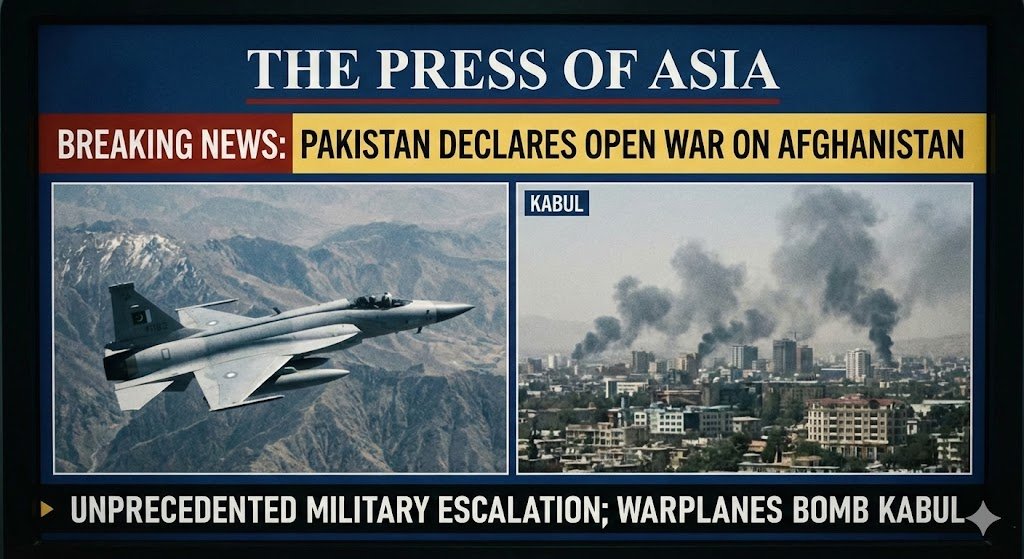
In a dramatic and unprecedented escalation of hostilities, Pakistan has declared open war on Afghanistan, with Pakistani warplanes carrying out airstrikes on Kabul on February 27, 2026. The bombings, which targeted multiple locations across the Afghan capital, have sent shockwaves through the international community and raised fears of a full-scale regional conflict in South Asia.
Background: Rising Tensions Between Pakistan and Afghanistan
The roots of this conflict lie in years of mounting tensions between Islamabad and Kabul. Pakistan has long accused the Afghan Taliban government of providing safe haven to the Tehrik-e-Taliban Pakistan (TTP), a militant group responsible for numerous terrorist attacks on Pakistani soil. The TTP has carried out hundreds of attacks in Pakistan’s northwestern regions, particularly in Khyber Pakhtunkhwa and Balochistan, killing thousands of Pakistani soldiers and civilians since 2021.
Afghanistan, under Taliban rule since August 2021, has consistently denied sheltering TTP militants. However, Pakistani military officials have maintained that the Afghan territory is being used as a launchpad for attacks against Pakistan. The situation had been deteriorating for months, with cross-border skirmishes becoming increasingly frequent along the Durand Line.
The Kabul Bombings: What Happened
Early on the morning of February 27, 2026, Pakistani Air Force jets carried out multiple airstrikes targeting what Islamabad described as terrorist hideouts in Kabul and surrounding provinces. The strikes hit several neighborhoods in the Afghan capital, with eyewitnesses reporting massive explosions and anti-aircraft fire lighting up the night sky. Al Jazeera correspondents on the ground confirmed multiple explosions and significant damage to civilian and infrastructure areas.
Afghan officials immediately condemned the attacks as a blatant violation of sovereignty. The Taliban government, which controls Afghanistan, declared a state of emergency and called on all Afghan citizens to resist the Pakistani aggression. Afghan military forces were placed on high alert, and cross-border firing was reported at multiple points along the shared border.
Pakistan’s Justification
In a statement issued by Pakistan’s Inter-Services Public Relations (ISPR), the Pakistani military justified the strikes as a necessary defensive measure against cross-border terrorism. Pakistan’s government stated that it had credible intelligence indicating that TTP commanders and operatives had been using locations in Kabul as command-and-control centers for planning attacks inside Pakistan.
Prime Minister of Pakistan addressed the nation, stating that Pakistan had exhausted all diplomatic options and was left with no choice but to take decisive action to protect its citizens. He emphasized that Pakistan’s strikes were targeted and precise, aimed exclusively at terrorist infrastructure and not at Afghan civilians or government institutions.
Afghanistan Strikes Back
Hours after the initial Pakistani airstrikes on Kabul, Afghanistan launched retaliatory attacks on Pakistani territory. Afghan forces targeted several Pakistani border posts and military installations in the tribal regions. Both countries have declared full military operations, with each accusing the other of initiating hostilities.
The situation has rapidly evolved into what analysts are describing as the most serious military confrontation between the two neighboring countries in recent history. With both nations possessing significant military capabilities, the risk of a prolonged and devastating conflict is very real.
International Reaction
The international community has reacted with alarm to the Pakistan-Afghanistan military confrontation. The United Nations Secretary-General called for an immediate ceasefire and urged both parties to return to dialogue. The United States, China, and other major powers have issued statements expressing deep concern and calling for restraint.
India, which shares borders with both countries and has its own complex relationships with them, is closely monitoring the situation. New Delhi has called for de-escalation and peaceful resolution of the dispute. The Shanghai Cooperation Organisation (SCO), of which both India and Pakistan are members, is expected to convene an emergency session to address the crisis.
Humanitarian Concerns
The Kabul bombings have triggered a fresh humanitarian crisis in Afghanistan, a country already devastated by decades of conflict and economic hardship. Aid agencies operating in Afghanistan have reported widespread panic among the civilian population, with thousands of families fleeing their homes in Kabul and surrounding areas.
The United Nations High Commissioner for Refugees (UNHCR) has warned that a prolonged conflict could lead to massive displacement, both within Afghanistan and across international borders. Pakistan, which already hosts millions of Afghan refugees, could face an additional wave of displaced persons seeking safety from the fighting.
Geopolitical Implications for Asia
The Pakistan-Afghanistan conflict has far-reaching implications for regional and global geopolitics. China, which has significant economic interests in Pakistan through the China-Pakistan Economic Corridor (CPEC) and has been cultivating ties with the Afghan Taliban, is particularly alarmed. Beijing has urged both sides to exercise restraint and protect Chinese nationals and investments in the region.
The United States, which withdrew its forces from Afghanistan in 2021, faces a complex diplomatic situation. Washington must balance its strategic concerns about regional stability with its complicated relationship with both Islamabad and the Taliban government in Kabul.
Russia and Iran, both of which have established relations with the Taliban government, have also expressed concern about the escalation. The conflict threatens to destabilize an already volatile region and could have cascading effects across Central and South Asia.
What Lies Ahead
As of February 27, 2026, the situation remains fluid and deeply concerning. Diplomatic efforts are underway at multiple levels to prevent further escalation, but the mistrust between Islamabad and Kabul runs deep. Both sides have dug in, and there is no clear path to an immediate de-escalation.
International mediators face a formidable challenge. The Afghan Taliban government, which is not internationally recognized by most countries, is difficult to engage through traditional diplomatic channels. Pakistan, facing domestic political pressures and the ongoing threat of TTP terrorism, may find it politically difficult to back down.
For the people of both countries, particularly civilians caught in the crossfire, the immediate priority is safety and survival. The coming days will be critical in determining whether this confrontation spirals into a full-scale war or whether cooler heads can prevail to bring both sides back from the brink.
Conclusion
The Pakistan-Afghanistan military confrontation represents a catastrophic failure of diplomacy and a dangerous escalation that threatens the stability of South and Central Asia. The international community must urgently and collectively act to prevent further bloodshed. The stakes could not be higher, as a prolonged conflict between these two nations would have devastating consequences not only for their own populations but for the entire region and beyond. The Press of Asia will continue to monitor and report on this rapidly evolving situation.