
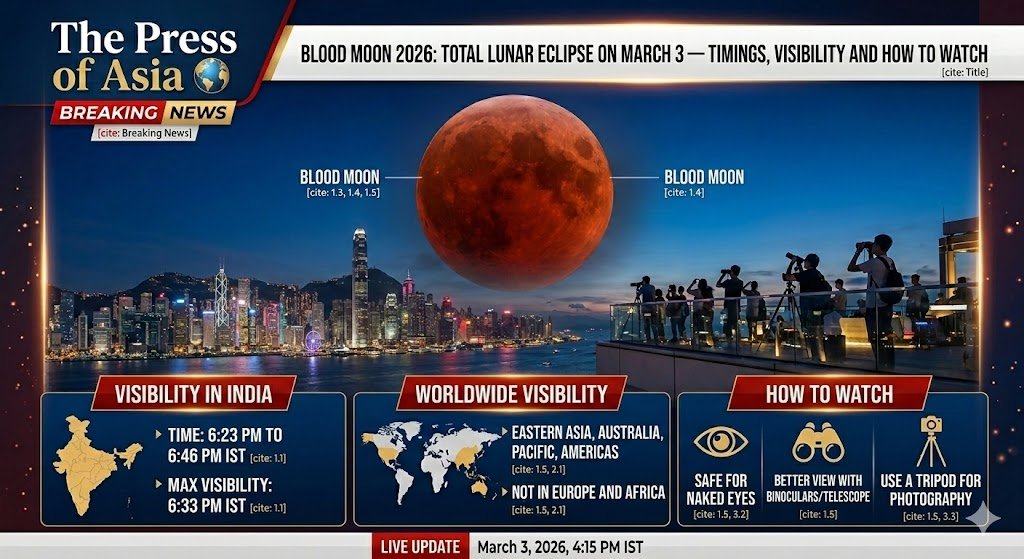
The first total lunar eclipse of 2026 — known as the Blood Moon — graced the skies on March 3, 2026, offering a spectacular celestial event visible across Asia, Australia, and North America.
A lunar eclipse occurs when Earth passes directly between the Sun and the Moon, causing Earth’s shadow to fall on the Moon. During the total phase, the Moon turns a deep red or blood-orange color, earning it the dramatic title of “Blood Moon.”
This March 2026 Blood Moon is particularly significant as it is the last total lunar eclipse until December 31, 2028 — making it a rare and must-watch astronomical event.
Timings of the March 3, 2026 Lunar Eclipse:
- Penumbral Eclipse begins: 8:44 AM UTC (2:14 PM IST)
- Partial Eclipse begins: 9:50 AM UTC (3:20 PM IST)
- Total Eclipse (Blood Moon) begins: 11:04 AM UTC (4:34 PM IST)
- Maximum Eclipse: 11:33 AM UTC (5:03 PM IST)
- Total Eclipse ends: 12:02 PM UTC (5:32 PM IST)
- Partial Eclipse ends: 1:17 PM UTC (6:47 PM IST)
- Penumbral Eclipse ends: 2:23 PM UTC (7:53 PM IST)
Visibility in India:
While the full totality phase may not be fully visible from all parts of India due to daylight hours, several cities including Mumbai, Delhi, Kolkata, Chennai, and Bengaluru may witness the penumbral and partial phases during moonrise.
The eclipse will be most prominently visible from North America, South America, Australia, New Zealand, and eastern parts of Asia.
Duration and Facts:
The total duration of the eclipse is approximately 5 hours and 39 minutes. The duration of totality is 58 minutes. The Moon’s diameter will be 100% covered by Earth’s umbra at peak totality.
This Blood Moon coincides with Holi 2026 — India’s festival of colors — making it doubly significant for Indian sky-watchers and astrology enthusiasts. Some religious communities observe Sutak Kaal during the eclipse, a period during which auspicious activities are traditionally avoided.
Astronomers and space enthusiasts can watch the event live through NASA’s website, Space.com, and various astronomy YouTube channels. In India, telescope clubs in major cities are organizing live watch parties for this rare event.
Don’t miss this spectacular Blood Moon — the last of its kind for nearly three years!