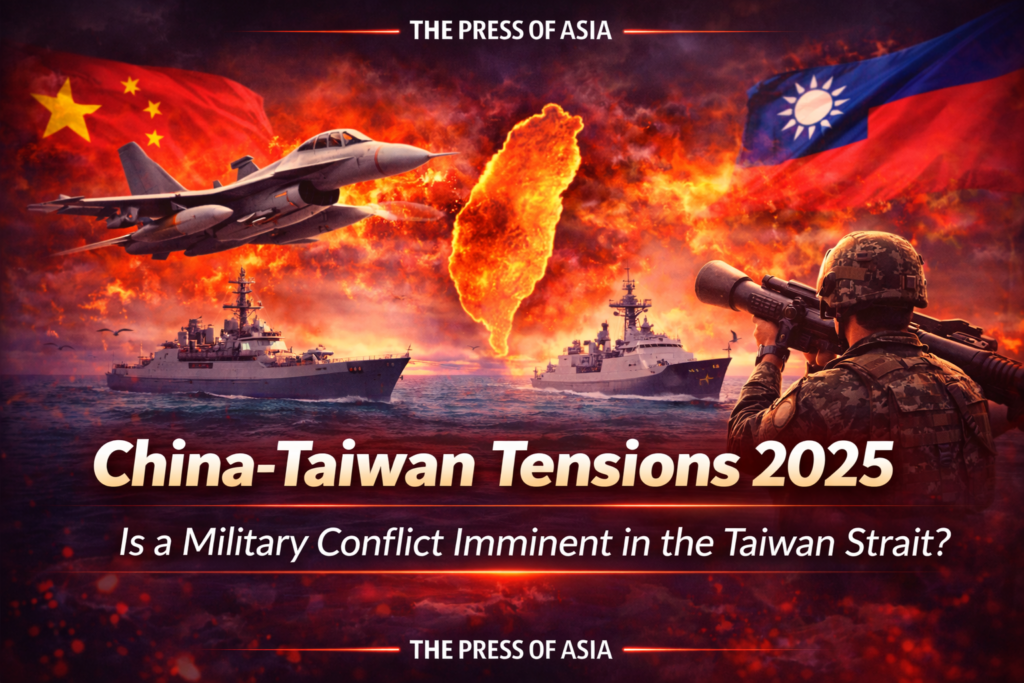
The Taiwan Strait remains one of the world’s most dangerous flashpoints in 2025, with China intensifying military pressure on Taiwan while the United States and its allies strengthen their defensive commitments to the island. The question on everyone’s mind: is a military conflict truly imminent?
Chinese military aircraft and naval vessels have dramatically increased their operations near Taiwan this year. The People’s Liberation Army (PLA) has conducted multiple large-scale military exercises around Taiwan, simulating a blockade scenario and amphibious invasion drills. These exercises have become more sophisticated and closer to Taiwan’s territorial limits.
Taiwan’s government under President Lai Ching-te has responded by strengthening its own defense capabilities and deepening security cooperation with the United States. Washington has approved significant arms sales to Taiwan in 2025, including advanced missile systems, drones, and submarines.
The United States maintains its policy of strategic ambiguity — neither officially confirming nor denying whether it would militarily defend Taiwan — but President Biden’s and now his successor’s statements have suggested a stronger commitment to Taiwan’s defense than in previous administrations.
Analysts are divided on the immediacy of the threat. Some experts believe China lacks the full military capability to successfully invade Taiwan in 2025, as an amphibious operation of that scale would be enormously complex. Others warn that Xi Jinping has made Taiwan unification a personal legacy goal and may be willing to take greater risks.
The economic stakes are staggeringly high. Taiwan produces over 60% of the world’s semiconductors and more than 90% of the most advanced chips. Any conflict would trigger a global economic catastrophe, devastating industries from smartphones to cars to defense systems.
Japan and South Korea are watching with extreme concern, knowing that a Taiwan conflict would directly impact their security and economic stability. Both countries have begun accelerating their own military modernization programs in response.
For now, diplomatic channels remain open, but the gap between Beijing and Taipei appears wider than ever. Whether 2025 marks the beginning of a truly dangerous new chapter in cross-strait relations remains the most consequential geopolitical question in Asia today.