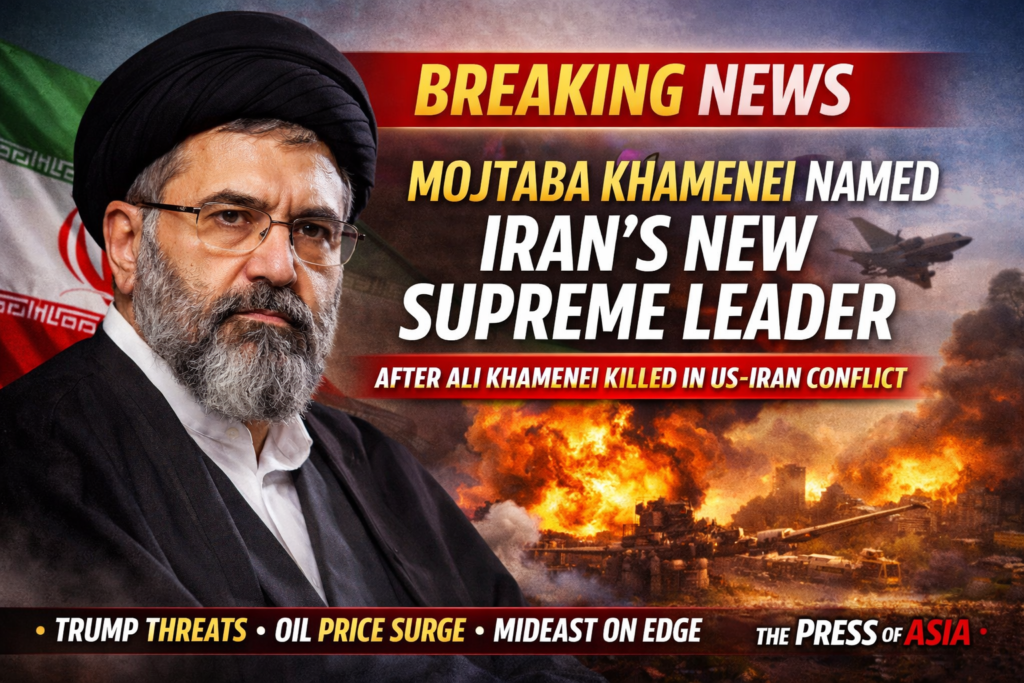
In a dramatic development that signals a major turning point in the ongoing US-Iran conflict, Iran has officially named Mojtaba Khamenei as its new Supreme Leader. The appointment came on the tenth day of Operation Epic Fury — the joint US-Israeli military campaign that has fundamentally reshaped the geopolitical landscape of the Middle East. With seven American soldiers killed, oil prices surging, and Trump threatening Iran’s new leader, the world watches anxiously as this unprecedented war enters a new and potentially more dangerous phase.
Who Is Mojtaba Khamenei? The Son Who Inherits a Nation at War
Mojtaba Khamenei, 54, is the second son of the late Ayatollah Ali Khamenei, who was killed during the first wave of US and Israeli airstrikes earlier this month. Unlike his father, who held official clerical and political positions for decades, Mojtaba has largely operated from the shadows. He is a mid-ranking cleric educated at a religious seminary in Qom and is widely believed to have cultivated deep ties with the Islamic Revolutionary Guard Corps (IRGC), making him a powerful behind-the-scenes figure in Iranian politics.
The selection was made by Iran’s Assembly of Experts — the clerical body constitutionally tasked with appointing the supreme leader — in a session convened shortly after midnight on Monday. The assembly announced that Mojtaba was chosen through a “decisive vote” and called on all Iranian citizens, particularly elites from seminaries and universities, to pledge their loyalty and preserve national unity during what it described as a “crucial period” for the Islamic Republic.
Despite having no official government position, Mojtaba is reported to control a vast financial empire. Multiple international reports have linked him to foundations and business networks worth billions of dollars, providing him with both economic leverage and political influence even before his formal elevation to the top of the Iranian state.
Operation Epic Fury: Ten Days That Shook the Middle East
Operation Epic Fury was launched on February 28, 2026, when the United States and Israel initiated a massive coordinated military assault on Iran. In the first 48 hours alone, US and Israeli aircraft struck over 1,000 Iranian sites, including fortified underground missile installations. B-2 stealth bombers dropped 2,000-pound bunker-busting bombs on hardened nuclear and military facilities, while US naval vessels began systematically destroying Iran’s naval fleet in the Persian Gulf.
By the end of the first week, the US military claimed to have destroyed 17 Iranian naval vessels, over 1,900 military targets, hundreds of ballistic missiles and launchers, and a significant portion of Iran’s air defense network. Most critically, Ayatollah Ali Khamenei, Iran’s Supreme Leader for over three decades, was killed during the opening strikes on his compound in Tehran — a development that sent shockwaves through the Islamic Republic and the wider Muslim world.
The human cost on the American side has also been significant. The Pentagon has confirmed the deaths of seven US service members, with the toll climbing steadily through the week. President Trump, speaking via Truth Social, acknowledged the losses but vowed to press forward, saying the US would avenge their deaths and continue until its objectives were met.
Trump Warns Mojtaba Khamenei: ‘He Will Not Last Long’
President Trump wasted no time in responding to Iran’s appointment of Mojtaba Khamenei as Supreme Leader. In a post on Truth Social, Trump called Mojtaba an “unacceptable” choice and warned that the new leader would “not last long” without US approval. Trump stated that the United States should and would have a say in Iran’s future political trajectory, effectively signaling that regime change remains a key objective of the military campaign.
Secretary of State Marco Rubio echoed this hardline stance, telling reporters on Capitol Hill that combined US and Israeli air operations would continue to dismantle the Iranian regime’s capabilities to threaten its neighbors. Rubio also said the US was coordinating evacuation of over 1,600 additional American citizens from the broader Middle East region, as the conflict continues to destabilize the area.
Despite Trump’s threats, the IRGC and other key state institutions in Iran moved swiftly to signal their support for the new supreme leader. Iran’s security chief stated that Mojtaba possesses the necessary capabilities to lead the country through this sensitive period, and the Revolutionary Guards indicated their readiness to back him — a crucial endorsement that mirrors the kind of institutional support his father enjoyed.
The Regional Fallout: Gulf States Under Fire
The conflict has not remained confined to Iran’s borders. Iranian strikes have extended across the Gulf region, with projectiles and drones targeting locations in Saudi Arabia, Kuwait, and the UAE. In Saudi Arabia, a suspected Iranian projectile struck a residential building in a populated area, killing two people. In Kuwait City, a fire broke out at a prominent tower following an Iranian drone strike, though it was extinguished without reported fatalities.
Abu Dhabi in the UAE has also been targeted, with Iranian-launched projectiles being intercepted by air defense systems on multiple occasions. The US Embassy in Beirut has shut down operations citing “ongoing regional tensions,” following earlier closures at embassies in Saudi Arabia and Kuwait. Thousands of commercial flights have been canceled across the region as airlines suspend routes through Middle Eastern airspace.
The United States has responded by offering to provide insurance coverage for Gulf shipping and to escort civilian tankers through the Strait of Hormuz, one of the world’s most critical oil chokepoints. Trump downplayed concerns about rising oil prices, insisting they would stabilize once the conflict concludes, though global energy markets have reacted sharply to the uncertainty.
Global Reaction: World Leaders Respond to Iran’s New Leadership
The appointment of Mojtaba Khamenei has drawn immediate and divided international reactions. Critics, particularly from Western governments, have questioned the legitimacy of the appointment and the dynastic nature of the succession. The selection of a son to succeed his father is seen as unprecedented in the Islamic Republic’s 47-year history, with many foreign policy analysts describing it as a sign of desperation by the Iranian state at a moment of maximum vulnerability.
On International Women’s Day, marches across multiple cities placed focus on the US-Israeli war on Iran and the broader humanitarian crisis unfolding. Protesters called for an immediate ceasefire and condemned what they described as the targeting of civilian infrastructure. Global oil prices have surged significantly since the beginning of Operation Epic Fury, fueling inflation fears in economies already under pressure.
Russia and China have both condemned the US-Israeli military campaign, calling it a violation of international law and demanding an immediate halt to hostilities. However, neither country has taken any direct military action in support of Iran. The United Nations Security Council has been deadlocked, with the US and Israel blocking any resolutions calling for a ceasefire.
What Comes Next: Endgame Unclear as War Enters New Phase
With the appointment of Mojtaba Khamenei, the US-Iran war has entered a new and unpredictable phase. The Islamic Republic has shown remarkable institutional resilience, quickly naming a new supreme leader and rallying key state organs behind him. The IRGC, which controls Iran’s most powerful military capabilities including its ballistic missile arsenal, has pledged full support to the new leadership.
Analysts are divided on what the US endgame looks like. Some speculate that Washington is pursuing outright regime change, while others believe the goal is a more limited disarmament of Iran’s nuclear and missile programs. Trump himself has given conflicting signals, at times speaking of Iran’s complete transformation and at other times suggesting a negotiated solution remains possible.
For now, Operation Epic Fury continues. US Central Command has confirmed strikes are ongoing, and Secretary Rubio has warned of further escalation in the coming hours and days. With seven Americans dead, oil prices at multi-year highs, and a new Iranian supreme leader promising resistance, the world is bracing for what may be the most consequential confrontation in the Middle East since the 2003 Iraq War. The fate of Mojtaba Khamenei — and of the Islamic Republic itself — may depend on what happens in the days ahead.