
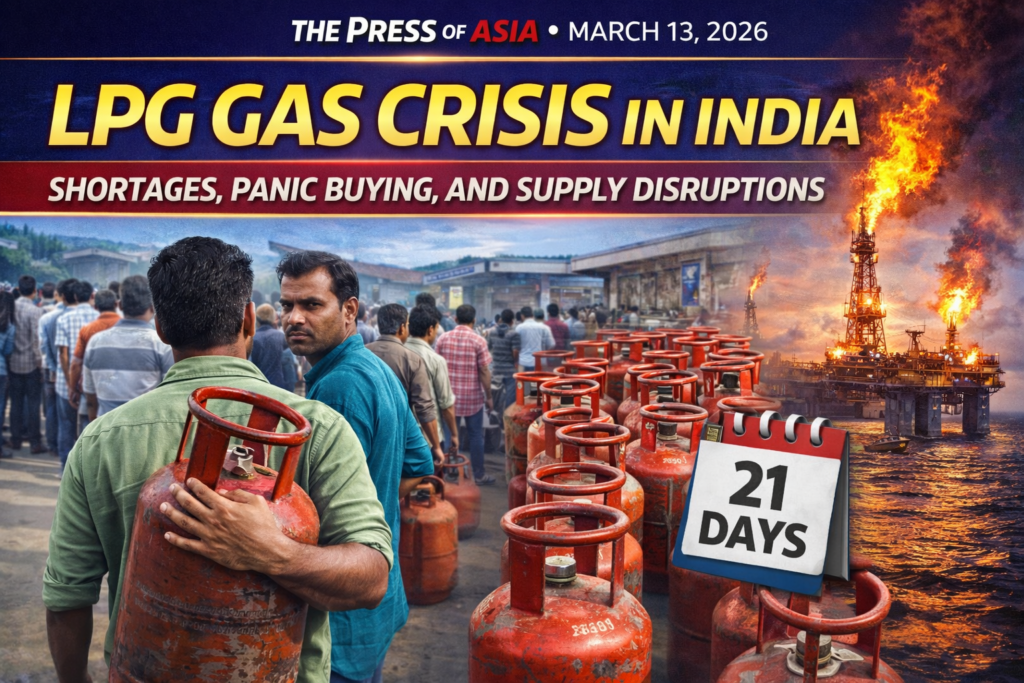
LPG Gas Crisis in India: Middle East War, Panic Buying and Supply Disruptions Create Nationwide Concern
By The Press of Asia | March 13, 2026
India is currently witnessing growing concern over the availability of LPG (Liquefied Petroleum Gas) cylinders in several cities and states. Long queues outside LPG distributors, delays in cylinder deliveries, and disruptions in commercial gas supply have triggered panic among households and businesses alike. While the government insists that there is no nationwide shortage, the current situation highlights how global geopolitical tensions can directly affect everyday life in India.
The ongoing crisis in West Asia, combined with India’s heavy dependence on imported LPG, has exposed vulnerabilities in the country’s energy supply chain. With millions of households relying on LPG as their primary cooking fuel, even minor disruptions in global supply routes can create significant domestic challenges.
Why LPG Supply Is Under Pressure in India
The primary reason behind the current LPG concern is the disruption of energy supply chains due to geopolitical tensions in West Asia. India imports a significant portion of its LPG from the Middle East, making the country vulnerable to disruptions in maritime trade routes.
According to government and industry data, India consumes more than 33 million tonnes of LPG annually, making it the world’s second-largest importer of the fuel. Nearly two-thirds of this demand is met through imports, and about 85–90 percent of those imports come from the Middle East region.
The current geopolitical conflict has affected shipping routes in the Persian Gulf and the Strait of Hormuz, one of the world’s most critical oil and gas transport corridors. Any slowdown or blockage in this region has an immediate ripple effect on global LPG supplies and prices.
Energy analysts warn that if shipping delays continue for an extended period, India could face further pressure on its LPG stocks, which typically maintain only limited buffer capacity.
Panic Buying and Booking Surge
Another major factor aggravating the situation is panic buying by consumers. As news of supply disruptions spread across social media and news channels, many households rushed to book LPG cylinders earlier than usual.
Oil marketing companies have reported a sharp spike in refill bookings. Daily LPG booking requests have surged dramatically, rising from roughly 5.5 million bookings to nearly 7.6 million per day.
To manage the surge in demand and prevent stock depletion, oil companies have introduced restrictions on booking refills before a certain period. In many cities, consumers cannot book another cylinder until 21 days after their previous refill, a measure designed to stabilize the supply chain.
Government officials have repeatedly urged citizens not to panic and to avoid unnecessary bookings, stating that the current shortages are largely due to demand spikes rather than a complete supply collapse.
Impact on Businesses, Hotels and Small Vendors
While domestic LPG supply is being prioritized, the commercial sector is facing serious disruptions. Restaurants, hotels, bakeries, and small food businesses depend heavily on commercial LPG cylinders.
In several cities, restaurant associations have warned that many establishments may be forced to shut down temporarily if the gas supply does not normalize soon. For example, hotel owners in Bengaluru and other major cities have reported sudden interruptions in LPG cylinder deliveries, threatening daily operations.
Similarly, roadside dhabas and small eateries across northern India have struggled to obtain refills. Many have been forced to reduce cooking hours, limit menu options, or switch to alternative fuels such as kerosene and diesel.
Industrial sectors are also feeling the impact. Some manufacturing companies have reported reduced production due to shortages of industrial gases derived from LPG and natural gas.
Experts warn that if the situation persists, it could lead to disruptions in food supply chains, manufacturing output, and small-business livelihoods.
Government Response and Emergency Measures
To prevent a nationwide cooking gas shortage, the Indian government has taken several emergency measures.
The Ministry of Petroleum and Natural Gas has directed oil refineries to maximize LPG production and divert propane and butane supplies toward domestic cooking gas production.
The government has also invoked special powers under the LPG Control Order to ensure that all refinery output related to LPG components is prioritized for household supply. These measures have already resulted in an increase of nearly 28 percent in LPG production within a few days.
In addition, ports across the country have been instructed to prioritize LPG carriers to speed up unloading and distribution.
Authorities are also taking action against black marketing and hoarding of LPG cylinders, which often occur during supply scares.
India’s Structural Dependence on Imported LPG
The current situation highlights a deeper structural challenge in India’s energy sector — dependence on imported LPG.
Over the past decade, the government has expanded LPG access dramatically through schemes such as Pradhan Mantri Ujjwala Yojana, which provided subsidized LPG connections to millions of low-income households.
As a result, the number of LPG consumers in India has crossed 330 million households, making it one of the most widely used cooking fuels in the country.
However, domestic LPG production has not grown at the same pace as demand. Experts say India’s domestic refineries produce less than half of the LPG required for national consumption, forcing the country to rely heavily on imports.
This dependency makes India vulnerable to global energy shocks, particularly those originating in politically unstable regions.
Could Piped Gas Be the Future?
The government is encouraging urban households to shift to piped natural gas (PNG) wherever possible. PNG offers a stable supply through pipeline networks and reduces dependence on cylinder distribution.
Currently, only about 1.3 crore households in India use piped gas, compared to more than 33 crore LPG connections nationwide.
Expanding city gas distribution networks could help reduce pressure on LPG supplies in the long term.
What This Means for India’s Energy Security
Energy experts believe the current LPG situation offers an important lesson for India’s long-term energy strategy.
India must diversify its energy import sources, increase domestic production, and invest in alternative fuels such as:
- biogas
- compressed natural gas (CNG)
- piped natural gas
- electric cooking solutions
Building larger strategic reserves of LPG could also help cushion future supply disruptions.
In addition, strengthening domestic refining capacity and securing supply agreements with multiple countries could reduce dependence on any single region.
Conclusion
The LPG supply concerns unfolding across India demonstrate how closely everyday life is tied to global energy geopolitics. While the government has taken rapid steps to boost domestic production and stabilize supplies, the situation remains a reminder of India’s dependence on imported energy resources.
For millions of Indian households, LPG cylinders are not just a commodity but an essential part of daily life. Ensuring a stable and affordable supply will require not only short-term crisis management but also long-term structural reforms in India’s energy policy.
As global tensions continue to affect fuel markets, India’s ability to secure reliable energy supplies will play a critical role in protecting both economic stability and household welfare.