Iran Allows Indian Oil and Gas Tankers Through Strait of Hormuz: Major Relief for India’s Energy Security
By The Press of Asia | March 14, 2026
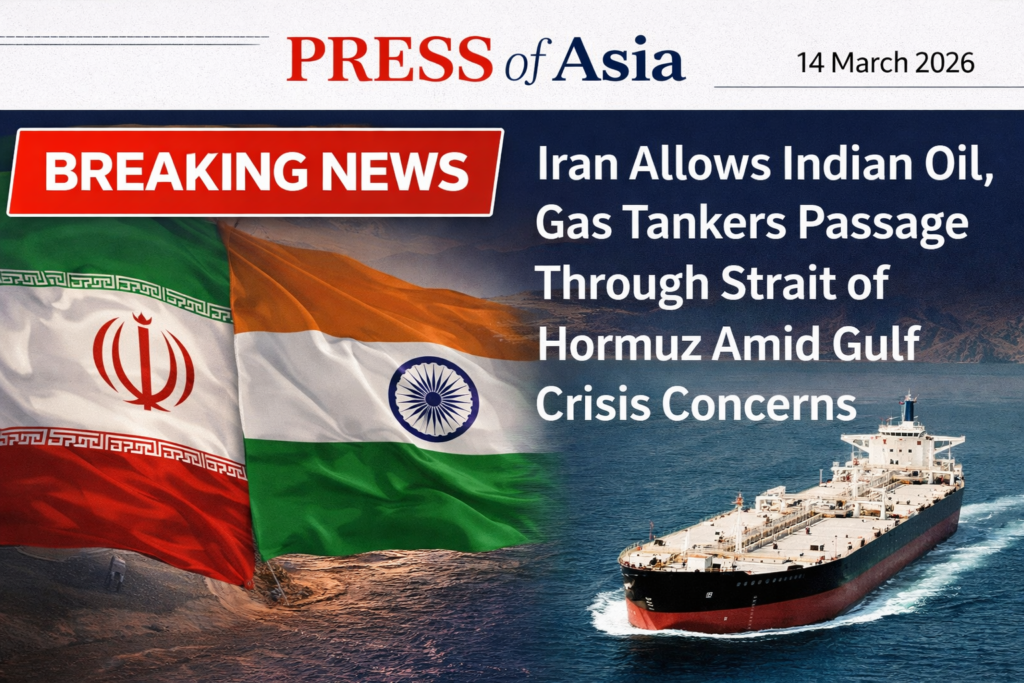
In a significant diplomatic and economic development amid rising tensions in West Asia, Iran has allowed Indian-flagged oil and liquefied petroleum gas (LPG) tankers to pass through the strategically critical Strait of Hormuz. The move has brought relief to India, which depends heavily on energy imports from the Middle East.
The decision comes at a time when the ongoing regional conflict has disrupted maritime shipping routes across the Persian Gulf, raising fears of an energy crisis and pushing global oil prices higher.
What Happened: Iran Clears Passage for Indian Tankers
According to multiple international reports, Iran permitted at least two Indian-flagged LPG tankers to sail through the Strait of Hormuz, despite heightened security and partial restrictions on maritime traffic in the region.
One of the vessels reportedly crossed the strait safely, while another tanker was expected to follow shortly.
Iran’s move is being viewed as a rare exception during the current Gulf crisis, where several ships from other countries have faced delays or security risks while navigating the critical waterway.
Why the Strait of Hormuz Matters
The Strait of Hormuz is one of the world’s most important energy corridors. The narrow maritime passage connects the Persian Gulf to the Gulf of Oman and the Arabian Sea.
Energy analysts estimate that:
- Around 20% of global oil and LNG shipments pass through the strait.
- Nearly 40% of India’s crude oil imports rely on this route.
Any disruption in this chokepoint can have immediate consequences for global energy markets and fuel prices.
Because of the ongoing conflict in the region, several shipping companies had slowed or temporarily halted traffic through the strait, triggering fears of supply shortages.
Diplomatic Talks Between India and Iran
The decision to allow Indian tankers to pass through the strait followed diplomatic communication between the two countries.
India’s External Affairs Minister S. Jaishankar reportedly held discussions with Iranian Foreign Minister Abbas Araghchi to ensure the safety of Indian vessels and energy shipments.
Iranian officials also described India as a “friend” and indicated that they would try to ensure safe passage for Indian-flagged ships through the strait.
The diplomatic engagement highlights India’s careful balancing strategy in the Middle East, maintaining relations with multiple regional powers.
Impact on India’s Energy Supply
India is one of the world’s largest energy importers.
Key facts about India’s energy dependence include:
- India consumes over 33 million tonnes of LPG annually.
- Nearly two-thirds of its LPG demand is met through imports.
- About 85–90% of these imports come from the Middle East region.
Because of this dependence, any disruption in Gulf shipping lanes can quickly create supply concerns within India.
The safe passage granted by Iran is expected to help stabilize LPG and crude oil supplies, particularly at a time when India has been experiencing increased fuel demand.
Global Energy Markets React
The tensions in West Asia have already affected global energy markets.
Oil prices have surged above $100 per barrel, as traders fear supply disruptions from the Persian Gulf.
Shipping insurance costs have also risen sharply due to the security risks faced by commercial vessels.
Energy experts say that if the Strait of Hormuz were to close completely, the consequences could include:
- major oil supply shortages
- global inflation
- disruptions in shipping routes
- economic pressure on energy-importing countries
Indian Ships and Seafarers in the Region
At the height of the crisis, dozens of Indian vessels were reported to be located near the Strait of Hormuz.
Reports suggested that over 20 Indian-flagged ships and hundreds of Indian seafarers were in the surrounding waters, raising safety concerns.
The Indian government has been closely monitoring the situation and coordinating with maritime authorities to ensure crew safety.
India has also considered naval escorts and additional maritime security measures to protect commercial shipping routes.
Strategic Importance for India
Iran’s decision to allow Indian ships to pass highlights the strategic importance of India-Iran relations.
Despite geopolitical tensions in the region, both countries share long-standing ties in areas such as:
- energy trade
- infrastructure development
- regional connectivity projects like the Chabahar Port
India also relies on stable relations with Gulf nations to secure energy supplies for its rapidly growing economy.
What Happens Next
While the current development has eased immediate concerns, experts warn that the situation in the region remains fragile.
Any escalation in the conflict could once again threaten shipping routes and global energy supplies.
For India, the incident underscores the need to:
- diversify oil and gas import sources
- expand strategic energy reserves
- invest in renewable energy and alternative fuels
Strengthening energy security will remain a key priority as geopolitical tensions continue to influence global energy markets.
Conclusion
Iran’s decision to allow Indian oil and gas tankers to pass through the Strait of Hormuz has provided crucial relief to India’s energy supply chain during a period of global uncertainty.
The development highlights the importance of diplomacy, strategic partnerships, and maritime security in safeguarding international trade routes.
As tensions continue in West Asia, India’s ability to maintain balanced diplomatic relations while protecting its energy interests will remain critical for economic stability.