
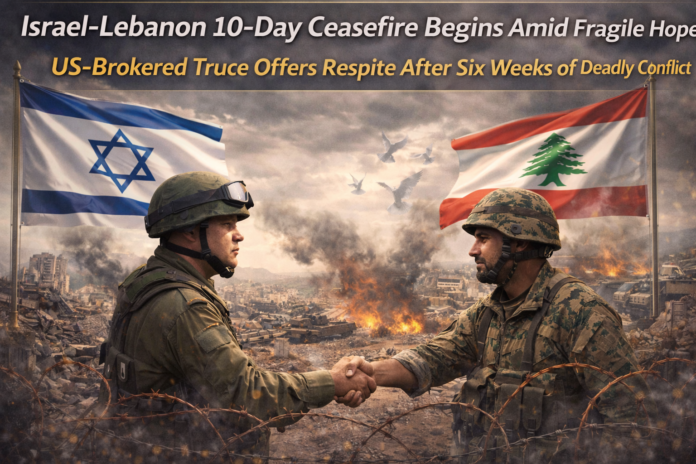

Beirut/Jerusalem, April 18, 2026: A US-brokered 10-day ceasefire between Israel and Lebanon took effect at midnight local time (21:00 GMT) on April 16-17, 2026, bringing a temporary halt to six weeks of intense and deadly fighting that has devastated communities on both sides of the border. The truce, announced by US President Donald Trump following direct talks between Israeli and Lebanese officials in Washington on April 14, represents the first pause in hostilities since the conflict erupted and offers a narrow window for negotiations toward a more durable peace.
The ceasefire has been cautiously welcomed by the international community, humanitarian organizations, and war-weary civilians in both countries. However, early reports of violations and the absence of a formal agreement with Hezbollah, the Iran-backed militant group at the center of the conflict, have raised serious questions about the truce’s viability and whether it can serve as a stepping stone toward lasting stability in the region.
The Human Cost: Six Weeks of Devastation
The conflict between Israel and Hezbollah-backed forces in Lebanon has taken a catastrophic toll on civilian populations. According to Lebanese government and international humanitarian sources, at least 2,196 people in Lebanon have been killed since the fighting began in early March 2026. The vast majority of casualties have been civilians, including hundreds of children and women.
More than one million people—approximately one in five Lebanese residents—have been displaced from their homes, fleeing Israeli airstrikes and ground operations in southern Lebanon. The displacement has created a humanitarian crisis, with overcrowded shelters, shortages of food and medical supplies, and limited access to clean water affecting hundreds of thousands of people.
In Israel, the toll has been comparatively lower but still significant. Israeli officials report that two civilians and 13 soldiers have been killed in cross-border rocket and drone attacks launched by Hezbollah from Lebanese territory. Tens of thousands of Israelis living in northern communities near the Lebanese border have been evacuated or have left voluntarily due to the constant threat of incoming fire.
Infrastructure in both countries has suffered extensive damage. Lebanese towns and villages in the south have been reduced to rubble by Israeli bombardment, while Israeli towns near the border have sustained damage from rocket attacks. Schools, hospitals, roads, and power infrastructure have been destroyed or severely damaged, compounding the suffering of civilians.
How the Ceasefire Came About: US Diplomatic Intervention
The ceasefire agreement is the result of intense diplomatic efforts by the United States, which has sought to de-escalate the broader regional conflict that includes the ongoing US-Israeli military campaign against Iran. President Trump played a central role in brokering the deal, leveraging American influence with both Israel and Lebanon to bring the parties to the negotiating table.
On April 14, senior officials from the Israeli and Lebanese governments met in Washington for the first direct talks between the two countries in decades. The negotiations, facilitated by US Secretary of State Marco Rubio and other senior American diplomats, focused on establishing a temporary cessation of hostilities to create space for further discussions.
President Trump announced the agreement on April 16, describing it as a “historic opportunity” to end the cycle of violence. “The leaders of Israel and Lebanon have agreed to a 10-day ceasefire,” Trump stated at a White House press briefing. “This is a chance to move toward peace, to save lives, and to build a better future for the people of the Middle East.”
The ceasefire took effect at 5:00 PM EST on April 16 (midnight local time in Beirut and Jerusalem). Under the terms of the truce, both sides agreed to halt offensive military operations, including Israeli airstrikes and large-scale ground incursions, as well as cross-border rocket and drone attacks from Lebanese territory.
Key Provisions and Points of Contention
While the ceasefire marks a significant development, its details and limitations have become sources of controversy and concern. Key provisions reported by diplomatic sources include:
- Suspension of Hostilities: Both Israel and Lebanon agreed to cease offensive military operations for 10 days, with the ceasefire beginning at midnight on April 16-17, 2026.
- Israeli Troop Positions: Israeli forces currently deployed inside southern Lebanon will remain in place during the ceasefire, maintaining what Israeli officials describe as a “security zone.” Israel has insisted that its military will not withdraw from occupied positions during the truce.
- Hezbollah’s Role: Hezbollah, the powerful Iran-backed Lebanese militant group, is not a formal party to the ceasefire agreement. While Hezbollah has indicated through senior officials that it will “respect” the ceasefire if Israeli attacks cease, it has not committed to a formal agreement, raising concerns about potential violations.
- Negotiation Framework: The 10-day period is intended to facilitate further negotiations toward a longer-term settlement, potentially including discussions on Hezbollah’s disarmament, Israeli troop withdrawal, and security arrangements along the Israel-Lebanon border.
The decision by Israel to keep troops stationed in southern Lebanon during the ceasefire has been a major point of contention. Lebanese officials and Hezbollah have demanded an immediate Israeli withdrawal, arguing that the continued presence of Israeli forces on Lebanese soil constitutes an ongoing occupation and violation of Lebanese sovereignty.
Israeli Prime Minister Benjamin Netanyahu, however, has defended the decision, stating that Israeli forces must remain in place to prevent Hezbollah from regrouping and rearming. “Israel will not compromise on its security,” Netanyahu said in a televised address. “Our soldiers will stay where they are needed to protect Israeli lives.”
Early Ceasefire Violations Raise Concerns
Within hours of the ceasefire taking effect, reports emerged of violations by both sides. The Lebanese Army reported “acts of aggression” by Israeli forces on Friday morning, April 17, including artillery fire and drone strikes in southern Lebanon. Lebanese officials condemned these actions as breaches of the ceasefire and called on the international community to hold Israel accountable.
Israeli military sources, meanwhile, accused Hezbollah operatives of attempting to reposition forces and move weapons in southern Lebanon during the early hours of the ceasefire. Israeli Defense Minister Israel Katz warned that Israel would respond to any violations, stating: “If Hezbollah breaks the ceasefire, we will act decisively to protect our people.”
These early incidents have fueled skepticism about whether the ceasefire can hold for the full 10 days, let alone serve as a foundation for a more lasting peace. Humanitarian organizations have urged both sides to exercise restraint and prioritize the safety of civilians.
Hezbollah’s Position: Conditional Support
Hezbollah’s stance on the ceasefire remains ambiguous and conditional. While a senior Hezbollah official stated that the group would “respect the ceasefire if Israeli attacks stop,” Hezbollah has not formally endorsed the agreement or committed to a long-term cessation of hostilities.
Hezbollah’s leadership has long insisted that it will not disarm or cease resistance activities as long as Israeli forces occupy any part of Lebanese territory. The group views its armed presence as essential to defending Lebanon from Israeli aggression and maintaining leverage in any future negotiations.
Hassan Nasrallah, Hezbollah’s Secretary-General, has not issued a public statement on the ceasefire at the time of writing, but sources close to the organization suggest that Hezbollah will use the truce period to assess Israel’s actions and regroup if necessary.
The lack of Hezbollah’s formal participation in the ceasefire agreement is seen by many analysts as a critical weakness that could undermine the truce’s effectiveness.
International Reactions: Cautious Welcome
The international community has broadly welcomed the ceasefire, viewing it as a necessary first step toward de-escalation in a region already destabilized by multiple conflicts, including the US-Israeli war against Iran.
UN Secretary-General António Guterres expressed his support for the ceasefire, calling it “a welcome pause in a devastating conflict.” He urged all parties to respect the truce and engage in good-faith negotiations to achieve a lasting peace. “The people of Lebanon and Israel deserve to live in safety and dignity,” Guterres said. “This ceasefire must be the beginning of a political solution, not just a temporary pause.”
The European Union, France, the United Kingdom, and other international actors have also welcomed the agreement. French President Emmanuel Macron congratulated the United States on its diplomatic efforts and reaffirmed France’s support for Lebanon’s sovereignty and stability.
Iran, which backs Hezbollah financially and militarily, has not officially commented on the ceasefire, but Iranian media reports suggest that Tehran views the truce with suspicion, particularly in the context of the broader US-Israeli military campaign against Iran.
Civilian Hopes and Fears
For civilians in Lebanon and Israel, the ceasefire brings a mix of relief, hope, and apprehension. In Lebanon, many displaced families are hoping to return to their homes, assess the damage, and begin the long process of rebuilding their lives. Humanitarian organizations are racing to deliver aid and support to affected communities during the temporary lull in fighting.
In Beirut, the announcement of the ceasefire was met with celebrations, fireworks, and expressions of joy on the streets. “This is the first night in weeks that we can sleep without fear,” said Fatima Hassan, a mother of three from southern Lebanon who has been displaced to Beirut. “We pray that this ceasefire lasts and leads to real peace.”
However, many Lebanese also express deep skepticism about the prospects for a lasting settlement. “We’ve seen ceasefires before, and they always break down,” said Ahmad Khalil, a shopkeeper in the southern city of Tyre. “As long as Israel keeps troops on our land and Hezbollah has weapons, there will be no peace.”
In northern Israel, reactions have been more mixed. While some residents welcome the pause in hostilities, others feel betrayed by what they see as a premature ceasefire that does not address the underlying threat posed by Hezbollah. “We were evacuated from our homes, and now the government is agreeing to a ceasefire without guaranteeing our safety,” said Rachel Levy, a resident of a border town. “What happens after 10 days?”
Challenges Ahead: Path to a Lasting Peace
The 10-day ceasefire is intended to provide a window for diplomatic efforts to forge a more comprehensive and lasting agreement. However, the path to peace is fraught with challenges and deeply entrenched positions on both sides.
Key issues that must be addressed in any long-term settlement include:
- Hezbollah’s Disarmament: Israel has consistently demanded the complete disarmament of Hezbollah as a precondition for peace. This is a non-starter for Hezbollah and many Lebanese, who view the group’s armed presence as essential for national defense.
- Israeli Withdrawal: Lebanon and Hezbollah demand the immediate and complete withdrawal of Israeli forces from Lebanese territory. Israel, however, insists on maintaining a security presence until credible guarantees are in place.
- Security Arrangements: Both sides will need to agree on mechanisms to prevent future escalations, potentially including international monitoring forces, demilitarized zones, and other confidence-building measures.
- Regional Context: The Israel-Lebanon conflict is closely tied to the broader regional dynamics, including the US-Israeli war against Iran and Iran’s support for Hezbollah. Any lasting peace will require addressing these wider issues.
Diplomats and analysts caution that 10 days is a very short time to resolve such complex and deeply rooted issues. The success of the ceasefire and subsequent negotiations will depend on political will, compromise, and sustained international support.
Conclusion: A Fragile Opportunity
The Israel-Lebanon ceasefire represents a fragile but important opportunity to halt the bloodshed and open a path toward peace. After six weeks of devastating conflict that has killed thousands, displaced hundreds of thousands, and destroyed communities, the truce offers a moment of respite for civilians on both sides.
However, the early reports of violations, the absence of Hezbollah’s formal participation, and the deep-seated disagreements over key issues cast doubt on the ceasefire’s long-term viability. The next 10 days will be critical in determining whether this truce can evolve into a meaningful peace process or whether it will simply be a temporary pause before hostilities resume.
For now, the people of Lebanon and Israel are watching, hoping, and praying that this ceasefire marks the beginning of the end of a conflict that has brought so much suffering.