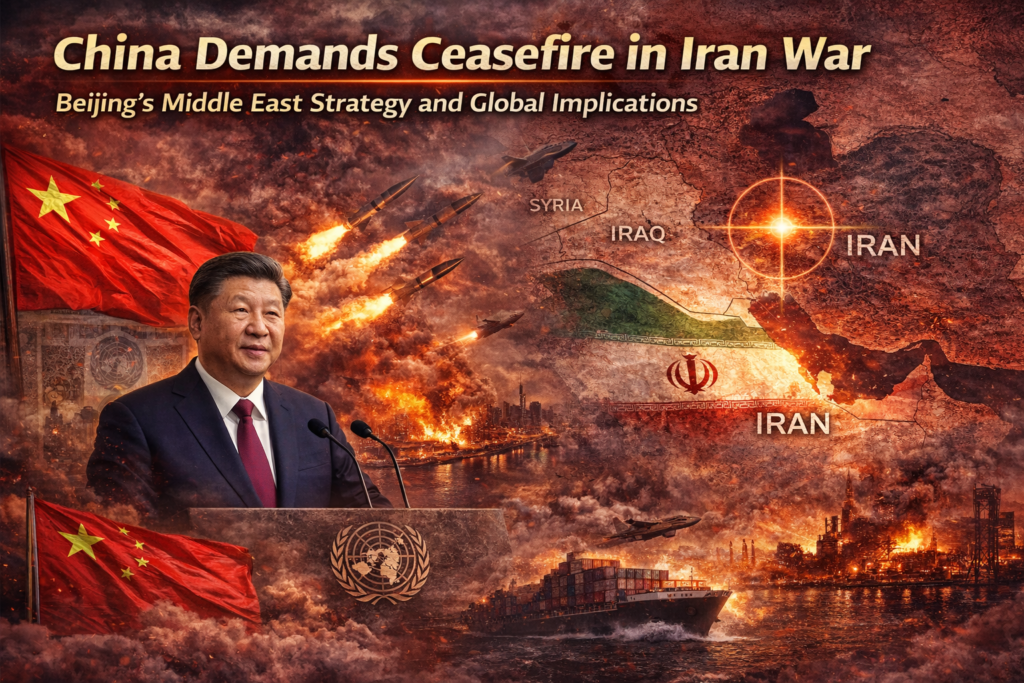
China has emerged as the most vocal and influential voice calling for a ceasefire in the ongoing Iran-US-Israel war, issuing its strongest diplomatic ultimatum yet on March 7, 2026. Chinese President Xi Jinping, speaking at the UN General Assembly via video link, demanded an immediate halt to military operations in Iran, warning that the conflict threatens global trade, energy supplies, and financial stability in ways that will harm China’s economy. China’s intervention marks a significant shift from its usual policy of non-interference in foreign conflicts, reflecting Beijing’s growing alarm at the disruption to its oil imports from Iran and the threat to its Belt and Road Initiative (BRI) infrastructure across the Middle East. The world is watching whether China’s diplomatic weight can achieve what the UN Security Council has so far failed to do: bring the warring parties to the negotiating table.
Why China Is Alarmed: Economic Interests at Stake
China’s aggressive diplomatic push for a ceasefire is driven primarily by its massive economic stakes in the Middle East and Iran specifically. China is Iran’s single largest trading partner and imports approximately 1.2 million barrels of Iranian oil per day, accounting for 12% of China’s total crude oil imports. The US-Israel military strikes have severely damaged Iran’s oil export infrastructure, forcing Chinese refineries to seek alternative supplies at higher prices. China has invested over $400 billion in Belt and Road Initiative projects across the Middle East, including ports in Pakistan, Saudi Arabia, and UAE, as well as rail links and industrial parks. The conflict threatens to disrupt these investments and undermine China’s carefully constructed economic relationships with Gulf states. China has also deployed thousands of workers and engineers across Middle Eastern countries who are now at risk as the conflict expands.
China’s Diplomatic Strategy: The Five-Point Peace Plan
China has proposed a Five-Point Peace Plan for the Iran conflict, presented by Foreign Minister Wang Yi to the UN Security Council on March 6, 2026. The plan calls for: immediate ceasefire and withdrawal of all offensive military forces; resumption of the 2015 Iran nuclear deal (JCPOA) with enhanced verification mechanisms; compensation for Iran for damage caused by military strikes; lifting of sanctions on Iran in phases; and establishment of a regional security framework involving all Middle Eastern nations. The plan has been endorsed by Russia, most Arab nations, India, and the Global South broadly. However, the United States and Israel have rejected it, arguing that Iran’s nuclear weapons program cannot be managed through diplomacy after Iran violated the JCPOA multiple times. The European Union has expressed qualified support for the Chinese plan as a basis for negotiations, representing a potential diplomatic wedge between the US and its European allies.
China-US Tensions Reach Boiling Point
The Iran conflict has dramatically escalated tensions between China and the United States, which were already strained over Taiwan, trade, and technology. China has recalled its ambassador to Washington, suspended military-to-military communications, and cancelled planned bilateral economic dialogues. Beijing has warned that it will impose sanctions on US and Israeli companies involved in military operations against Iran, including Lockheed Martin, Boeing Defense, and RTX (Raytheon). China has also threatened to restrict exports of rare earth minerals critical to US defense and technology industries, a threat that has alarmed Pentagon planners given China’s 80%+ global dominance in rare earth processing. The Chinese navy has deployed additional warships to the Arabian Sea under the guise of anti-piracy operations, positioning forces closer to the conflict zone in what US officials privately describe as a dangerous provocation.
Russia-China Coordination: A Unified Front
Russia and China have presented a unified front in response to the Iran conflict, reflecting the deepening of their strategic partnership forged since Russia’s invasion of Ukraine in 2022. Both countries have jointly condemned the US-Israel military operations as violations of international law and called for an emergency UN Security Council session. Russia and China have used their veto power to block UN resolutions that would have authorized the US military campaign retroactively. The two powers have also agreed to increase oil trade between themselves to reduce dependence on dollar-denominated Middle Eastern oil, further undermining the US dollar’s role as the global reserve currency for energy transactions. The growing Russia-China axis is seen by Western strategists as the most significant long-term consequence of the Iran crisis, representing a fundamental realignment of global power that will outlast the immediate conflict.
India’s Position: Strategic Balancing Between Blocs
India finds itself in an extraordinarily complex position as the US-China confrontation over Iran intensifies. India has warm relationships with both the United States and China, but the two are now on opposite sides of the most significant geopolitical conflict since the Cold War. India supports China’s call for a ceasefire diplomatically but cannot openly back Beijing’s five-point plan without straining its Quad partnership with Washington. At the same time, India has significant trade relations with Iran through the Chabahar Port and cultural ties with the Persian world that it is reluctant to sacrifice. Indian diplomacy has been described by analysts as a tightrope walk, with External Affairs Minister Jaishankar simultaneously attending meetings with US Secretary of State and Chinese Foreign Minister Wang Yi to position India as a neutral mediator. India’s potential role as a peace broker could significantly enhance its global stature if successful.
Global South Response: Anti-War Sentiment Grows
Beyond China, the broader Global South has overwhelmingly supported calls for a ceasefire in Iran. At the UN General Assembly emergency session, 147 countries voted for an immediate ceasefire resolution, with only the US, Israel, UK, and three other nations voting against. The African Union, ASEAN, Arab League, and Organisation of Islamic Cooperation have all issued statements calling for peace negotiations. Developing countries are particularly alarmed by the economic consequences of the conflict, including soaring oil prices and food inflation that are threatening to push millions more people into poverty. The growing divide between the Western bloc (US, UK, EU supporting military operations) and the Global South (demanding ceasefire and diplomacy) represents one of the starkest global divisions since the era of colonialism, with potentially lasting consequences for the international order.
Conclusion
China’s forceful intervention in the Iran conflict represents a watershed moment in global geopolitics. Beijing’s willingness to confront Washington diplomatically over the Middle East reflects its growing confidence as a global power with economic interests worldwide. Whether China’s diplomatic pressure can achieve a ceasefire depends on the next moves from Washington, Tehran, and Tel Aviv. What is certain is that the Iran war is accelerating a realignment of global power that will define international relations for decades to come. The emerging US-China confrontation over Iran’s future adds another dangerous dimension to an already catastrophic conflict. Press of Asia will continue to track China’s role in Middle East diplomacy and its implications for India’s strategic position.