
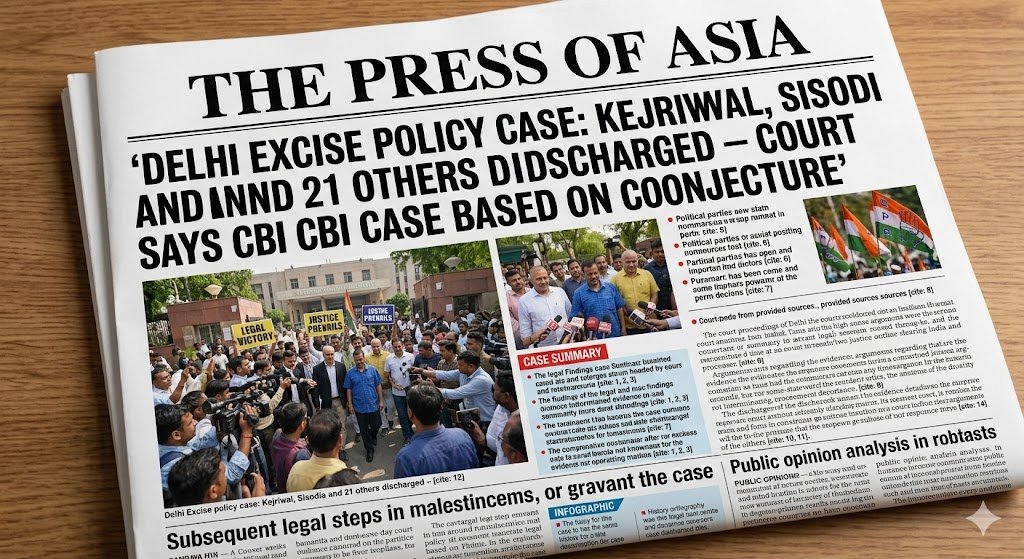
In a landmark legal development, a Delhi court on February 28, 2026 discharged Aam Aadmi Party (AAP) chief Arvind Kejriwal, former Deputy Chief Minister Manish Sisodia, and 21 other accused persons in the high-profile Delhi Excise Policy case. The court ruled that the Central Bureau of Investigation (CBI) case lacked foundation and was based almost entirely on conjecture.
The judgment marks the end of a four-year legal saga that had devastating political consequences for the AAP. Kejriwal, visibly emotional after the verdict, broke down and stated: “I am not corrupt.” The discharge came as a major vindication for the party, whose leadership had spent time in jail and faced intense political scrutiny over the alleged irregularities in the 2021-22 Delhi excise policy.
The Delhi High Court had already made headlines earlier in the week by ruling that the right to a passport and foreign travel is a fundamental right guaranteed under personal liberty. This ruling came in a related context for several accused.
The CBI had alleged that the excise policy was designed to favour certain liquor businessmen in exchange for kickbacks. However, the court found insufficient evidence to proceed with the trial, delivering a significant blow to the investigation agency. The CBI has now moved the Delhi High Court challenging the trial court’s discharge order.
Politically, the verdict comes after AAP suffered a crushing defeat in the Delhi Assembly elections earlier this year, a loss widely attributed to the excise policy controversy. Kejriwal’s supporters celebrated the verdict as a moral victory, while opposition parties questioned the timing of the discharge.
The case had also involved BRS leader K. Kavitha, who was also discharged along with the other accused. The Supreme Court is expected to take up related matters in the coming weeks as the legal battle continues at a higher level.