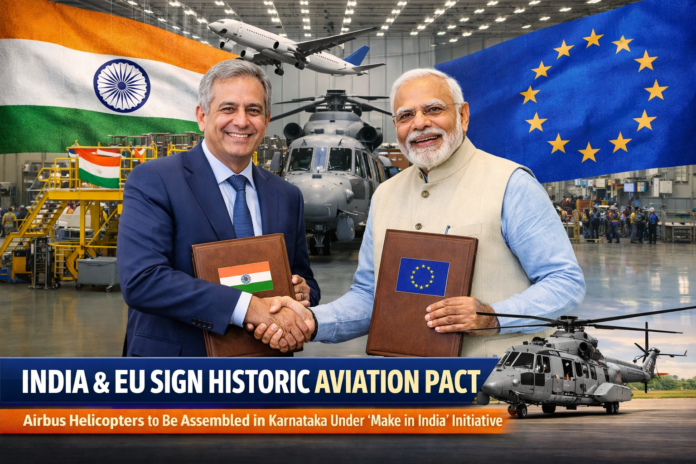

New Delhi, March 30, 2026: In a major boost to India’s aviation manufacturing ambitions and bilateral relations with Europe, India and the European Union have signed a landmark Working Arrangement between the European Union Aviation Safety Agency (EASA) and India’s Directorate General of Civil Aviation (DGCA). Signed in New Delhi on March 23, 2026, the agreement marks a new chapter in India-EU cooperation on industrial aviation production, directly supporting the Government of India’s flagship “Make in India” initiative and potentially transforming Karnataka into a key hub for European aircraft manufacturing in Asia.
The Agreement: What Has Been Signed and What It Means
The working arrangement is a formal regulatory cooperation agreement between EASA — the EU’s aviation safety regulator — and India’s DGCA. At its core, the agreement enables the assembly of Airbus Helicopters H125/AS350 aircraft in the state of Karnataka, under European safety and manufacturing standards. This is a landmark development: it means that high-value helicopter manufacturing operations, previously conducted only in Europe, will now take place on Indian soil with full EU regulatory recognition.
The H125/AS350 is one of the world’s most popular single-engine helicopters, widely used for a variety of civil and parapublic missions including tourism, offshore energy support, law enforcement, emergency medical services, and mountainous terrain operations. Having this aircraft assembled in India will reduce import costs, create high-skilled manufacturing jobs, and position India as a credible player in the global aviation supply chain. The Tata-Airbus production line in Karnataka is expected to be operational soon, adding a new dimension to India’s defence and aerospace manufacturing ecosystem.
Background: EU-India Aviation Partnership and the January 2026 Summit
The working arrangement builds on commitments made during the EU-India Summit held in January 2026, where civil aviation safety was identified as a priority area under the Strategic Joint Agenda. The two sides had agreed to accelerate cooperation to ensure that safety and sustainability remain central to aviation growth. The EASA-DGCA arrangement, concluded just two months after the summit, reflects the speed and seriousness with which both partners are pursuing this agenda.
The signing was followed by a regional workshop held in New Delhi from March 24 to 26 under the EU-South Asia Aviation Partnership Programme. The three-day event brought together aviation regulators, airlines, and industry stakeholders from across South Asia to strengthen operational collaboration and share best practices in aviation safety and sustainability. India’s leadership in hosting this event underscores its growing role as a hub for aviation development in the broader South Asian region.
Make in India and the Aviation Sector: A Strategic Priority
The India-EU aviation pact is the latest milestone in the Modi government’s Make in India programme’s push into the aerospace and defence sector. Over the past decade, India has made significant strides in attracting defence manufacturing investment, with notable achievements including Tata Advanced Systems manufacturing C-295 transport aircraft fuselages for Airbus, HAL producing Tejas fighter jets, and the establishment of dedicated Aerospace and Defence Corridors in Uttar Pradesh and Tamil Nadu.
The helicopter assembly agreement in Karnataka adds to this momentum. Karnataka — home to Bengaluru’s aerospace cluster, HAL’s main production facilities, and ISRO’s headquarters — is ideally positioned to serve as a hub for rotary-wing manufacturing. The state government has been actively pursuing aerospace investments, and the Airbus Helicopters assembly line is expected to generate both direct employment and a wider ecosystem of component suppliers and service providers in the region.
Regulatory Harmonisation: The Key to Unlocking Aviation Trade
One of the most significant aspects of the EASA-DGCA working arrangement is the regulatory harmonisation it enables. In the aviation sector, safety regulations are the primary determinant of whether aircraft manufactured or certified in one country can fly in another. By aligning Indian regulatory standards with EU standards for the production of the H125/AS350, the agreement clears a major hurdle that has historically limited India’s ability to export domestically-assembled aircraft to European and other international markets.
The harmonisation also benefits Indian airlines and operators. Currently, aircraft certified under EASA standards are widely accepted globally, while aircraft with only DGCA certification face more limited international acceptance. By working towards a closer alignment of the two regulatory frameworks, the EU-India aviation pact is helping to raise India’s profile as a credible aviation manufacturing nation whose products meet the world’s highest safety standards.
India’s Booming Aviation Market: Context for the EU Pact
The timing of the India-EU aviation pact is particularly significant. India has become the world’s third-largest domestic aviation market, with passenger numbers recovering strongly after the pandemic and continuing to grow rapidly. Indian carriers have placed record orders for new aircraft, including massive orders from IndiGo for over 500 Airbus A320-family jets and Air India’s multi-billion-dollar order for over 470 aircraft from both Airbus and Boeing. This growth in demand makes India an increasingly important partner for global aviation manufacturers and regulators.
The EU is India’s largest trading partner, and aviation is a sector where both sides see enormous potential for deepening economic ties. The EASA-DGCA agreement is just the first concrete deliverable of a much broader aviation cooperation agenda. Future areas of collaboration are expected to include sustainable aviation fuels, advanced air mobility (drones and urban air taxis), digital aviation, and safety data sharing. For India, the EU pact represents an opportunity not just to manufacture more aircraft domestically, but to become a full member of the global aviation community, shaping the standards and technologies that will define the industry’s future. The Make in India skies are looking broader than ever before.