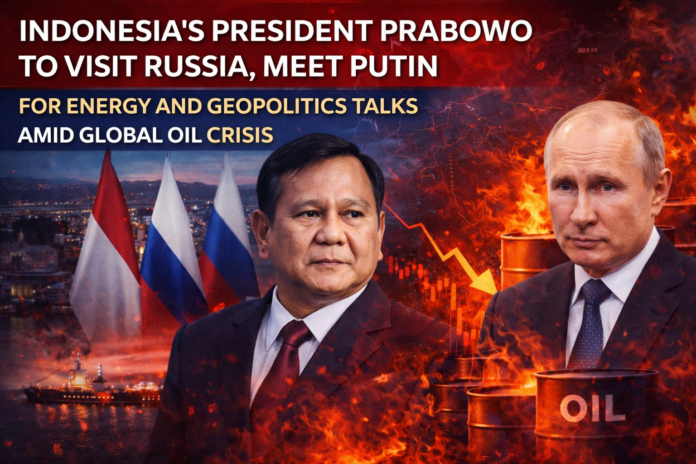

Jakarta / Moscow, April 12, 2026 — In a significant diplomatic development that underscores the deepening energy anxieties gripping Asia amid the ongoing Iran war, Indonesian President Prabowo Subianto is set to travel to Moscow this week for a high-stakes meeting with Russian President Vladimir Putin. The visit, confirmed by Indonesia’s Foreign Minister Sugiono on Saturday, centres on securing alternative oil supplies for Indonesia as a global energy crisis triggered by the West Asia conflict pushes crude prices toward the $100-per-barrel threshold and strains fuel supplies across the Asia-Pacific region.
The upcoming Prabowo-Putin summit represents one of the most consequential bilateral engagements in recent Southeast Asian diplomatic history. It comes at a time when energy markets worldwide are in turmoil following the escalation of the Iran conflict, which has disrupted oil shipping routes through the Strait of Hormuz and sent crude prices soaring. For Indonesia, a country that relies heavily on imported oil to fuel its growing economy, the stakes of this visit could not be higher. President Prabowo, who has been pursuing an assertive and independent foreign policy since taking office, is sending a clear message: Indonesia will go wherever necessary to protect its national energy interests, regardless of geopolitical alignments.
The Energy Crisis Driving the Moscow Visit
The immediate backdrop to Prabowo’s Russia trip is a severe global oil supply crunch that has been building since early 2026. The war in West Asia — which has drawn in major regional powers and threatened to close one of the world’s most critical oil transit routes — has caused international crude prices to hover dangerously close to $100 per barrel. Indonesia, which imports the vast majority of its crude oil requirements, is feeling the economic pain acutely. Fuel subsidies are straining the government budget, inflation is ticking upward, and ordinary Indonesians are beginning to feel the pinch at petrol stations and in the prices of everyday goods.
Russia, which has emerged as one of the world’s top oil exporters despite Western sanctions following its 2022 invasion of Ukraine, has been actively courting Asian buyers eager to diversify away from Middle Eastern supply chains that are now exposed to war risk. The Kremlin indicated earlier this week that it had received a “huge number of requests” from different countries seeking Russian energy, a signal that Moscow is positioning itself as the alternative supplier of choice for a world suddenly anxious about energy security. Indonesia’s approach to Russia fits squarely into this emerging geopolitical energy dynamic.
Indonesian Foreign Minister Sugiono, speaking to reporters in Jakarta on Saturday, confirmed that President Prabowo’s departure for Russia is scheduled for this week. He described the visit as being of “chief strategic value” for Indonesia and confirmed he would accompany the president to Moscow. While Sugiono declined to specify the exact departure date, he left no doubt about the purpose of the mission: to discuss the possibility of Indonesia purchasing Russian oil at favourable terms to shore up domestic fuel supplies and stabilise energy prices.
Prabowo’s Independent Foreign Policy in Action
The Moscow visit is the latest expression of what analysts have come to describe as Prabowo’s distinctly pragmatic and non-aligned foreign policy approach. Since taking office, Prabowo has shown a willingness to engage with all major powers — from Washington and Beijing to Moscow — on the basis of what Indonesia calls its “bebas dan aktif” (free and active) foreign policy doctrine. This doctrine, rooted in Indonesia’s founding principles, holds that the country should not be bound to any single power bloc and should instead pursue its national interests through active and independent diplomacy.
In recent months, Prabowo has already met with South Korean President Lee Jae Myung in Seoul, engaged in talks with Chinese and American officials, and now is heading to Moscow. The breadth of his diplomatic engagements signals that Indonesia, as the world’s fourth most populous nation and the largest economy in Southeast Asia, intends to play a more assertive and consequential role in global affairs. The decision to personally travel to Russia to discuss energy purchases — at a time when many Western nations are trying to isolate Moscow — demonstrates that Prabowo is willing to prioritise Indonesia’s economic needs over alignment with Western pressure.
Implications for ASEAN and the Broader Asia-Pacific
Indonesia’s move to seek Russian oil is likely to reverberate across Southeast Asia, where many countries are grappling with similar energy supply anxieties. The ASEAN bloc has so far maintained a largely neutral stance on the Russia-Ukraine conflict and the wider geopolitical divisions between the West and Russia. Indonesia’s high-profile presidential visit to Moscow could embolden other ASEAN states to similarly engage with Russia on energy matters, deepening a trend of Asian energy buyers turning to Moscow as a pragmatic alternative to politically volatile Middle Eastern supplies.
The Asian Development Bank has projected Indonesia’s economic growth to rise to 5.2 per cent in 2026, reflecting the country’s underlying economic dynamism. However, this growth forecast is contingent on Indonesia being able to manage its energy import costs. A prolonged period of high oil prices without a secure and affordable supply deal could erode economic gains, fuel inflation, and put pressure on Indonesia’s currency. Securing discounted Russian oil — as India and China have successfully done in the wake of Western sanctions — would allow Indonesia to insulate its economy from the worst effects of the global energy shock.
For Russia, Indonesia represents a significant diplomatic prize. Winning over the world’s largest Muslim-majority nation and the leading voice in ASEAN would demonstrate that Moscow’s international isolation, sought by Western powers through a broad sanctions regime, is far from complete. The Kremlin has been actively seeking to build new energy partnerships across Asia, Africa, and Latin America. A formal energy agreement with Indonesia would be a major win for Putin at a time when his country faces continued economic pressure from Western sanctions.
The Iran War and Its Cascading Effects on Asian Energy Markets
The context for Prabowo’s Moscow visit cannot be fully understood without examining the cascading effects of the ongoing Iran war on Asian energy markets. The conflict, which began in early 2026, has created severe disruptions to global oil supply chains. Iran is one of the world’s major oil producers and its conflict has raised fears of further disruptions to Strait of Hormuz shipping, through which an estimated 20 per cent of global oil trade transits daily. Even partial or temporary closures of this critical chokepoint have sent oil markets into a frenzy, driving up prices and creating acute supply anxiety among major importing nations.
Asian nations, which collectively account for a large share of global oil consumption, have been among the hardest hit. Japan, South Korea, China, India, and the ASEAN nations are all heavily dependent on Middle Eastern oil imports. Japan’s producer prices have risen sharply, while South Korea has moved to pass a supplementary budget of approximately 30 trillion won to mitigate the economic fallout from the conflict. India, which imports 85 to 88 per cent of its crude oil requirements, is facing a particularly acute dilemma as soaring prices threaten to widen its current account deficit, depreciate the rupee, and stoke inflation across the economy.
In this context, Indonesia’s Prabowo is not alone in seeking Russian energy as an alternative. India has dramatically increased its purchases of discounted Russian crude since 2022, reducing its exposure to Middle Eastern supply disruptions. China has similarly deepened its energy relationship with Russia. Prabowo’s Moscow visit signals that Indonesia may be taking a page from the same playbook, seeking to diversify its energy supply mix in a world where geopolitical fault lines are redrawing the map of global energy trade.
What to Expect From the Prabowo-Putin Summit
While the detailed agenda of the Prabowo-Putin talks has not been officially disclosed, a number of key issues are expected to dominate discussions. The central focus is almost certain to be the possibility of Indonesia purchasing Russian crude oil at negotiated prices, potentially at a discount to prevailing market rates. This would follow the model that India and China have used to secure affordable Russian energy, significantly reducing their exposure to global oil price volatility. Such a deal would require careful structuring to navigate potential Western sanctions concerns, but Indonesia’s non-aligned stance gives it more room to manoeuvre than most.
Beyond energy, the two leaders are expected to discuss broader geopolitical issues, including the Iran war, the Ukraine conflict, and Indonesia’s aspirations to join the BRICS grouping of major emerging economies. Indonesia has expressed growing interest in BRICS membership, which would further signal its intent to engage with the emerging multipolar world order rather than align itself exclusively with the Western-led international system. The Moscow visit may well prove to be a milestone moment in Indonesia’s journey toward a more prominent and independent role on the world stage.
As President Prabowo prepares to board his flight to Moscow, the world will be watching. The outcomes of this summit — whether it results in a formal oil deal, a broader strategic partnership, or simply a set of agreed principles for enhanced bilateral cooperation — will have significant implications not just for Indonesia and Russia, but for the entire architecture of Asian energy security and global geopolitical alignments in 2026 and beyond.