
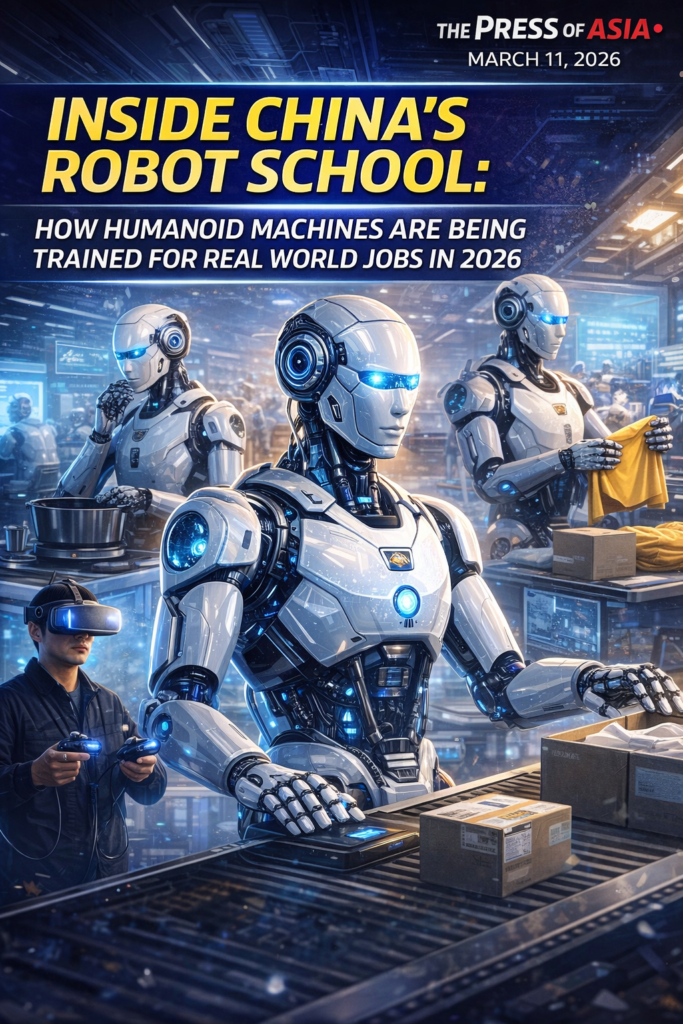
In a laboratory in Wuhan, China, a group of humanoid robots is undergoing a training process that looks remarkably like a school classroom. Engineers wearing virtual reality headsets guide robot arms and bodies through everyday tasks — making coffee, folding clothes, sorting packages, fetching bottled water. Each movement is recorded and uploaded to the cloud, forming a training dataset that the robots then learn from. Welcome to China’s robot school: a rapidly expanding network of facilities that is shaping what many experts believe could be one of the most transformative technological developments of the 21st century.
What Is China’s Robot School?
The concept of a “robot school” has been gaining global attention, with China at the forefront. In Beijing’s Shijingshan district, the Beijing Humanoid Robot Data Training Center — the largest facility of its kind in China — spans more than 10,000 square metres across two floors. Inside, the environment has been meticulously constructed to replicate real-world settings at a full 1:1 scale. Scenes include factory floors, restaurant kitchens, bedrooms, logistics warehouses, and retail shops. Each modular training unit, or “cell,” is frequently reconfigured to simulate different operational contexts.
In Wuhan, the Euronews network reported in March 2026 that a similar facility is operating, where robots are trained using VR teleoperation. Human trainers wear VR headsets and controllers, essentially controlling the robots like avatars in a video game to demonstrate movements. “We wear VR glasses and have controllers in hand. Our left and right hands are like the robot’s left and right arms. It will learn our postures by moving them. The data will be uploaded to the cloud. Once the data is approved, it will be uploaded to the robot, and it will learn from it,” said Qu Qiongbin, an AI robot trainer at the facility.
In Shandong province, another “robot school” has dozens of humanoid machines mimicking human engineers as they carry trays, fold clothes, and fetch bottled water from shelves, according to China Daily. These centres are no longer isolated experiments; they represent a coordinated national push to rapidly develop and deploy humanoid robots across China’s economy.
The ‘Kuafu’ Robot And VR-Powered Training
The primary model being trained at Beijing’s Humanoid Robot Data Training Center is a robot named “Kuafu,” standing 1.66 metres tall. Training is conducted in small-class settings, with each robot assigned two dedicated human trainers. The centre employs 110 staff members, most of whom were born in the 2000s.
The level of detail involved in training is staggering. Zhu Kai, head of the Beijing training centre, explained: “Just as children require repeated practice to walk, robots must train extensively across diverse scenarios to build functional intelligence.” The trainers Shi and Han, considered among the centre’s top staff, require seven or eight days to guide a robot through a single scenario. A seemingly simple task like placing a frying pan on a stove required 1,250 repetitions, with each movement precisely recorded to improve the robot’s coordination and gradually replicate human-like performance.
At the Wuhan facility, Yang Xinyi, project leader at Data Fusion Technology, explained the philosophy: “We train and teach robots by creating realistic, one-to-one scenarios. Trainers may repeat a single action hundreds, thousands, or even tens of thousands of times to teach it, and then use the data to support this training.” Visitors can already interact with robots at the 7S Humanoid Robot Store in Wuhan, where machines respond to public commands and demonstrate simple real-world tasks.
China’s Race To Lead The Global Humanoid Robot Industry
China’s robot school boom is driven by a strategic imperative: winning the global race for humanoid robotics. The United States and China are currently the world’s two leading nations in this emerging sector, and the competition is intensifying rapidly. China’s central and local governments have invested heavily in establishing training bases, recognising that humanoid robots could be the next major engine of economic growth.
Cities across China are competing to attract robotics startups and research labs with strong commercial potential. Dozens of robot training centres have been established across the country by local governments as part of a national push to generate the movement data that autonomous humanoid machines require in order to develop intelligence.
The Beijing Humanoid Robot Data Training Center generates over 6 million data points every year. Historically, robotics companies collected training data in isolation, resulting in inconsistent quality. These new training bases enable standardised, large-scale data generation at lower costs and higher quality, giving Chinese manufacturers a significant competitive advantage.
Fueled by this infrastructure, the global humanoid robot market is expected to exceed USD 20 billion by 2030, with China projected to account for roughly one quarter of that total, according to the Gaogong Industry Institute.
Robots Graduate And Enter The Workforce
Robots that complete their training at China’s facilities don’t simply remain in labs. An electronic display at the Beijing training centre highlights the deployment records of several “outstanding graduates.” Trained robots are now working as material handlers at factories of China FAW Group (a major automaker), couriers at Shenzhen Capital Group, power inspection officers at China Southern Power Grid, and service guides at the Zhongguancun Forum, a prestigious high-tech innovation platform.
The robots have acquired more than 20 operational skills through their training, including material handling, inspection and delivery, with task success rates exceeding 95 percent. These figures are particularly impressive given how recently the technology was considered experimental.
The scenario-based practical training at these facilities mirrors the actual environments robots will enter, from ZTE’s intelligent production lines and FAW Group’s automobile workshops to SF Express’s logistics systems and Unilever’s shampoo boxing operations. This deliberate alignment between training and deployment is a key factor behind the robots’ employability and practical success in real-world conditions.
What This Means For The Future Of Work And India
China’s rapid advances in humanoid robotics have significant global implications, including for India. As humanoid robots enter factories, logistics centres, warehouses, and even homes, the long-term impact on the global labour market could be profound. Jobs currently performed by humans in manufacturing, delivery, retail and elder care are among those being targeted first for robotic replacement.
For India, which has a vast workforce employed in manufacturing and services, the rise of affordable, capable humanoid robots from China raises important questions about competitiveness. Chinese robotics companies are developing increasingly cost-effective models, with some startups targeting price points as low as USD 1,370 for basic humanoid units designed for homes and classrooms. As these systems become more affordable and capable, they could disrupt global supply chains and alter the competitive dynamics of labour-intensive industries.
At the same time, the rise of humanoid robotics also creates enormous opportunities. Countries that invest in robotics manufacturing, AI research, software development, and robotics training infrastructure stand to benefit enormously from the transition. India’s technology sector, which has long been a leader in software and AI services, has an opportunity to contribute to the global robotics value chain if it acts swiftly.
The global humanoid robot market is still in its early stages, but events in China’s robot schools in 2026 suggest that the transition from science fiction to commercial reality is happening faster than most observers anticipated.
Conclusion
China’s network of humanoid robot training schools represents a bold and systematic bet on the future of automation. By investing in large-scale data collection, standardised training protocols, and real-world scenario replication, China is positioning itself to dominate the next wave of the global technology economy. As robots trained in facilities in Beijing, Wuhan and Shandong begin working in factories, warehouses and shops, the world is getting its first clear look at what a robot-powered economy could look like. The question now is not whether humanoid robots will transform the world of work, but how quickly and how completely.