
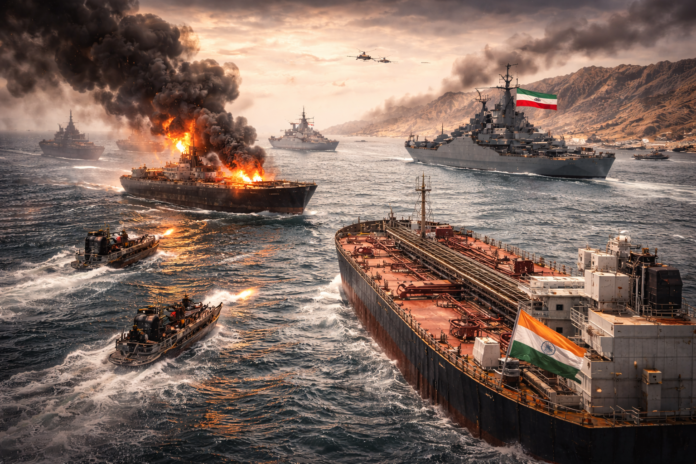

In a shocking escalation that has directly impacted India’s maritime interests, Iranian naval forces fired warning shots at and ordered two Indian commercial vessels to abort their passage through the Strait of Hormuz on April 18-19, 2026. The Ministry of External Affairs (MEA) has lodged a strong protest with Tehran, while the Indian government demands the immediate and safe release of the vessels and their crews. The incident has sparked a major diplomatic crisis between India and Iran, coming at a time of heightened regional tensions.
The Incident: What Happened to Indian Ships?
According to reports from multiple international news agencies including Al Jazeera, NBC News, and BBC, Iranian gunboats intercepted at least two Indian commercial vessels attempting to pass through the Strait of Hormuz on April 18, 2026. The IRGC issued radio communications ordering the vessels to abort their passage. When one vessel reportedly did not comply immediately, warning shots were fired in its direction. No Indian crew members were reported injured, but both ships were forced to turn back and anchor offshore.
India’s Diplomatic Response
India’s Ministry of External Affairs (MEA) summoned the Iranian Ambassador in New Delhi and lodged a strong protest over the targeting of Indian commercial vessels. The MEA called the incident a violation of international maritime law and the United Nations Convention on the Law of the Sea (UNCLOS). India’s ambassador in Tehran was also directed to make a formal representation to the Iranian Foreign Ministry demanding the immediate safe passage of Indian ships.
India’s External Affairs Minister issued a strong statement calling for the immediate and unconditional release of all restrictions on Indian commercial shipping in international waters. India affirmed that it would take all diplomatic measures necessary to protect the safety of Indian seafarers and the commercial interests of Indian shipping companies operating in the Persian Gulf region.
Why Did Iran Target Indian Ships?
Iran’s closure of the Strait of Hormuz is directed primarily at enforcing its blockade response to the US Navy’s blockade of Iranian ports. Iran has made clear that any vessel attempting to pass through the Strait risks being intercepted, irrespective of its nationality or ownership. However, the targeting of Indian ships is particularly significant because India has maintained a carefully balanced neutral posture in the US-Iran conflict, maintaining relations with both Washington and Tehran.
India had hoped that its neutral stance would protect its commercial interests in the region. The targeting of Indian ships signals that Iran is taking an indiscriminate approach to the Hormuz blockade, which could force India to take a stronger diplomatic stand. India imports approximately 60% of its crude oil from the Middle East and has significant trade interests in the Persian Gulf, making any prolonged Hormuz closure a serious economic threat.
Impact on India’s Shipping and Trade
Several Indian shipping companies including the Shipping Corporation of India (SCI) have already suspended all transits through the Strait of Hormuz following the incidents. Indian oil companies are now rerouting their tankers via the Cape of Good Hope route, adding 10-14 days to transit times and significantly increasing freight costs. These additional costs are expected to eventually result in higher domestic fuel prices if the blockade continues for an extended period.
India’s Chabahar Port project in Iran, which is a key part of India’s connectivity strategy to Central Asia and Afghanistan, has also been impacted by the Hormuz situation. The Indian government is in active dialogue with Iranian authorities to ensure that Indian-funded Chabahar Port operations are not disrupted by the broader conflict. Chabahar enjoys an exemption from US sanctions but its operations are practically affected by the current military situation.
International Reaction and Call for Safe Shipping
The attacks on Indian ships drew sharp condemnation from the international community. The UK, France, and European Union called for immediate safe passage for all commercial vessels in international waters. US President Donald Trump, when asked about Iranian gunboats firing on vessels including Indian ships, reportedly declined to directly acknowledge the incident. China and Russia, which also have significant shipping interests in the Persian Gulf, called for restraint from all parties.
The International Maritime Organization (IMO) has issued an emergency security advisory for the Strait of Hormuz region, urging all commercial vessels to avoid the area until further notice. This is only the second time in history the IMO has issued such an advisory, underscoring the severity of the current crisis. India is actively engaged in international discussions to ensure a rapid resolution to the Hormuz crisis. Press of Asia will keep tracking all developments related to Indian ships and seafarers in the region.