
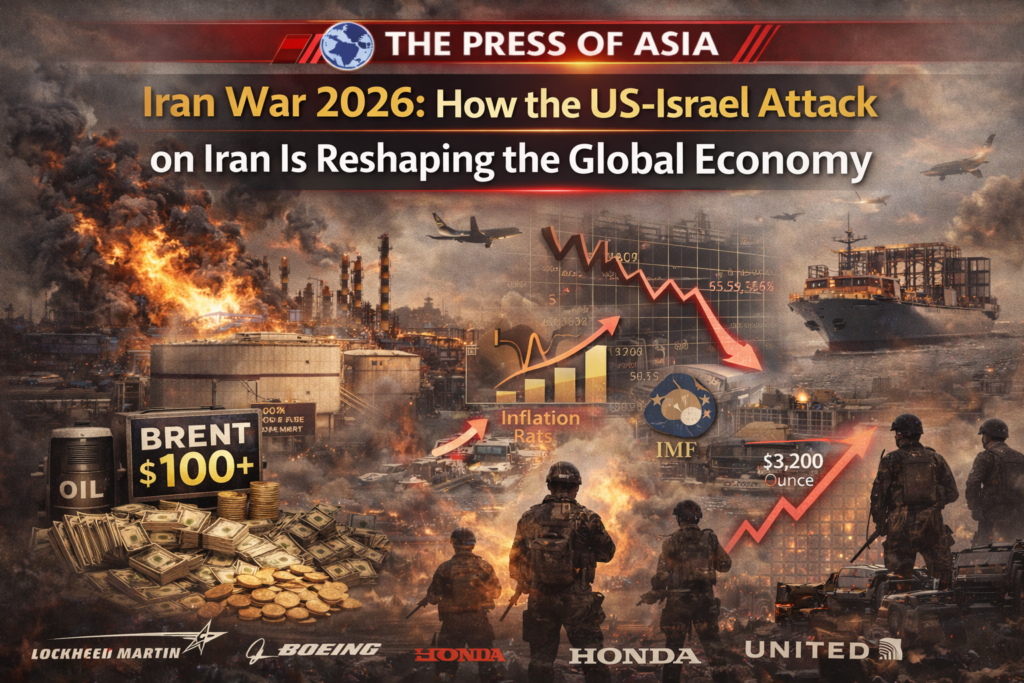
The outbreak of war between the United States, Israel, and Iran is sending shockwaves through the global economy, threatening to reverse years of progress on inflation reduction, supply chain normalization, and economic recovery.
Oil Markets in Turmoil:
Brent crude oil surged over 6% following the initial strikes, briefly touching $82 per barrel. The Strait of Hormuz closure and disruption to Gulf shipping lanes are keeping prices elevated. Analysts at Goldman Sachs warn that if the conflict extends beyond six weeks, oil could hit $100+ per barrel.
Inflation Threat:
Economists at Oxford Economics warn that a $10 rise in oil prices per barrel is enough to add 0.3-0.5% to global inflation. Countries that had recently achieved their inflation targets, including the US, UK, and European nations, now face renewed price pressures. The US Federal Reserve may be forced to keep interest rates higher for longer.
Stock Market Impact:
- US Dow Jones fell 800 points on Monday
- European stocks declined 2-3%
- Sensex (India) dropped over 1,500 points on Feb 28
- Asian markets see flight to safe-haven assets (gold, yen, US Treasuries)
- Gold prices surged to record highs above $3,200 per ounce
Supply Chain Disruptions:
Beyond oil, the conflict threatens to disrupt global supply chains. The Middle East is a critical transit point for goods moving between Asia, Europe, and Africa. Container shipping rates are rising as vessels avoid the Persian Gulf and Red Sea routes.
IMF Warning:
The International Monetary Fund issued an emergency statement warning of “significant downside risks” to its 2026 global growth forecasts if the conflict escalates. It urged all parties to seek a ceasefire immediately.
Winners and Losers:
Winners: Defense companies, oil producers outside the Gulf (US shale, Canada, Russia), gold miners
Losers: Airlines, automobile manufacturers, import-dependent nations, emerging economies, tourism
India’s Exposure:
With oil imports worth $130 billion annually and significant remittances from Gulf workers, India faces one of the highest exposures among major economies. The rupee has weakened against the dollar, and fiscal deficit concerns are mounting.
The world’s central banks and finance ministers are on high alert. Emergency meetings of the G7 and G20 are being considered to coordinate a response to what could be a defining economic crisis of 2026.