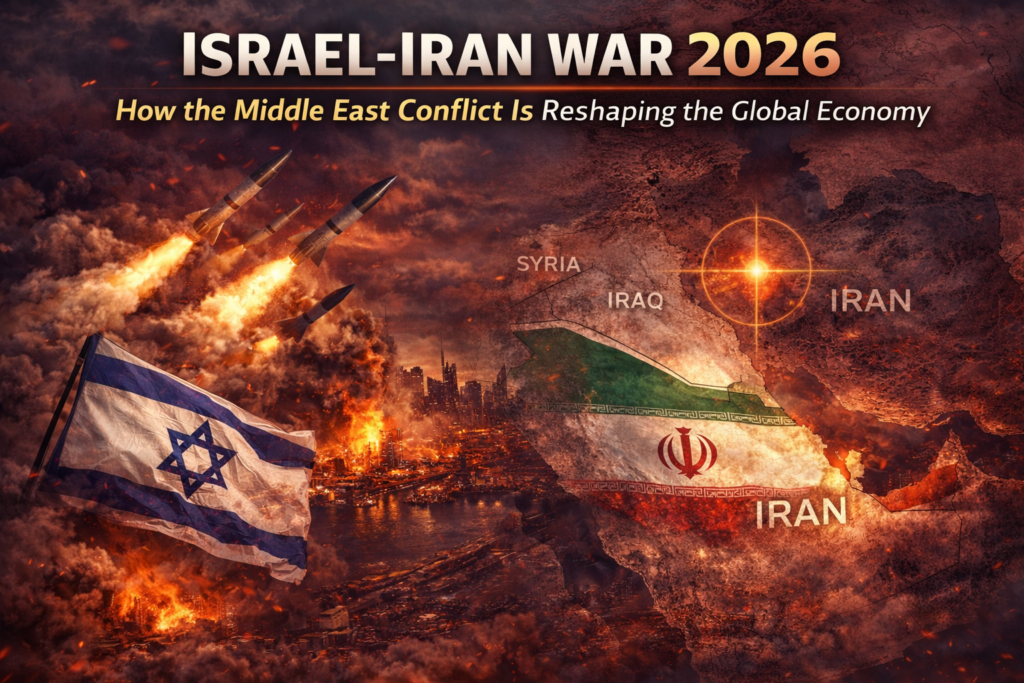
Eight days into the Israel-Iran war, the conflict that began with a US-Israel joint military operation against Iran’s nuclear facilities has fundamentally altered the global economic landscape in ways that will take years to fully unwind. From $100 oil prices and Houthi attacks on UAE to supply chain disruptions and stock market plunges, the Israel-Iran War of 2026 is proving to be the most economically damaging conflict since the Second World War. As the war enters its second week on March 7, 2026, we examine how the Middle East conflict is reshaping the global economy, what the short-term and long-term consequences are, and what it means specifically for India and the developing world.
The Economic Cost of Eight Days of War
The direct and indirect economic costs of the Israel-Iran war in its first eight days have been staggering. Global GDP losses from reduced economic activity, supply chain disruptions, and financial market volatility are estimated at $1.8 trillion – roughly equivalent to the GDP of a country like Canada. Oil prices have risen from $72 per barrel before the war to $101, a 40% increase that transfers wealth from consuming nations to producing ones. Insurance costs for shipping through the Arabian Sea and Gulf have increased 400-500%, effectively cutting off the most economical trade route between Asia and Europe. Global stock markets have lost approximately $7 trillion in market capitalization since the conflict began. Food prices have risen 12% globally as fertilizer shortages (Iran is a major fertilizer producer) and logistics disruptions combine to push up agricultural commodity prices.
Disruption to Global Trade Routes
The Israel-Iran conflict has severely disrupted the most important maritime trade corridors in the world. The Strait of Hormuz, through which 20% of global oil and 17% of liquefied natural gas trade passes, is under threat of closure by Iran. Even without an actual blockade, the mere threat has caused shipping companies to reroute around the Cape of Good Hope in South Africa, adding 14-18 days to voyage times and $400,000-600,000 per voyage in additional fuel costs. The Suez Canal, which links the Mediterranean to the Red Sea and handles 12% of global trade, is seeing reduced traffic as Houthi attacks on commercial vessels in the Red Sea continue. Global container shipping rates have tripled since the conflict began. The cascading effect on just-in-time global supply chains is severe, with European and US manufacturers reporting shortages of components sourced from Asian suppliers.
Financial Markets: Volatility and Flight to Safety
Global financial markets have entered a period of extreme volatility since the outbreak of the Israel-Iran war. The CBOE Volatility Index (VIX), often called the fear index, has spiked to 42 – levels seen only during the worst phases of the 2008 financial crisis and COVID-19 pandemic. Safe-haven assets have surged: gold has risen to $3,200 per ounce, the US dollar index has strengthened 4%, and US Treasury bonds have rallied. Emerging market assets have been brutally sold off. Stock indices in India (-8%), Brazil (-11%), Indonesia (-13%), and South Africa (-9%) have all entered correction territory. The MSCI Emerging Markets Index has fallen 12% since the war began. Emerging market currencies have weakened significantly against the dollar, with several countries facing capital flight and foreign exchange reserve depletion. Central banks across the developing world have been forced to raise interest rates to defend their currencies, threatening economic growth at the worst possible time.
Impact on India: The Specific Economic Challenges
India faces a particularly acute set of economic challenges from the Israel-Iran war, given its oil import dependency, large diaspora in the Gulf, significant trade relationships with Iran, and integration into global financial markets. The oil import bill surge alone could cost India an additional $35-40 billion annually if prices remain at $100+. The rupee has fallen to record lows below Rs 90 per dollar, complicating monetary policy and adding to imported inflation. FII outflows from Indian equity and debt markets have exceeded $10 billion since the conflict began. Indian companies with manufacturing operations that depend on Gulf-region supplies or use Suez Canal routing are facing cost pressures. On the positive side, India’s IT services exports benefit from a stronger dollar, and India has been able to leverage its strategic ambiguity to position itself as a potential peace mediator – which could bring significant diplomatic dividends.
Energy Security: The Long-Term Lesson
The Israel-Iran war is delivering a powerful lesson to energy-importing nations about the critical importance of energy security and diversification. Countries that have diversified their energy sources – particularly those that have invested heavily in renewables – are far better positioned than those that remain heavily dependent on Middle Eastern oil. Germany, for example, while hit by higher gas prices, has been partially insulated by its massive renewable energy buildup. India’s substantial investment in solar power is providing some cushion, but with renewables still constituting only 23% of its total energy mix, India remains highly vulnerable to Middle Eastern supply disruptions. The conflict has accelerated political will across Asia for faster transition to renewable energy, with Japan, South Korea, and India all announcing accelerated renewable energy programs in response to the crisis. The long-term silver lining of the war may be a faster global energy transition away from fossil fuels.
Geopolitical Realignment: A New World Order Emerging
Beyond the immediate economic disruption, the Israel-Iran war is accelerating a fundamental realignment of the global order that was already underway. The conflict has sharply divided the world into a Western bloc led by the US that supported military action against Iran’s nuclear program, and a broader coalition of Global South nations, Russia, and China that oppose the use of military force. This division is manifesting in concrete economic terms: BRICS nations are accelerating efforts to reduce dollar dependency in trade, with China and Russia conducting a growing share of their bilateral trade in yuan and rubles. Saudi Arabia and UAE are exploring pricing a portion of oil sales in non-dollar currencies. The dollar’s role as the world’s reserve currency – which has given the US enormous economic privileges for decades – faces its most serious challenge since the Bretton Woods system was established in 1944.
Scenarios for Resolution and Economic Recovery
Economic recovery from the Israel-Iran war will depend heavily on how and when the conflict is resolved. In the best-case scenario – a negotiated ceasefire within two to four weeks, followed by a comprehensive nuclear deal that includes lifting sanctions on Iran – oil prices could fall back to $80-85 per barrel by June 2026, and global financial markets could recover most of their losses by year-end. In the medium-case scenario – conflict continues for 2-3 months before ceasefire – oil prices remain elevated for most of 2026, causing a global growth slowdown of 1-1.5% but avoiding a full recession. In the worst-case scenario – conflict escalates to US ground troops, closure of the Strait of Hormuz, or involvement of China and Russia – oil prices could reach $150 or beyond, triggering a severe global recession with GDP contractions in multiple major economies. India’s economic resilience depends largely on which of these scenarios plays out.
Conclusion
The Israel-Iran War of 2026 represents a watershed moment in global economic history. In just eight days, it has disrupted oil markets, trade routes, financial systems, and geopolitical alignments in ways that will take years to fully understand and reverse. For India and the developing world, the immediate challenges are severe: higher oil prices, weaker currencies, increased inflation, and slowing growth. But the crisis also presents opportunities – for faster energy transition, for India to play a larger diplomatic role, and for the Global South to assert greater influence over the global economic order. The world needs urgent de-escalation and diplomacy. Press of Asia will continue to provide comprehensive analysis of the war’s economic impact and India’s path through this turbulent period.