
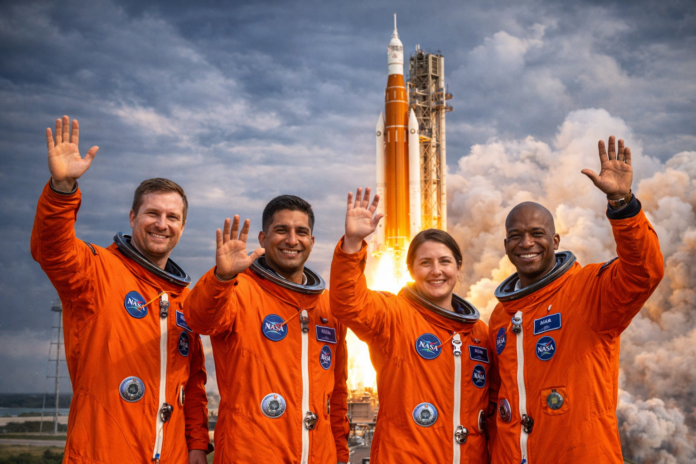

Kennedy Space Center, Florida / New Delhi, April 2, 2026: Humanity returned to the Moon on Wednesday as NASA’s Artemis II mission successfully lifted off from Kennedy Space Center’s Launch Complex 39B at 6:35 p.m. EDT (4:05 a.m. IST, April 2), marking the first time in over half a century that astronauts have journeyed toward the lunar surface. The landmark launch, which went off on April 1, 2026, sent four crew members on a 10-day voyage around the Moon and back — the most ambitious crewed space mission since the Apollo programme ended in December 1972.
The mission carries NASA astronauts Commander Reid Wiseman, Pilot Victor Glover, and Mission Specialist Christina Koch, along with Canadian Space Agency (CSA) astronaut Mission Specialist Jeremy Hansen. Together, they are travelling aboard the Orion spacecraft, mounted atop NASA’s powerful Space Launch System (SLS) rocket. The mission is a critical test flight designed to pave the way for the Artemis III mission, which aims to land astronauts on the Moon’s surface — potentially becoming the first human Moon landing since Apollo 17 in 1972.
Liftoff: A Historic Moment for All Humanity
The Artemis II launch was watched live by millions around the world, including from India where space enthusiasts stayed awake through the early hours of April 2 to witness the historic event. Commander Reid Wiseman summed up the spirit of the mission with a memorable phrase before liftoff: “We go for all humanity.” The 10-day mission will see the crew travel further from Earth than any human being has ventured since the final Apollo mission.
NASA confirmed that the Orion capsule successfully separated from the SLS upper stage after liftoff, and that the spacecraft is now on its trajectory toward the Moon. The crew has also begun manually flying the Orion capsule as part of a series of critical tests, and mission controllers have noted a minor technical issue with the spacecraft’s onboard toilet system, which is being managed in real time. Despite this, the mission is reported to be proceeding smoothly.
Mission Timeline: What Happens Over the Next 10 Days
- April 1-4: Orion transits from Earth orbit toward the Moon, crew performs spacecraft systems tests.
- April 6: Orion is expected to reach the Moon and perform a lunar flyby, passing within a few thousand kilometres of the lunar surface before looping around.
- April 7-10: Return transit to Earth, splashdown targeted for the Pacific Ocean on approximately April 10-11, 2026.
The mission is designed not to enter lunar orbit but to fly a “free-return trajectory” around the Moon — meaning the spacecraft will use the Moon’s gravity to slingshot it back toward Earth without requiring additional engine burns. This approach maximises safety while allowing NASA to test the crew’s ability to operate Orion under deep-space conditions.
Why Artemis II Matters: The Return to the Moon
Artemis II is the second flight of NASA’s Space Launch System and the first crewed mission of the Orion spacecraft. It follows the successful uncrewed Artemis I mission in 2022, which tested the SLS and Orion systems without a crew. If Artemis II succeeds in its objectives, it will set the stage for Artemis III, which is planned to land the first woman and the next man on the Moon, with the South Pole of the Moon as the targeted landing region.
The significance of Artemis extends far beyond national pride. NASA envisions the Artemis programme as the foundation for sustained human presence in deep space, including the eventual goal of sending humans to Mars. The Artemis missions are building the infrastructure, knowledge, and technology that will be needed for multi-month deep-space missions in the coming decades.
Meet the Artemis II Crew
Commander Reid Wiseman is a veteran US Navy test pilot and NASA astronaut who previously served aboard the International Space Station (ISS). Pilot Victor Glover, also a Navy test pilot and NASA astronaut, made history in 2020-21 as the first Black astronaut to live aboard the ISS for a long-duration mission. Mission Specialist Christina Koch holds the record for the longest single spaceflight by a woman, having spent 328 days aboard the ISS in 2019-20. Mission Specialist Jeremy Hansen is a Canadian astronaut and CF-18 fighter pilot who will become the first Canadian to travel to the Moon.
India and the Artemis Programme
India has a significant stake in the broader context of the global return to the Moon. The Indian Space Research Organisation (ISRO) achieved its own landmark lunar success in August 2023 when Chandrayaan-3 became the first mission to successfully land near the Moon’s South Pole. India is also a signatory to the Artemis Accords, a set of principles for international cooperation in space exploration promoted by NASA, and ISRO has been in discussions about potential collaboration on future lunar and deep-space missions.
The Artemis II launch adds powerful momentum to the global race to return to the Moon, with multiple nations — including China, which is also targeting a crewed lunar landing later this decade — watching developments closely. For the four astronauts now making their way toward the Moon aboard Orion, the mission represents the next giant leap in humanity’s journey beyond our home planet.
Global Space Race: The Context Around Artemis II
The Artemis II launch comes at a pivotal moment in the global space race. China has been advancing its own crewed lunar programme rapidly, with the China National Space Administration (CNSA) planning to land taikonauts on the Moon before 2030. Russia, European nations, Japan, and others are also pursuing various lunar and deep-space programmes. The renewed competition and cooperation in space exploration has revived public interest and political investment in space science at levels not seen since the height of the original Space Race in the 1960s.
In this context, Artemis II carries symbolic weight that extends well beyond its scientific and engineering objectives. It signals that the United States remains committed to its leadership role in space exploration despite political and budgetary headwinds in recent years. The mission also demonstrates the viability of the SLS and Orion systems after years of development and delays, and provides critical data that will inform every aspect of future crewed missions, from life support systems to navigation and communication.
What Comes After Artemis II?
If the Artemis II mission is successful, NASA plans to move forward with Artemis III, which aims to land astronauts at the lunar South Pole — a region of great scientific interest because it is believed to contain significant deposits of water ice. This ice could potentially be harvested for use as drinking water, oxygen, and rocket propellant in future missions, making the South Pole a critical location for establishing a long-term human presence on the Moon. NASA is targeting Artemis III for launch in the next few years, pending the successful outcome of the current mission and the readiness of the commercial lunar lander being developed by SpaceX.
For now, all eyes are on the four brave astronauts aboard Orion as they journey deeper into space than any human being has travelled since 1972. Their successful return will mark a new chapter not just for NASA and the United States, but for all of humanity’s ambition to explore, understand, and ultimately settle beyond the boundaries of our home world.