
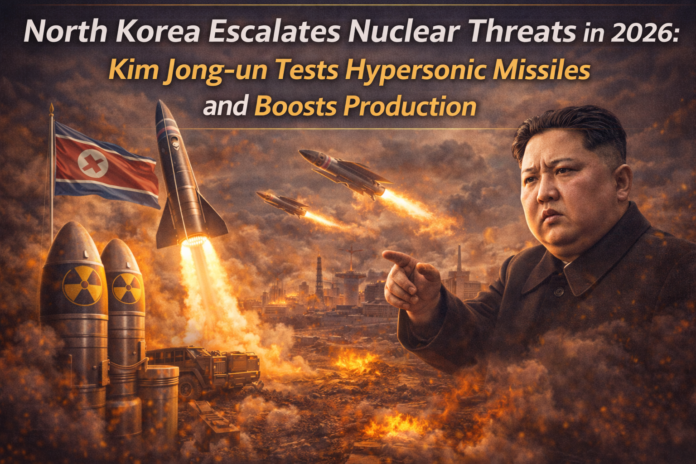

North Korea has significantly escalated its nuclear and missile activities in 2026, conducting multiple rounds of weapons tests that have alarmed the international community and heightened tensions on the Korean Peninsula. Leader Kim Jong-un has ordered a dramatic increase in missile production, personally overseeing tests of hypersonic missiles and nuclear-capable rocket systems. With the United States and South Korea continuing their joint military exercises, Pyongyang has responded with increasingly provocative weapons demonstrations, pushing Northeast Asia to the edge of a new security crisis.
Kim Jong-un’s Missile Tests in Early 2026
The year 2026 opened with a dramatic show of force from North Korea. On January 4, 2026, Kim Jong-un supervised the launch of hypersonic missiles, which successfully struck targets approximately 1,000 kilometers away over the waters to the east of North Korea. This event marked Pyongyang’s first ballistic missile test of the year, and Kim used the occasion to emphasize the necessity for a formidable nuclear deterrent. In March 2026, South Korea’s military detected approximately 10 ballistic missiles fired from North Korea’s capital region toward the eastern sea. The launches coincided with US-South Korean Freedom Shield training exercises, which North Korea views as rehearsals for an invasion. Kim Jong-un, accompanied by his teenage daughter, observed a live-fire test of multiple rocket launch systems from North Korea’s east coast. North Korea’s official Korean Central News Agency reported that Kim watched the strike drill involving twelve 600mm-calibre, ultraprecision rocket launchers. Kim described the exercise as routine, aimed at verifying the country’s defensive capabilities, and announced it would be repeated frequently. In March 2026, North Korea conducted its second cruise missile test from a new warship, with Kim executing a remote launch to test command and control capabilities. These tests collectively represent a significant escalation of North Korea’s weapons activities and demonstrate rapid advancements in its military technology.
North Korea’s Military Doctrine: Deterrence Through Strength
Kim Jong-un has articulated a clear military doctrine for North Korea in 2026: lasting peace through deterrence, not aggression. In a speech at one of the missile tests, Kim insisted that the weapons programme is designed to maintain what he called lasting peace through deterrence, countering what he described as aggressive American and South Korean military posturing. This doctrine of military self-sufficiency and deterrence reflects North Korea’s deep-seated fear of regime change, which has been amplified by what Pyongyang views as American hostility, including devastating economic sanctions, regular military exercises on its doorstep, and the stated goal of denuclearisation, which North Korea interprets as a demand for unilateral disarmament. North Korea has observed what happened to Iraq’s Saddam Hussein and Libya’s Muammar Gaddafi after they gave up their weapons programmes, and the lesson drawn by Kim Jong-un is clear: nuclear weapons are the ultimate guarantee of regime survival. Kim Jong-un has ordered North Korea to boost missile production in 2026, with state media reporting that he has directed the military-industrial complex to dramatically increase the output of precision-guided missiles, hypersonic glide vehicles, and nuclear-capable long-range rockets. This suggests that North Korea’s military buildup is not merely symbolic but represents a serious and sustained effort to build a credible nuclear arsenal.
North Korea-Russia Military Cooperation in 2026
A significant development in 2026 has been the deepening of military cooperation between North Korea and Russia. North Korea has reportedly supplied artillery shells, missiles, and troops to Russia for use in the Ukraine war, in exchange for advanced military technology, economic assistance, and political support. This partnership has alarmed Western governments and South Korea, as it gives North Korea access to Russian military technology that could accelerate its own weapons development programme. The US and its allies have sanctioned North Korean officials and entities involved in this military relationship, but the sanctions have had limited impact on a country already subject to the world’s most comprehensive sanctions regime. Russia’s provision of advanced aerospace and missile technology to North Korea represents a potentially game-changing development, as it could dramatically shorten the timeline for North Korea to develop miniaturised nuclear warheads capable of being mounted on its intercontinental ballistic missiles. Analysts have warned that North Korea may already possess the capability to strike the continental United States with nuclear-armed ICBMs, and that Russian technological assistance could make this capability even more reliable and accurate.
International Response: Sanctions, Diplomacy, and Deterrence
The international community’s response to North Korea’s escalating weapons activities has been largely ineffective. The United Nations Security Council has been unable to pass new sanctions resolutions because Russia and China, both veto-wielding members, have blocked Western-sponsored measures. China, which provides the vast majority of North Korea’s food and energy imports, has been reluctant to exert the maximum pressure that could genuinely constrain Pyongyang’s behaviour, fearing the collapse of the North Korean state and a potential refugee crisis on its border. The United States has deployed additional military assets to the region, including aircraft carrier groups, long-range bombers, and nuclear-capable submarines, as part of extended deterrence commitments to South Korea and Japan. South Korea, under President Lee Jae Myung, has been pursuing a dual-track policy of maintaining strong military deterrence while also keeping the door open to dialogue with North Korea. Japan, deeply concerned about North Korea’s missile capabilities, has been accelerating its own rearmament programme, including the acquisition of counter-strike capabilities. There is growing recognition in Washington and Seoul that diplomacy with North Korea is unlikely to produce meaningful results in the near term, and that the focus must shift to strengthening deterrence and developing better missile defence systems.
What Lies Ahead: The Korean Peninsula in 2026
As April 2026 progresses, the security situation on the Korean Peninsula remains highly dangerous. North Korea shows no signs of slowing its weapons development programme, and the international community has few effective tools to constrain it. Kim Jong-un’s decision to bring his daughter to missile tests suggests that he is thinking about the long-term future of the Kim dynasty and its nuclear arsenal, not about negotiating it away. The possibility of another inter-Korean dialogue or US-North Korea summit cannot be entirely ruled out, as diplomacy has historically produced temporary pauses in provocations. However, without a fundamental change in North Korea’s security calculus, any dialogue is unlikely to produce the comprehensive denuclearisation that the US and its allies demand. The challenge for the international community is to manage the risk of escalation while maintaining a credible deterrent posture. One miscalculation — a missile test that goes wrong, a military exercise misinterpreted as a real attack, or a conventional incident along the border — could trigger a catastrophic conflict with nuclear dimensions. The Korean Peninsula remains one of the most dangerous flashpoints in the world in 2026.