
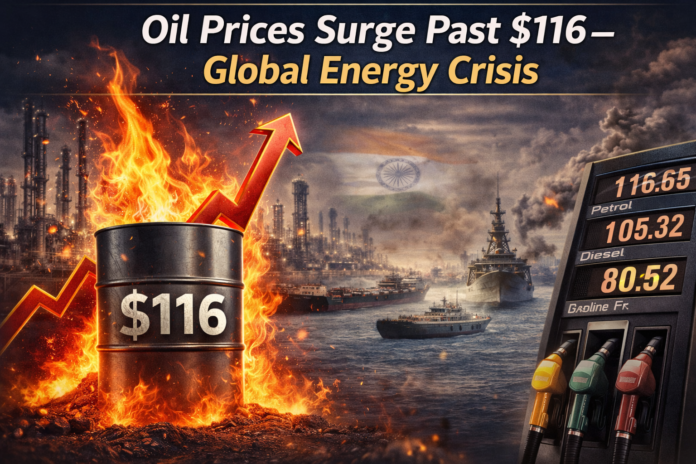

New Delhi, March 30, 2026: Global crude oil prices surged past $116 per barrel on Monday morning, reaching their highest level in nearly two weeks, as the Iran-US-Israel war entered a new phase of escalation. Brent crude jumped more than 3 percent in early Asian trading, driven by fears of a full US ground invasion of Iran and Iran’s retaliatory attacks spreading to Gulf neighbours. The oil price shock is sending tremors through the global economy and hitting India particularly hard, threatening energy security, inflation, and the livelihoods of millions.
Oil Hits $116: The Biggest Energy Crisis in Decades
Brent crude oil, the global benchmark, crossed $116 per barrel on March 30, 2026 — its highest since March 19, when it briefly touched $119. Since the war began on February 28, 2026, oil prices have surged nearly 60 percent, rising from under $80 per barrel just one day before the conflict erupted. Energy market experts warn that prices could climb to $120 and beyond if the Strait of Hormuz remains blocked or under threat. Greg Newman, CEO of Onyx Capital Group, stated that energy markets are only now beginning to feel the full impact of the disruption, as global oil supply chains operate on loading cycles of several weeks.
The primary driver of rising oil prices is Iran’s effective blockade of the Strait of Hormuz, the narrow waterway through which approximately 20 percent of the world’s oil and liquefied natural gas passes every day. Iran has weaponised this strategic chokepoint in retaliation for US and Israeli military strikes. Any vessel attempting to pass must now obtain clearance codes and accept escort by Iran’s Islamic Revolutionary Guard Corps (IRGC) through a single controlled corridor — a requirement that most Western shipping companies have refused to comply with, significantly reducing oil flow through the channel.
Iran Warns of Ground Invasion; Kuwait Hit by Iranian Strike
The situation dramatically worsened on March 30 when Iran accused the United States of plotting a ground invasion. The Speaker of Iran’s parliament issued a chilling warning, stating that Iran was prepared to “set them on fire” and punish US regional allies if American troops set foot on Iranian soil. This came as Iranian-backed forces launched attacks on Israel for the first time in this conflict, and Israel simultaneously expanded its military operations into southern Lebanon, pushing towards the Litani River.
In a significant escalation, Iran attacked a power and desalination plant in Kuwait, killing one worker — an Indian national — and causing severe material damage. The attack on Kuwait marks the first time in this conflict that a Gulf Cooperation Council (GCC) member state has been directly hit, raising fears that the war is spreading beyond Iran’s immediate borders. Kuwait’s government condemned the strike, and the incident has triggered deep anxiety among the 8 million Indian workers living across the Gulf region.
India’s Energy Security Under Serious Threat
India imports approximately 85 percent of its crude oil needs, with the Middle East supplying the bulk of this requirement. The Strait of Hormuz is therefore a lifeline for India’s energy system. Any prolonged disruption to oil flows through the Strait directly affects India’s ability to power its factories, vehicles, farms, and homes. Petrol and diesel prices in India have remained officially unchanged as of March 30, 2026, as the government absorbs higher costs through reduced margins on petroleum products. However, economists warn this buffer cannot last indefinitely.
The Indian government has officially rejected viral claims circulating on social media that India has only 5-10 days of oil reserves, calling such information “incorrect” and “baseless.” India maintains strategic petroleum reserves at underground rock caverns in Visakhapatnam, Mangaluru, and Padur that can supply roughly 9-12 days of consumption at current import rates. Additionally, India has been diversifying its oil supply chain, increasing imports from Russia, the United States, and West Africa to reduce dependence on Middle Eastern sources. However, Russian oil too transits through routes affected by the broader conflict, and American oil is significantly more expensive.
Indian Economy: Rupee Pressure, Inflation Risk and the Stock Market
The oil price surge is already feeding into the Indian economy in multiple ways. The Indian rupee has come under renewed pressure as higher oil import bills widen the current account deficit and push capital outflows. The Reserve Bank of India has been intervening in currency markets to stabilise the rupee, but its foreign exchange reserves, while substantial, are not unlimited. A sustained oil price shock of $116 or above is estimated to add approximately 0.5-0.8 percent to India’s inflation rate, eroding purchasing power for ordinary consumers who are already dealing with rising food prices.
Indian equity markets have shown significant volatility in response to the war, with energy sector stocks and aviation companies bearing the brunt. Higher jet fuel prices are squeezing airline margins, and shipping companies face soaring insurance premiums for vessels operating near the Persian Gulf. The broader Sensex and Nifty indices have been volatile, reflecting investor uncertainty. Meanwhile, gold prices have surged as investors globally seek safe-haven assets, and this trend is clearly visible in Indian gold markets as well, where prices have risen sharply since February 28.
Indian Workers in the Gulf: Safety Concerns Mount
The death of an Indian worker in the Iranian attack on Kuwait’s power plant has sharpened concerns about the safety of the approximately 8 million Indians working across the Gulf Cooperation Council countries — Saudi Arabia, UAE, Qatar, Kuwait, Bahrain, and Oman. These workers send home an estimated $40 billion in remittances each year, making the Gulf diaspora a critical pillar of India’s economy. Any mass evacuation or disruption to their employment would have devastating consequences for millions of Indian families.
The Ministry of External Affairs has set up emergency helplines and is coordinating with Indian embassies across the region. Air India has announced 30 scheduled and non-scheduled flights to and from the West Asia region to assist Indians who wish to return home. However, government officials have also urged Indian workers not to panic and to follow guidance from local authorities and Indian consulates. The situation is being monitored at the highest levels, with Prime Minister Modi personally overseeing India’s response to the crisis.
UN Task Force and Diplomatic Efforts
The United Nations has launched an emergency task force to design a mechanism for keeping vital trade flowing through the Strait of Hormuz. The task force, led by Jorge Moreira da Silva, Executive Director of the UN Office for Project Services (UNOPS), includes representatives from the UN Conference on Trade and Development (UNCTAD), the International Maritime Organization (IMO), and the International Chamber of Commerce (ICC). The mechanism is modelled on successful precedents like the Black Sea Grain Initiative, which kept Ukrainian grain flowing during the Russia-Ukraine war.
Diplomatic efforts are also ongoing on multiple fronts. Pakistan is hosting top diplomats from Saudi Arabia, Turkey, and Egypt in Islamabad to discuss mediation between the US and Iran. The United States presented a 15-point peace proposal to Iran through Pakistan on March 24, and President Trump announced a pause on targeting Iranian energy infrastructure. However, Iran remains deeply skeptical of American intentions, and the military conflict continues to escalate even as diplomats talk. The path to a ceasefire remains uncertain, and the global economy — including India — will continue to feel the pain until a resolution is found.