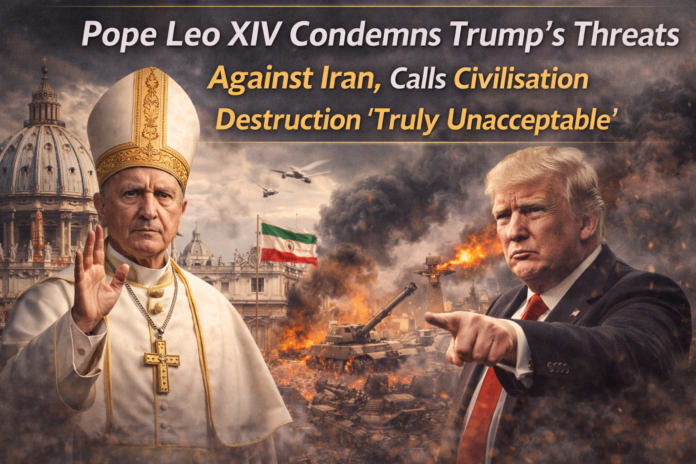

Vatican City, April 8, 2026 — Pope Leo XIV on Tuesday sharply condemned United States President Donald Trump’s threatening statements toward Iran, declaring that Trump’s warning that “a whole civilisation will die tonight” if Tehran did not yield to American demands was “truly unacceptable.” The pontiff’s remarks, delivered from the Vatican, were among the strongest public criticisms by a religious leader since the outbreak of the US-Iran conflict, and they underscore the Vatican’s traditional stance of advocating for diplomacy and dialogue in times of war.
The statement came at a time of extreme tension in the Middle East, with the US military having carried out more than 800 strikes against Iranian targets before a fragile two-week ceasefire was announced by President Trump. Despite the ceasefire, the rhetoric from Washington remained highly charged, and the Pope’s intervention was seen as a direct plea to both sides to choose peace over annihilation.
The Pope’s Message: Peace Over Power
In his statement, Pope Leo XIV implored world leaders to seek a peaceful resolution to the ongoing conflict. The Pope emphasized that threats involving mass civilian casualties were fundamentally at odds with human dignity and international humanitarian law. He specifically called on all parties, including the United States and Iran, to prioritize the protection of civilian lives and to commit to genuine negotiations rather than escalating military posturing.
The Vatican has consistently called for dialogue and de-escalation since the beginning of the US-Iran conflict. Pope Leo XIV, who assumed the papacy earlier this year, has made peace and human dignity cornerstones of his pontificate. His intervention in the Iran crisis marks one of his most direct and public engagements in an active military conflict, reflecting the gravity of the situation as seen from the Holy See.
The Pope’s statement drew widespread attention internationally. World leaders and civil society organizations alike took note of the Vatican’s moral authority in calling out what many considered dangerous and inflammatory language from the White House. Human rights organizations echoed the Pope’s concerns, pointing to existing civilian casualties in Iran as a result of the ongoing strikes.
Trump’s ‘One Night’ Warning and Ceasefire Announcement
Prior to the ceasefire, President Trump had issued an extraordinary threat on social media and in public statements, warning Iran that it could be “destroyed in one night” if it did not comply with US demands. This rhetoric, unprecedented in modern diplomatic history for its bluntness, sparked international condemnation from multiple quarters, including allies of the United States.
The statement came in the context of a military campaign in which the US, alongside Israel, had conducted an extensive aerial bombing campaign targeting Iranian military infrastructure, nuclear sites, and command-and-control facilities over the course of several weeks. Iran responded with missile attacks on US military bases and Israeli territory, escalating the conflict to a level not seen in the Middle East since previous major wars.
The subsequent announcement of a two-week ceasefire, however, signaled that back-channel diplomacy had been working even as public rhetoric remained fierce. According to US officials, the ceasefire was contingent on Iran reopening the Strait of Hormuz to international shipping. The US military had reportedly carried out over 800 strikes before Trump declared the truce. The ceasefire was generally welcomed internationally, though analysts cautioned that the underlying issues between the US and Iran — including Iran’s nuclear program, regional influence, and proxy forces — remained deeply unresolved.
Iranians Take to Streets in Defiance as Vatican Calls for Peace
While Pope Leo XIV called for peace from the Vatican, the streets of Iranian cities were filled with thousands of citizens who had formed human chains on bridges and central squares in a show of national solidarity and defiance. The demonstrations, which intensified in the days before the ceasefire following Trump’s most aggressive threats, saw Iranians from all walks of life coming together to condemn what they described as American aggression and to express support for their armed forces.
The demonstrations were organized partly by the Iranian government, which called on citizens to show unity and protect national infrastructure. However, independent observers noted that many participants appeared to be motivated by genuine patriotism and fear rather than political instruction alone. International news agencies reported that the crowd sizes on the evening before the ceasefire announcement were among the largest since the conflict began.
The Iranian government dismissed Trump’s threats as empty bluster but acknowledged the seriousness of the ongoing military campaign. Iranian Foreign Ministry officials called on the international community, including Pope Leo XIV and other world leaders, to take stronger action to hold the US and Israel accountable for what Tehran described as war crimes against Iranian civilians.
The ceasefire has provided a temporary pause in the violence, and the Vatican’s moral pressure — along with condemnation from multiple world leaders, including European heads of state and Pope Leo XIV — is being credited by some analysts as having contributed to the diplomatic environment that made the agreement possible. As the two-week window begins, all eyes are on whether the fragile truce can be transformed into a sustainable peace.