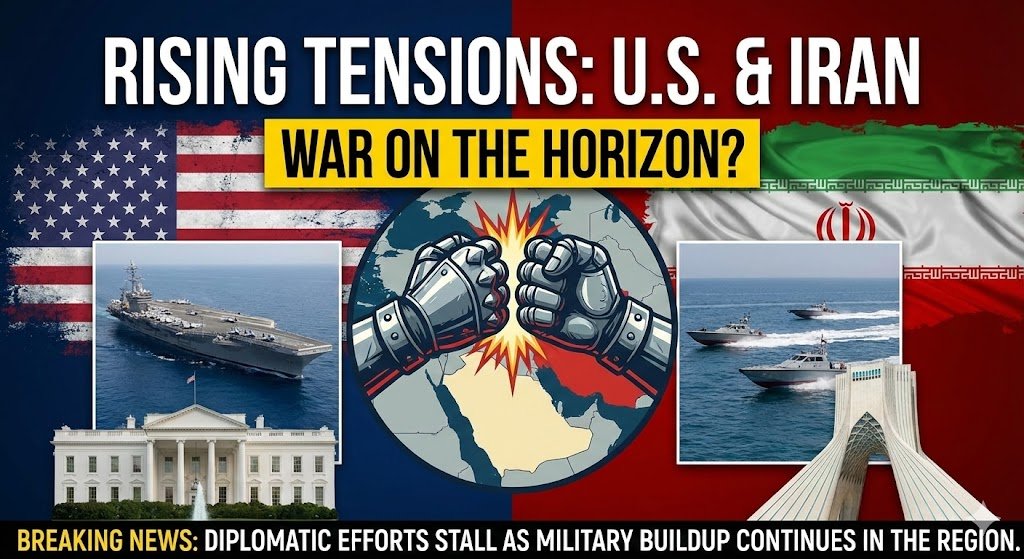
Tensions between the United States and Iran have once again reached a critical point, raising global concerns about the possibility of a direct military conflict. Over the past few months, a series of diplomatic failures, regional confrontations, and military posturing have intensified fears that the long-standing rivalry between Washington and Tehran could escalate into a wider war.
The relationship between the United States and Iran has remained strained since the U.S. withdrawal from the Joint Comprehensive Plan of Action (JCPOA), commonly known as the Iran nuclear deal, in 2018. Since then, negotiations to revive the agreement have repeatedly stalled. The U.S. accuses Iran of advancing its nuclear program beyond agreed limits, while Iran claims it is acting in self-defense against economic sanctions and political pressure imposed by Washington.
Recent developments in the Middle East have further complicated the situation. Iran-backed groups in Iraq, Syria, and Yemen have been involved in attacks targeting U.S. military assets and allies. In response, the United States has carried out airstrikes against militia bases, signaling that it is prepared to use force to protect its interests and personnel in the region. Although both sides deny seeking a full-scale war, the frequency of such incidents has increased the risk of miscalculation.
Another major flashpoint is the Strait of Hormuz, a vital global shipping route through which nearly one-fifth of the world’s oil supply passes. Any military confrontation in this area could disrupt energy markets worldwide, leading to a sharp rise in oil prices and economic instability. Iran has repeatedly warned that it could restrict access to the strait if provoked, while the U.S. Navy maintains a strong presence to ensure freedom of navigation.
The Israel factor also plays a significant role in the escalating tensions. Israel considers Iran’s nuclear ambitions an existential threat and has reportedly conducted covert operations to slow Tehran’s progress. The United States, a key ally of Israel, has reiterated its commitment to preventing Iran from acquiring nuclear weapons, adding another layer of complexity to an already volatile situation.
International reactions have been cautious but concerned. European nations have called for restraint and renewed diplomacy, urging both sides to return to negotiations. Russia and China, meanwhile, have criticized U.S. sanctions and warned against military escalation, emphasizing the need for political solutions.
Despite the aggressive rhetoric and military maneuvers, experts believe a full-scale war is not inevitable. Both the U.S. and Iran are aware that such a conflict would come at a high cost, not only for the region but for the global economy. However, as tensions continue to rise, the margin for diplomatic error is shrinking rapidly.
For now, the world watches closely as events unfold, hoping that diplomacy will prevail over confrontation and that a devastating war can still be avoided.