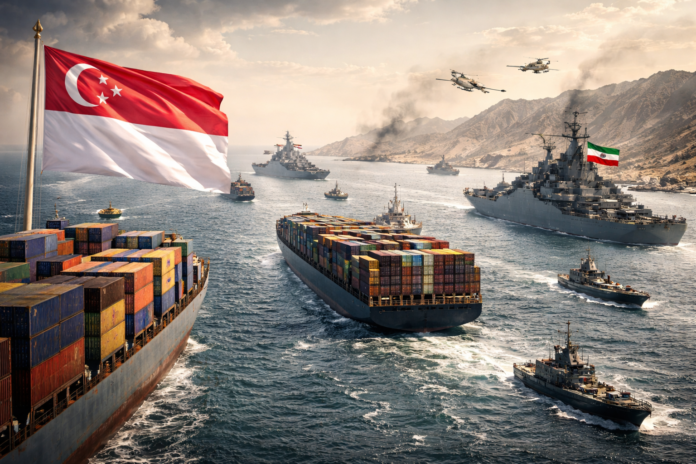

Singapore, April 8, 2026 — Singapore’s Foreign Minister Vivian Balakrishnan made a firm and principled declaration on April 7, stating that Singapore will not negotiate with Iran for safe passage through the Strait of Hormuz, and will not engage in discussions over toll rates for the use of the waterway. Speaking in Parliament, Dr. Balakrishnan made clear that this stance was not about taking sides in the ongoing US-Iran conflict, but was rooted in Singapore’s unwavering commitment to the principles of freedom of navigation under international law, specifically the United Nations Convention on the Law of the Sea (UNCLOS).
“As a matter of principle, and not because we’re taking sides, I cannot engage in negotiations for safe passage of ships or negotiate on toll rates,” Dr. Balakrishnan told Parliament. He emphasized that passage through international straits is a legal right, not a privilege to be negotiated or paid for. Singapore, as one of the world’s most trade-dependent economies and the operator of one of Asia’s busiest ports, has a profound interest in ensuring that international shipping lanes remain open and free.
Singapore’s Stand on UNCLOS and Freedom of Navigation
Singapore’s position is grounded in its longstanding and unwavering adherence to international maritime law. As a small city-state that depends entirely on maritime trade for its survival and prosperity, Singapore has always been among the strongest defenders of the principle that international waterways must remain open to all ships regardless of their flag or destination.
Under the United Nations Convention on the Law of the Sea, vessels of all nations enjoy the right of transit passage through international straits used for navigation. This right cannot be suspended or made conditional by any state, including coastal states. Singapore’s Foreign Minister made clear that this is not a matter of negotiation — it is a matter of international law, and no sovereign state should be expected to negotiate for rights that are already enshrined in international legal frameworks.
Singapore has repeatedly upheld these principles at international forums including the United Nations and ASEAN summits. The city-state’s position resonates strongly with other small and medium-sized nations in Asia and around the world that rely heavily on open sea lanes for their economies. Foreign Minister Balakrishnan’s statement was widely reported across Southeast Asia and received with widespread approval from regional governments and maritime industry stakeholders.
Impact of US-Iran Conflict on Southeast Asia’s Economy
The ongoing conflict between the United States, Israel, and Iran has had significant economic ripple effects across Southeast Asia. Singapore, which serves as a major transshipment hub and financial center, has been among the most closely watching the situation in the Persian Gulf and the Strait of Hormuz.
Economists in Singapore have noted downside risks to the country’s GDP growth forecast as a result of the Middle East conflict. Disruptions to global shipping, higher energy prices, and reduced trade flows through the Gulf have all contributed to uncertainty in Singapore’s economic outlook. Private sector economists who monitor the Singapore economy have largely held their growth forecasts steady for now, but most acknowledge that a prolonged conflict could force significant downward revisions.
Other Southeast Asian nations have also been affected. Thailand’s hotel and tourism sector has reported a significant slump in advance bookings for the second quarter of 2026, with the Middle East war cited as a major factor deterring international visitors. The Thai Hotels Association has urged the government to take action to stabilize the tourism sector. Indonesia’s Bank Indonesia (BI) has been compelled to optimize its monetary instruments and strengthen pro-market monetary operations to stabilize the Indonesian rupiah, which has faced depreciation pressure amid global uncertainty caused by the conflict.
For the Philippines, the war has had a direct human cost, with President Ferdinand Marcos Jr. expressing condolences after a Filipino national was killed in a missile attack in Haifa, Israel. The Philippine government has mobilized resources to assist affected Filipinos in the region.
The Road Ahead: Asia’s Stakes in Middle East Stability
The two-week ceasefire announced by US President Donald Trump, while providing temporary relief to global markets and shipping routes, has not resolved the fundamental tensions underlying the US-Iran conflict. For Singapore and other Asian nations, the next two weeks will be critical in determining whether the fragile truce holds and whether a more durable diplomatic arrangement can be reached.
France’s President Emmanuel Macron has announced that more than 15 countries are planning to coordinate efforts to facilitate safe and unimpeded passage through the Strait of Hormuz, demonstrating the broad international recognition of the waterway’s importance. Singapore’s principled refusal to negotiate with Iran, while standing firm on UNCLOS rights, aligns with this broader multilateral approach.
Asian nations, many of which depend heavily on Middle Eastern oil and gas, have collectively called for a diplomatic resolution to the conflict. China, Japan, South Korea, and India have all expressed support for the ceasefire and urged both sides to use the two-week window productively to reach a lasting agreement. The Association of Southeast Asian Nations (ASEAN), of which Singapore is a founding member and frequently the diplomatic conscience, is expected to issue a collective statement calling for sustained de-escalation.
For Singapore specifically, the stakes are enormous. The Port of Singapore is one of the world’s busiest, handling over 37 million TEUs of container throughput annually. Any prolonged disruption to major shipping routes would directly affect the port’s operations, Singapore’s revenues, and the broader regional economy. Foreign Minister Balakrishnan’s clear and principled articulation of Singapore’s position on the Strait of Hormuz is thus not just a legal statement — it is a declaration of Singapore’s vital economic interests and its commitment to a rules-based international order.