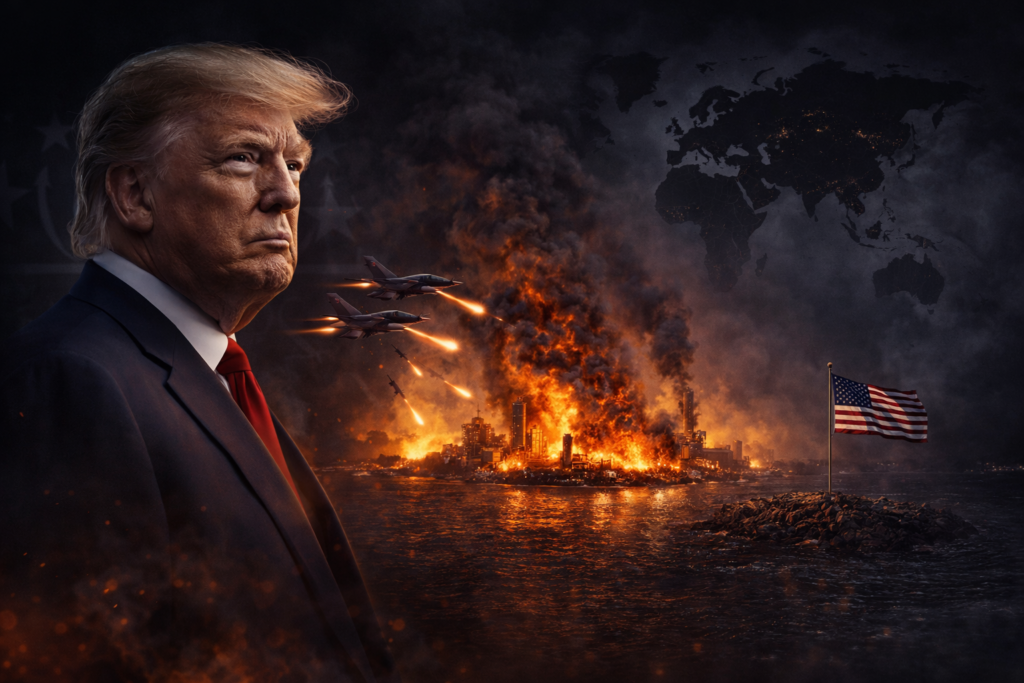
US President Donald Trump made a dramatic pivot in his strategy on March 18, 2026, abandoning his months-long effort to build an international coalition to support the US-Israel war against Iran. In a sharp change of tone, Trump publicly scolded allied nations — including Japan, South Korea, Australia, and NATO members — that had openly rejected his requests for military assistance. At the same time, Trump escalated his threats against Iran, warning that the United States could expand its strikes to Kharg Island, Iran’s most critical oil export hub.
This development marks a significant turning point in the war, which has already entered its 19th day. It signals that the United States and Israel are prepared to continue the conflict without international backing, potentially deepening the global economic consequences and increasing pressure on Asian nations to take sides diplomatically.
How Did Trump’s Coalition Strategy Fail?
From the outset of the US-Israel military campaign against Iran, the Trump administration sought to create a broad international coalition — similar to the ones assembled for the Gulf War in 1991 and the 2003 Iraq invasion. The US approached its closest allies in the Asia-Pacific, Europe, and the Gulf, urging them to either contribute military assets or at least provide political cover for the operation.
However, the response from the international community was overwhelmingly negative. Japan and South Korea, both US treaty allies with significant American military bases on their soil, politely but firmly declined to participate. Australia, another close US security partner, similarly rejected the appeal. NATO’s European members, still focused on their eastern flank with Russia, expressed deep reservations about a military adventure in West Asia that had no UN Security Council mandate.
The reasons cited by these countries varied, but common themes included: concern about the legal basis of the war, fear of domestic political backlash, worry about energy supply disruptions, and a fundamental disagreement with the strategy of military confrontation rather than diplomacy.
Trump’s Response: Fury and Escalation
Trump did not take the rejections quietly. At a press conference on March 18, he publicly named and shamed allies who had declined his request, calling their refusals an act of betrayal and weakness. He accused Japan, South Korea, and Australia of benefiting from US military protection while refusing to share the burden when it mattered most.
The Japanese government responded cautiously, reiterating its constitutional constraints on military engagement abroad. South Korea’s foreign ministry said it remained committed to its alliance with the US but could not participate in offensive military operations outside of a direct threat to the Korean Peninsula. Australia’s Prime Minister said his country was following the situation closely but had no plans to join the conflict.
Despite the setback in coalition-building, Trump doubled down on military pressure. He specifically threatened to expand US strikes to include Kharg Island, the facility through which Iran exports over 90% of its crude oil. This would be a massive escalation, and energy markets reacted immediately to the news.
The Kharg Island Threat: What It Means for Global Energy
Kharg Island, located in the northern Persian Gulf, is the terminal through which almost all of Iran’s oil exports flow. It handles roughly 5-6 million barrels of oil per day. A strike on Kharg Island would not only devastate Iran’s economy — its primary source of foreign exchange — but would also send global oil prices soaring far beyond their current level of approximately $106 per barrel.
Energy economists warn that a successful attack on Kharg Island could push oil prices to $140-$160 per barrel within days. The knock-on effects would be catastrophic for energy-importing nations in Asia, including India, Japan, South Korea, and the Philippines. Inflation would spike, currencies would weaken, and economic growth would slow sharply across the region.
India, which imports approximately 80% of its oil needs, would face a particularly severe shock. Petrol and diesel prices would rise sharply, pushing up food and transportation costs for the average Indian citizen. The government would face an impossible choice between subsidising fuel (draining its fiscal reserves) or passing the cost to consumers (stoking inflation).
China’s Response and the Postponed Xi-Trump Summit
China has emerged as one of the most vocal critics of the US-Israel military campaign. Chinese Foreign Minister Wang Yi has repeatedly called for an immediate ceasefire and a return to diplomacy. On the sidelines, China quietly indicated to Washington that President Xi Jinping would not meet Trump for their planned summit while the war continued.
Trump acknowledged the summit was being postponed, framing it as his own decision. However, diplomatic sources indicate that Beijing’s message was clear: China views the meeting as sending the wrong signal globally and does not want to be seen as endorsing the US military adventure in West Asia. China also has significant economic interests in Iran and the Gulf region, making it a natural opponent of the conflict.
What This Means for Asia’s Security Architecture
The fracture between the United States and its Asian allies over the Iran war has deeper implications for the region’s security architecture. For decades, Asian security has been built on a network of US alliances, bilateral agreements, and shared threat perceptions. The Iran conflict has exposed a significant fault line: US allies in Asia are not willing to follow Washington into a Middle East war that they see as counterproductive and dangerous.
This creates both opportunities and risks for Asian nations. Countries like India, which have maintained a careful policy of strategic autonomy, are well-positioned to play a mediating role. India has ties to both the United States and Iran, as well as influence with Gulf Arab states. New Delhi’s diplomatic engagement could potentially contribute to a ceasefire process.
For Japan and South Korea, the episode has raised uncomfortable questions about the reliability and wisdom of their US alliance, even as they continue to depend on Washington for security guarantees against North Korea and China.
Looking Ahead
As of March 18, 2026, the United States appears committed to continuing the war alongside Israel, with or without international support. Trump’s threat to strike Kharg Island suggests the conflict could enter a dramatically more destructive phase in the coming days. For Asia, the consequences — higher energy prices, disrupted trade, diplomatic realignments — are already being felt and are likely to deepen. Press of Asia will continue to track these developments and their impact on the region.