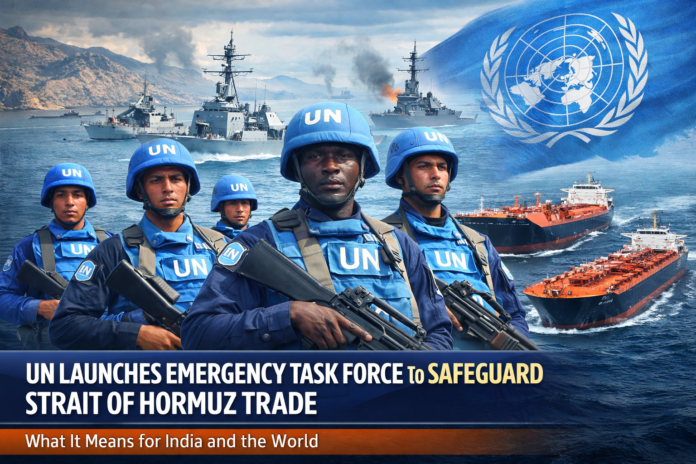

United Nations/New Delhi, March 30, 2026: In a significant multilateral response to the Iran-US-Israel war and the resulting threat to global trade, the United Nations Secretary-General Antonio Guterres has announced the formation of a special emergency Task Force to safeguard trade through the Strait of Hormuz. The announcement comes as oil prices surged past $116 per barrel and global shipping has been severely disrupted by Iran’s partial blockade of the vital maritime chokepoint. For India — one of the world’s largest importers of Middle Eastern oil — the UN move could be a critical lifeline for energy and food supply security.
What Is the Strait of Hormuz and Why Does It Matter?
The Strait of Hormuz is a narrow waterway located between the Gulf of Oman and the Persian Gulf, bordered by Iran to the north and Oman and the UAE to the south. At its narrowest point, it is only about 33 kilometres wide. Despite its modest dimensions, the Strait is one of the most strategically vital waterways in the world — approximately 20 percent of the world’s total oil supply and a substantial share of the world’s liquefied natural gas (LNG) passes through this channel every single day. For context, that is approximately 21 million barrels of oil per day — more oil than the combined daily production of the United States and Russia.
For India, the Strait of Hormuz is not just a geopolitical abstraction — it is literally the channel through which a large portion of India’s crude oil imports arrive. India’s major oil suppliers in the Middle East — Saudi Arabia, Iraq, UAE, Kuwait, and Qatar — all export their oil through the Strait. Any closure or serious disruption would immediately trigger an energy crisis in India, potentially causing petrol, diesel, cooking gas, and electricity prices to spike sharply.
The UN Task Force: Structure and Mission
The UN Task Force will be led by Jorge Moreira da Silva, currently the Executive Director of the United Nations Office for Project Services (UNOPS). The task force includes senior representatives from:
- UN Conference on Trade and Development (UNCTAD) — to address trade disruption impacts
- International Maritime Organization (IMO) — to work on maritime safety protocols
- International Chamber of Commerce (ICC) — to represent global business interests
- Additional specialised entities may be invited as needed
The task force’s primary mandate is to develop and propose technical mechanisms to facilitate the continued flow of humanitarian trade through the Strait, including food, medicines, and critically, fertilisers and related raw materials. The fertiliser angle is particularly important for countries like India, which depend on Gulf-origin fertilisers for agricultural productivity.
Lessons from the Black Sea Grain Initiative
The UN is drawing on its own recent experience in designing this mechanism. The task force is inspired by two key precedents: the Black Sea Grain Initiative (BSGI) — which successfully facilitated the export of Ukrainian grain during the Russia-Ukraine war — and the UN Verification, Inspection and Monitoring Mechanism for Yemen (UNVIM). Under the Black Sea Grain Initiative, the UN brokered an agreement between Russia, Ukraine, and Turkey that allowed Ukrainian grain ships to transit safely through the Black Sea, averting a global food crisis. A similar model, adapted for the Hormuz context, is what the new task force is aiming to replicate.
However, analysts caution that the Hormuz situation is significantly more complex than the Black Sea case. The Iran-US-Israel conflict involves a major military confrontation with direct US and Israeli forces engaged, unlike the Ukraine situation where both sides were willing to negotiate a limited trade arrangement. The success of the Hormuz mechanism will depend heavily on whether Iran — which currently requires IRGC escort for vessels transiting through a controlled corridor — is willing to cooperate with a UN-brokered system.
India’s Urgent Interest in the Task Force’s Success
India has a direct and urgent interest in the UN task force succeeding. With oil prices having surged 60 percent since the war began and the threat of further escalation hanging over the region, India’s policymakers are watching developments closely. India’s Ministry of Shipping had earlier rejected reports suggesting a toll or levy would be imposed on vessels transiting the Strait, terming such claims “baseless” and affirming India’s commitment to freedom of navigation under international law.
Beyond oil, India’s agriculture sector faces significant risk from Hormuz disruptions. India imports large quantities of potash and phosphate fertilisers from the Gulf region — particularly from Oman, Qatar, and Saudi Arabia. Any prolonged disruption in fertiliser supply could affect the upcoming Kharif crop season, with implications for food security and rural incomes. India has been building fertiliser buffer stocks as a precautionary measure, but the Ministry of Agriculture has acknowledged that a sustained blockade lasting beyond two to three months would create serious supply challenges.
The UN’s Broader Diplomatic Push and Pakistan’s Mediation Role
Alongside the task force, UN Secretary-General Guterres has deployed a Personal Envoy — Jean Arnault — to lead political engagement with relevant member states on a broader diplomatic settlement. The envoy will work in parallel with the task force, with the UN hoping that a successful technical arrangement for trade will build confidence and create diplomatic momentum towards a ceasefire.
Pakistan has emerged as an unexpected but critical diplomatic player in this conflict. Islamabad is currently hosting senior diplomats from Saudi Arabia, Turkey, and Egypt for mediation talks. Pakistan earlier secured a limited arrangement allowing Iranian ships to pass through the Strait, and has been the conduit for the 15-point US peace proposal that was transmitted to Tehran. Pakistan’s unique position as a Muslim-majority nuclear-armed state with ties to both the US and Iran gives it a rare mediating leverage. Whether this diplomatic activity can translate into a genuine ceasefire remains deeply uncertain, but the combination of UN-led trade mechanisms and Pakistan-led political mediation represents the most coherent international peace effort seen so far in this conflict. The world — and especially India — is watching with hope.