
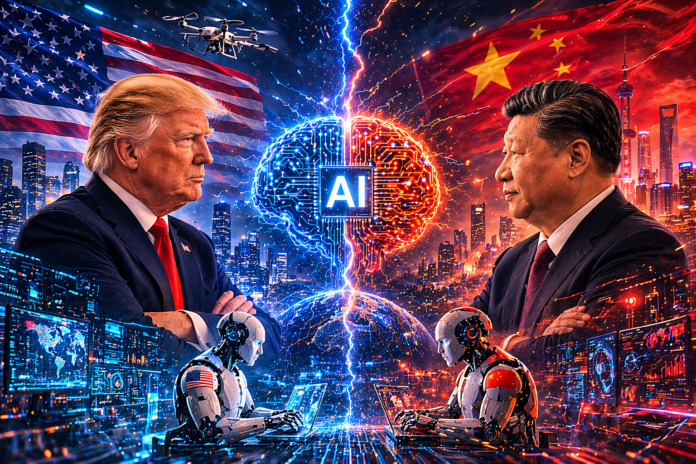

The race for artificial intelligence supremacy has emerged as the defining technological competition of the 21st century, with the United States and China locked in a fierce struggle for dominance that is reshaping economies, militaries, and societies worldwide. In 2026, this competition has entered a critical new phase, with both nations intensifying their investments, strategic initiatives, and diplomatic battles over the technologies that will determine global power for decades to come. The question of who is ‘winning’ the AI race is more complex and nuanced than it first appears — and the answer may ultimately depend on what kind of ‘race’ each country is running.
The DeepSeek Shock: How China Changed the AI Narrative in 2025
The global AI landscape was dramatically reshaped in early 2025 when Chinese AI company DeepSeek released its R1 model, which demonstrated performance rivaling leading US AI systems at a fraction of the computational cost. The DeepSeek moment sent shockwaves through Silicon Valley and Wall Street, erasing hundreds of billions in market capitalization from US AI-related stocks in a single day, as investors suddenly questioned whether America’s massive investments in expensive AI chips and data centers were truly necessary for frontier AI development.
One year after DeepSeek’s rise, the competitive landscape has evolved considerably. China has launched a $47.5 billion fund to boost semiconductor production, a direct response to US chip export restrictions that sought to prevent China from accessing the most advanced AI hardware. Chinese companies including Alibaba, Moonshot AI, and new players have released powerful AI models specifically optimized for efficiency — compensating for their lack of access to the most advanced Nvidia chips through algorithmic innovation and architectural improvements.
A 2025 Stanford AI Index Report highlighted that the AI landscape is becoming ‘increasingly competitive, with high-quality models now available from a growing number of developers.’ The report found that on sheer research output, China had already overtaken the United States, producing more AI publications and filing more AI patents. While US models still led in raw performance on cutting-edge benchmarks, China’s models from Alibaba, DeepSeek, and others were performing competitively in practical applications including translation, coding, reasoning, and customer service.
America’s Strengths: Frontier Models, Compute, and Innovation
Despite China’s remarkable progress, the United States retains significant advantages in several critical areas of AI competition. According to a detailed analysis by Caixing Global, the US leads in AI talent, core foundational model technology, and intelligent computing capacity, with the US controlling approximately 75% of global high-end AI computing capacity compared to China’s 15%.
American companies OpenAI, Google DeepMind, Anthropic, and Meta continue to push the frontiers of large language models, multimodal AI, and the quest for artificial general intelligence (AGI). The US government’s 2026 National AI Action Plan explicitly frames global AI development as a race with strategic implications for national security, economic competitiveness, and military superiority. The plan prioritizes maintaining US leadership in frontier AI models and controlling the global supply of advanced AI hardware through chip export restrictions.
America’s private-sector innovation ecosystem — driven by trillions of dollars in venture capital, a world-class research university system, and the concentration of global AI talent in Silicon Valley — remains unmatched. US AI companies attract top researchers from around the world, including significant numbers of Chinese-origin scientists who have chosen to work in America. However, this talent pipeline has been under pressure, with declining numbers of Chinese students enrolling in US universities and reduced bilateral research collaboration due to geopolitical tensions.
China’s Advantages: Scale, Deployment, and State-Led Strategy
While the United States leads in frontier AI model development, China holds several significant strategic advantages in the broader AI competition. China leads in AI practical deployment — the integration of AI technologies into real-world industries, government services, and everyday life on a massive scale. From AI-powered manufacturing and logistics to facial recognition systems, smart city infrastructure, and AI-driven healthcare, China is deploying AI at an industrial scale that has no parallel in the West.
China’s ‘AI Plus’ initiative, prominently featured in the country’s legislative sessions in March 2026, calls for deeper integration of AI across all sectors of the economy, from manufacturing to education to agriculture. The government’s ability to mandate AI adoption across state enterprises, direct billions in subsidized loans to AI startups, and coordinate data collection from the country’s 1.4 billion people gives China a state-led scaling advantage that purely market-driven US companies cannot easily replicate.
China also holds strategic advantages in the physical infrastructure of AI. The country leads in rare earth mineral production — materials critical for AI hardware manufacturing — and has significantly greater electricity generation capacity than the United States, which is increasingly becoming a bottleneck for the energy-hungry data centers that power AI training. According to Brookings Institution analysis, Chinese AI developers are running ‘multiple AI races’ simultaneously, with different companies competing on efficiency, specific industry applications, and embodied AI in humanoid robots — an area where Chinese companies like Unitree are already globally competitive.
The Semiconductor War: Chips as the New Oil
At the heart of the US-China AI competition lies the battle for semiconductor supremacy. Advanced AI chips — particularly Nvidia’s H100 and H200 GPU series and the next-generation Blackwell architecture — are the foundational infrastructure of modern AI development. The United States has used its control over chip design (dominated by American companies) and chip manufacturing equipment (dominated by US and allied companies including ASML) to impose increasingly strict export controls on China’s access to advanced semiconductors.
China’s response has been a massive state-led push for semiconductor self-sufficiency. The $47.5 billion Chinese semiconductor fund is aimed at developing domestic alternatives to Western chips, though most analysts believe China remains 2-5 technology generations behind the leading edge of chip manufacturing. CNBC’s March 2026 analysis noted that the AI race is now entering a new phase centered on industry-specific applications, with Chinese companies building specialized AI for manufacturing, healthcare, and finance that don’t necessarily require the most advanced chips.
An interesting diplomatic development emerged in late March 2026 when it was reported that the United States had partially relaxed export controls on Nvidia’s H200 chips to China, reflecting a calculated bet that controlled chip sales could preserve US leadership while generating revenue for American chipmakers. Critics argued this move risks weakening America’s long-term computing advantage. Meanwhile, Trump’s planned meeting with Xi Jinping in Beijing — rescheduled to May 2026 due to the Iran war — is expected to address AI and technology competition as a central agenda item.
What the AI Race Means for India and the Rest of the World
For countries like India, the US-China AI race presents both significant opportunities and considerable risks. India is emerging as a potential ‘third force’ in global AI, with its large pool of English-speaking technical talent, growing startup ecosystem, and government initiatives like the IndiaAI Mission that has committed significant funding to building domestic AI infrastructure and research capabilities. However, India faces the challenge of navigating between the two competing AI superpowers without being fully captured by either’s technology ecosystem.
Taiwan, which manufactures the world’s most advanced chips through TSMC, is at the center of the AI race’s hardware component. Analysts have projected 8% GDP growth for Taiwan in 2026, citing AI-driven demand for advanced semiconductors as a primary catalyst. But Taiwan’s central importance to global AI supply chains also makes it the most geopolitically vulnerable point in the entire AI ecosystem, given the ongoing tensions between China and the US over Taiwan’s status.
For the rest of the world, the US-China AI competition is creating a new form of technological bipolarity, where nations must increasingly choose between adopting US AI systems — OpenAI’s GPT models, Google’s Gemini, Amazon’s cloud AI services — or Chinese AI platforms from Alibaba, Baidu, and Huawei. This bifurcation of the global AI landscape into competing American and Chinese technology spheres has profound implications for data sovereignty, national security, economic competitiveness, and the future of the open internet.
As the world enters 2026, the US-China AI race has clearly moved beyond mere technological competition — it is now a fundamental contest for the economic, military, and geopolitical future of the 21st century. The country that achieves leadership in AI will likely enjoy decisive advantages in productivity, innovation, surveillance capability, military power, and soft power for decades to come. The stakes could not be higher.