
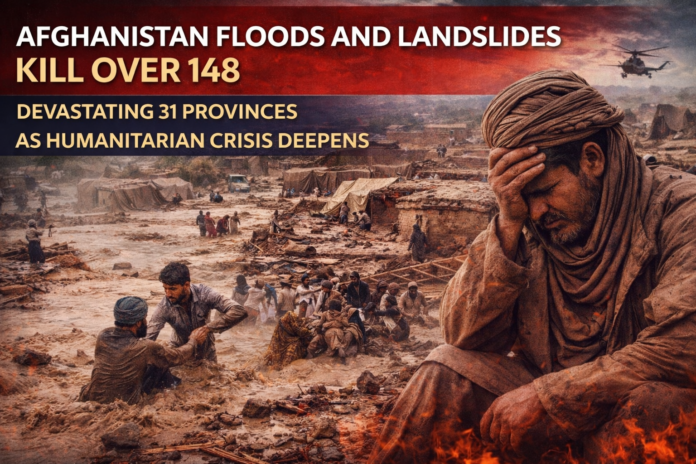

Kabul / Islamabad, April 12, 2026 — A catastrophic series of floods and landslides triggered by heavy monsoon rains has swept through Afghanistan over the past two weeks, killing at least 148 people and injuring 216 others across 31 of the country’s 34 provinces — a disaster of staggering scale that has affected hundreds of thousands of people and destroyed thousands of homes at a time when international attention is focused primarily on the geopolitical crises in the Middle East and Ukraine.
The floods, which began in late March 2026 and have continued in successive waves through early April, represent one of the worst natural disasters to strike Afghanistan in recent years. The scale of the devastation — affecting 31 out of 34 provinces and impacting approximately 73,300 individuals across more than 10,634 families, according to initial assessments by the United Nations Office for the Coordination of Humanitarian Affairs (OCHA) — has overwhelmed the already limited response capacity of the Taliban-controlled government and international aid agencies operating in the country.
At least 9,010 homes have been affected in total, with 7,672 entirely destroyed and 1,338 damaged. Approximately 15,627 jeribs (a traditional unit of land measurement) of agricultural land have reportedly been lost, 543 livestock killed, approximately 200 kilometres of roads damaged, and 19 bridges either destroyed or severely impaired. The destruction of agricultural land and infrastructure in a country where a large portion of the population depends on subsistence farming is a particularly severe blow that will compound food insecurity in the months ahead.
Regional Impact: Eastern and Southern Provinces Hit Hardest
The floods have struck with particular ferocity in Afghanistan’s eastern and southern regions, which are also home to some of the country’s most densely populated rural communities. In the eastern region alone, approximately 37,697 individuals across 5,371 families have been affected, with the provinces of Nangarhar, Laghman, and Kunar recording the highest numbers of displaced and affected people.
In the southern region, approximately 9,618 individuals across 1,372 families have been affected, with the provinces of Kandahar, Helmand, Kabul, Uruzgan, and Nimroz all reporting significant damage. Central and northern Afghanistan have also been hit, with flash floods tearing through mountain valleys and washing away bridges that serve as the only links between remote communities and the regional market towns where they obtain food, medicine, and other essentials.
The floods have also struck neighbouring Pakistan, which borders Afghanistan to the east and south. Earlier reports indicated that floods in Pakistan’s Khyber Pakhtunkhwa province — which borders Afghanistan — had killed 17 people and injured 56. This cross-border dimension of the disaster underlines the regional scale of the precipitation-driven flooding that has been triggered by unusually heavy and prolonged rainfall across the Hindu Kush mountain range and its foothills.