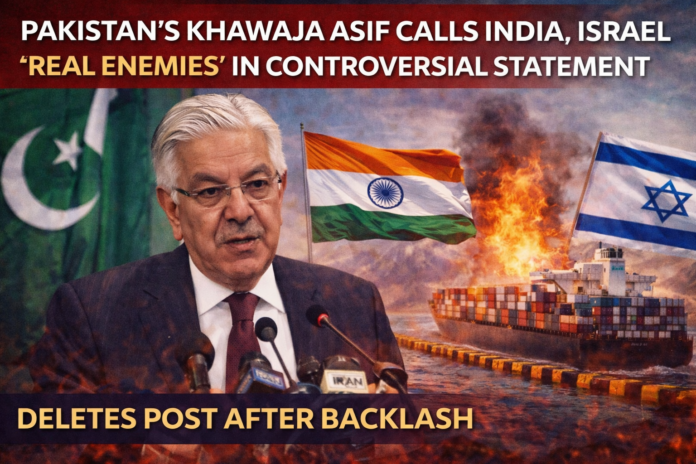

Islamabad, April 14, 2026: Pakistan’s Defence Minister Khawaja Asif has sparked widespread controversy after declaring India and Israel as the ‘real and eternal enemies’ of Pakistan and the Muslim world during a heated speech in Pakistan’s National Assembly on April 12, 2026. The statement, which was later posted on his social media account, drew sharp criticism both domestically and internationally, forcing the minister to delete the post amid mounting backlash. The incident has reignited debates about Pakistan’s foreign policy approach and its relations with neighboring India.
What Did Khawaja Asif Say?
During the National Assembly session, Defence Minister Khawaja Asif responded to criticisms regarding Pakistan’s recent role in mediating ceasefires between the United States and Iran. In his defense, Asif made inflammatory remarks identifying India and Israel as Pakistan’s primary adversaries. ‘We must be clear about who our real enemies are,’ Asif stated. ‘India and Israel are the two enemies of Pakistan and the Muslim world. They have always worked against our interests and continue to do so.’
Shortly after his parliamentary speech, Asif took to social media platform X (formerly Twitter) to reiterate his position. In a now-deleted post, he called Israel a ‘cancerous state’ and accused it of perpetrating violence across the Middle East region. He also made reference to India’s alleged role in undermining Pakistan’s security and stability. The post quickly went viral, attracting thousands of comments, many of which criticized the minister for his divisive rhetoric.
Deleted Post and Mounting Backlash
Within hours of posting, Khawaja Asif’s social media statements began attracting sharp criticism from political analysts, journalists, and citizens. Critics argued that such inflammatory language was unbecoming of a defense minister and could further isolate Pakistan diplomatically. Many pointed out that Pakistan’s economic challenges and need for international support made hostile rhetoric counterproductive.
By the evening of April 12, the post had been deleted from Asif’s account. While no official explanation was provided for the deletion, sources within the Pakistan government suggested that senior officials, including Prime Minister Shehbaz Sharif, had advised the minister to tone down his rhetoric to avoid diplomatic complications. The Ministry of Foreign Affairs also reportedly expressed concern that the statements could jeopardize Pakistan’s efforts to maintain balanced relations with key international partners.
India’s Response and Regional Implications
India’s Ministry of External Affairs responded to Asif’s comments with measured disapproval. In a statement, MEA spokesperson Arindam Bagchi said, ‘Such inflammatory statements from senior Pakistani officials only reinforce the perception that Pakistan continues to harbor hostility toward India. India remains committed to peace and stability in South Asia, but such rhetoric makes dialogue difficult.’
The controversy comes at a sensitive time in India-Pakistan relations. Although both countries agreed to a ceasefire in May 2025 following a brief military confrontation triggered by a terrorist attack in Pahalgam, tensions have remained high. Indian intelligence agencies have continued to flag concerns about Pakistani-backed terrorist groups operating in Jammu and Kashmir.
Analysts note that Asif’s remarks could further harden positions on both sides. ‘This kind of language makes it harder for moderates in both countries to advocate for dialogue,’ said Dr. Ayesha Siddiqa, a political and military analyst based in Islamabad. ‘It feeds into the narrative that Pakistan is not interested in peaceful coexistence.’
Domestic Political Context
Khawaja Asif’s remarks must also be understood within Pakistan’s domestic political context. The ruling Pakistan Muslim League-Nawaz (PML-N) government has been facing criticism from opposition parties, particularly the Pakistan Tehreek-e-Insaf (PTI), which accuses the government of being too soft on India and failing to protect Pakistan’s national interests. Asif’s hardline rhetoric may have been an attempt to deflect such criticism and appeal to nationalist sentiments within Pakistan.
However, the backlash suggests that many Pakistanis are weary of conflict-oriented rhetoric, especially given the country’s ongoing economic crisis. Pakistan is currently negotiating a bailout package with the International Monetary Fund (IMF) and is heavily dependent on financial support from countries like China, Saudi Arabia, and the United Arab Emirates. Diplomatic isolation could jeopardize these critical relationships.
Conclusion
Khawaja Asif’s controversial statement calling India and Israel ‘real enemies’ has underscored the challenges Pakistan faces in balancing domestic political pressures with the need for pragmatic foreign policy. While the minister’s remarks may have resonated with hardline nationalist elements within Pakistan, they risk further isolating the country at a time when it can least afford diplomatic fallout. The swift deletion of his social media post indicates recognition of the potential damage, but the incident has already left its mark on regional perceptions of Pakistan’s intentions and approach to its neighbors.