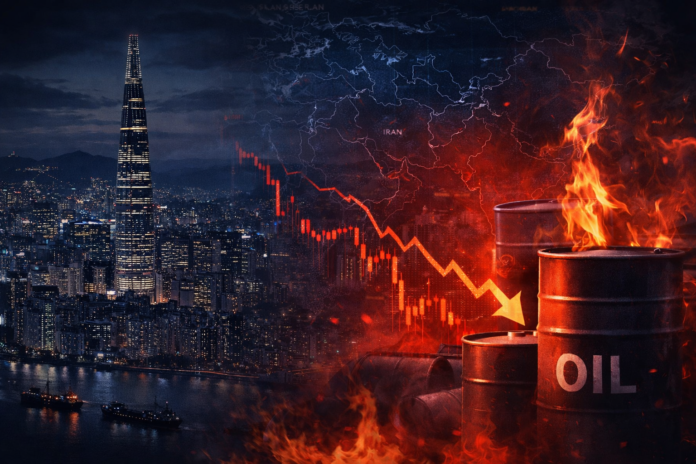

Seoul, April 11, 2026 — South Korea’s National Assembly has voted to approve a landmark supplementary budget worth approximately 30 trillion won (around $17.3 billion USD) to help the country manage the severe economic fallout from the ongoing war in West Asia. The emergency spending package, which grew from the government’s initial proposal of 26.2 trillion won after extensive committee reviews, represents one of the most significant fiscal interventions in South Korea’s recent economic history. The budget is designed to provide relief to consumers, support businesses impacted by global supply chain disruptions, and cushion the Korean economy against the shock of soaring energy prices and deteriorating global trade conditions triggered by the Iran conflict.
The passage of the supplementary budget reflects the depth of South Korea’s exposure to the global energy crisis sparked by the Iran war. As one of Asia’s most energy-intensive advanced economies, South Korea imports a staggering 94 per cent of its energy requirements and sources approximately 72 per cent of its crude oil from the Middle East. The disruption to Middle Eastern oil supplies caused by the ongoing conflict has directly hit South Korean consumers and industries, driving up fuel costs, increasing inflation, and threatening to slow economic growth in a country that has only recently stabilised after a period of political turbulence following the impeachment of former President Yoon Suk-yeol and the subsequent election of President Lee Jae Myung.
What the Emergency Budget Covers
The 30 trillion won supplementary budget package encompasses a range of targeted interventions aimed at stabilising the South Korean economy under current stress conditions. The package includes direct support measures for consumers facing rising energy and food costs, particularly targeted at lower- and middle-income households. Among the most politically contentious elements of the bill during National Assembly negotiations was the proposal to provide cash aid to the bottom 70 per cent of income earners, a measure aimed at offsetting the regressive impact of rising fuel and commodity prices on ordinary South Korean families. While parties remained divided on this specific provision, broader agreement was reached to process the bill by the end of the working week, reflecting a rare degree of bipartisan urgency on economic policy.
Beyond direct consumer relief, the budget also allocates substantial resources for businesses, particularly those in energy-intensive industries such as manufacturing, petrochemicals, and transportation, which have been disproportionately affected by higher fuel costs. The shipping and logistics sector, critical to South Korea’s export-driven economy, has seen operating costs rise sharply as oil prices have climbed. The emergency budget is intended to provide temporary relief that will allow businesses to maintain employment levels and operational capacity during this difficult period, buying time for global energy markets to stabilise.
South Korea’s Economic Vulnerability to the Iran War
South Korea’s deep exposure to Middle Eastern energy makes it particularly vulnerable to the kind of supply shocks that the Iran war has triggered. Unlike major oil producers such as the United States, Russia, or the Gulf states, South Korea has virtually no domestic energy production capacity of significance. It is entirely dependent on imported energy to power its industries, heat its homes, and fuel its transportation network. This structural vulnerability has been a concern for South Korean economic planners for decades, and the current crisis has once again highlighted the urgency of diversifying the country’s energy sources and accelerating its transition to renewable energy.
The Bank of Korea (BOK) held its interest rates unchanged at its most recent meeting, as the Iran war creates significant risks for the economy that complicate the central bank’s decision-making. Governor Rhee Chang-yong, in what is expected to be his final meeting before the end of his term, presided over a decision that reflects the difficult balance policymakers face: cutting rates could stimulate the economy but might accelerate currency depreciation and inflation, while raising rates could tighten the supply of credit but risk pushing the economy into recession at a vulnerable moment. The BOK’s neutral stance mirrors the cautious approach being taken by central banks across Asia in response to the energy crisis.
Geopolitical Context: Korea Between Major Powers
The economic crisis triggered by the Iran war is unfolding at a particularly complex moment for South Korean foreign policy. President Lee Jae Myung’s government has been navigating the tensions between South Korea’s deep security alliance with the United States and its enormous economic dependence on China, which is South Korea’s largest trading partner. The Iran war has added another dimension of complexity to this already challenging diplomatic environment, as South Korea must simultaneously manage its relationships with Washington on security matters, Beijing on trade, and Tokyo on regional cooperation, all while dealing with the economic shocks emanating from a conflict thousands of kilometres away in West Asia.
The Lee government has been actively seeking to expand South Korea’s diplomatic and economic partnerships to reduce these structural vulnerabilities. President Lee’s recent visits to multiple regional partners, including his meeting with Indonesian President Prabowo Subianto in Seoul, reflect a broader strategy of building multilateral relationships that can help South Korea weather future geopolitical and economic storms. The current energy crisis serves as a powerful reminder of why this diversification strategy is not merely desirable but essential for a country as economically open and energy-dependent as South Korea.
Outlook: Can South Korea Weather the Storm?
Despite the severity of the current economic challenges, South Korea has significant strengths that position it to weather the storm better than many economies. It is a high-income, highly industrialised country with a well-educated workforce, strong technological capabilities, and globally competitive industries in semiconductors, electronics, automotive manufacturing, and shipbuilding. The emergency budget, while a significant fiscal commitment, is well within South Korea’s capacity to finance given its relatively strong public finances and high sovereign credit rating. The measure of a government’s economic management in a crisis is not whether it faces difficulties, but whether it responds with speed, adequacy, and strategic clarity — and the rapid passage of this emergency budget suggests the Lee administration is meeting that test.
Economists and market analysts will be watching the impact of the supplementary budget closely in the coming weeks. If the measures succeed in stabilising consumer confidence and preventing a severe contraction in domestic demand, South Korea could emerge from the current crisis with its economic fundamentals broadly intact. However, if the Iran war continues to escalate and global energy prices remain elevated for an extended period, more fiscal interventions may be needed. For now, the passage of this emergency spending package represents a significant commitment by the South Korean government to protecting its citizens and economy from the ripple effects of a conflict that, while distant geographically, has proven all too close in its economic impact.