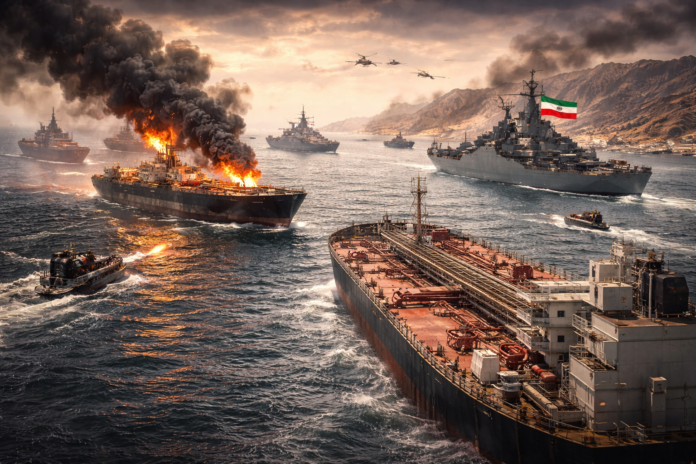

Iran has once again closed the Strait of Hormuz, one of the world’s most critical oil chokepoints, triggering fears of a global energy crisis and directly threatening Indian shipping interests in the region. This dramatic reversal came less than 24 hours after Tehran announced the waterway was fully open, shocking global markets and diplomatic circles alike.
On April 18, 2026, Iran’s Revolutionary Guard Corps (IRGC) announced the closure of the Strait of Hormuz, reversing its earlier announcement of reopening within just 24 hours. The IRGC stated this closure was a direct response to the ongoing US Navy blockade on Iranian ports. The Strait of Hormuz is a narrow waterway between Iran and Oman through which approximately 20% of the world’s crude oil supply passes daily. Any disruption here sends immediate shockwaves across global energy markets.
British military sources confirmed that Iranian gunboats fired warning shots at a commercial tanker near Oman’s coast without prior radio communication. Multiple commercial vessels reported receiving direct warnings from the Iranian navy against navigating through the strait. These developments come as the two-week ceasefire between the United States and Iran was approaching its April 22, 2026 deadline.
The situation has taken a direct toll on India’s strategic and commercial interests. Video footage released by Al Jazeera showed Iranian military personnel ordering an Indian vessel to abort its passage through the Strait of Hormuz. Two Indian ships were reportedly fired upon by Iranian forces, though the US President Donald Trump refused to acknowledge the incident when asked directly by reporters at the White House.
India depends heavily on the Persian Gulf region for its energy needs. Nearly 60% of India’s crude oil imports come from the Middle East, and any prolonged closure of the Strait of Hormuz could severely impact India’s energy security, causing domestic fuel prices to rise sharply. Indian oil companies like Indian Oil Corporation (IOC), Bharat Petroleum (BPCL), and Hindustan Petroleum (HPCL) are closely monitoring the situation.
The closure of the Strait of Hormuz sent immediate shockwaves through global commodity markets. Brent crude oil prices surged by over 8% in early trading on April 19, 2026. Asian markets, including Japan, South Korea, and India, which are major importers of Middle Eastern oil, saw significant stock market declines. The energy sector alone saw billions of dollars wiped off in market capitalization within hours of the announcement.
Shipping insurance premiums for vessels attempting to navigate through or near the Strait of Hormuz skyrocketed overnight. Major shipping companies rerouted their tankers around the Cape of Good Hope, significantly increasing transit times and costs. This add-on cost is expected to eventually be passed on to consumers in the form of higher fuel and commodity prices globally.
US President Donald Trump announced on April 19, 2026 that American negotiators would be heading to Pakistan on Monday for a second round of talks with Iran. The initial round of Islamabad Talks, held on April 11-12, 2026, had failed because Iran was unwilling to fully surrender its nuclear enrichment capabilities. Trump later threatened to blockade the Strait of Hormuz himself in retaliation.
However, the situation remains extremely fluid. With the ceasefire deadline of April 22, 2026 fast approaching, the world is watching closely. Pakistan has emerged as a key diplomatic broker between Washington and Tehran, with Pakistani Army Chief and Prime Minister Shehbaz Sharif shuttling between key capitals including Saudi Arabia, Qatar, and Tehran.
India is in a delicate position. On one hand, India has maintained cordial relations with Iran, and the two countries have significant trade ties, including the Chabahar Port project. On the other hand, India cannot afford to antagonize the United States, its most important strategic and economic partner. The Indian government has so far maintained a cautious silence on the Hormuz closure, calling for de-escalation through diplomatic channels.
India’s External Affairs Ministry confirmed that 2,361 Indian citizens have already been safely evacuated from Iran as the conflict escalated. India’s diplomatic missions in the region are on high alert. The government is in close contact with Indian shipping companies and urging vessels to avoid the Strait of Hormuz until the situation stabilizes.
The Strait of Hormuz crisis represents one of the most dangerous flashpoints in global geopolitics in 2026. With ceasefire talks on the verge of collapse, Iranian gunboats threatening commercial shipping, Indian vessels being ordered away, and global oil prices surging, the world is teetering on the edge of a full-scale energy and military crisis. The next few days, especially with the April 22 ceasefire deadline, will be crucial for determining whether diplomacy prevails or the situation spirals into a wider conflict that could reshape the global order.
Press of Asia will continue to provide live updates on this developing story. Stay tuned for the latest developments on the Iran-US conflict, the Strait of Hormuz situation, and its impact on India’s economy and security.Conclusion: A World on the Brink