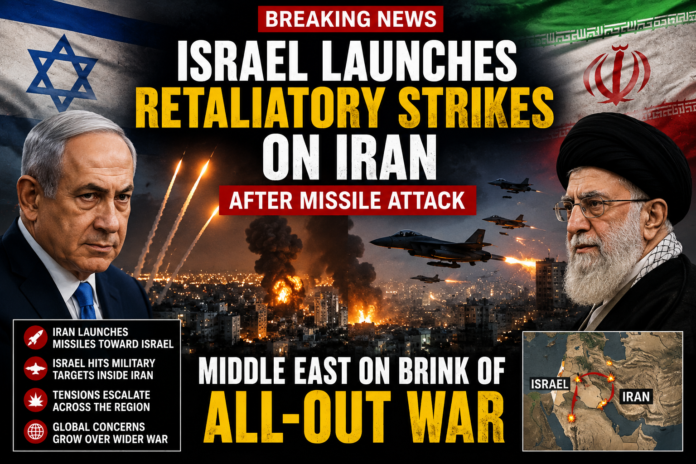

In a dramatic escalation that has pushed the Middle East to the brink of all-out war, Israel launched a series of devastating retaliatory strikes on military targets across Iran on Sunday night, just hours after Tehran fired a volley of missiles at northern Israel. The bombardment marks one of the most significant direct confrontations between the two longtime adversaries and threatens to unravel months of fragile ceasefire efforts in the region.
Explosions rocked Iran’s capital Tehran, as well as the strategic cities of Isfahan and Tabriz, according to reports from Al Jazeera and local sources. The Israeli military confirmed it had launched attacks on Iranian territory, targeting military installations and command centers in western and central Iran in response to what it described as an “unprecedented and unprovoked missile attack” by Iranian forces.
The Chain of Events
The current crisis began when Iran launched a wave of missiles at Israeli targets on Sunday evening, accusing Israel of repeated violations of the ceasefire agreement through its ongoing attacks on Lebanon. According to Iranian officials, the missile strike was a direct response to an Israeli bombardment of the southern suburbs of Beirut that killed at least two people and wounded 20 others earlier in the day.
“Israel has consistently violated the ceasefire terms, launching strikes on Lebanese territory and threatening regional stability,” stated Iranian Defense Minister Aziz Nasirzadeh in a televised address. “We have no choice but to defend our regional allies and respond to these provocations.”
The Israeli government, however, characterized Iran’s missile attack as a dangerous escalation that crossed multiple red lines. Prime Minister’s office released a statement saying that Israel “will not tolerate direct attacks on its territory and will respond with overwhelming force to protect its citizens.”
Global Oil Markets in Turmoil
The military confrontation has sent shockwaves through global energy markets, with oil prices surging to their highest levels in months. Brent crude climbed above $96 per barrel during Asian trading hours on Monday, while US crude also registered strong gains, reflecting investor fears about potential supply disruptions from one of the world’s most critical oil-producing regions.
Analysts point to the Strait of Hormuz—through which approximately 20% of the world’s oil supply passes—as a particular point of vulnerability. Any prolonged conflict could see Iran attempt to block or disrupt shipping through this vital waterway, potentially causing a global energy crisis.
“The market is pricing in significant geopolitical risk premium right now,” said commodity analyst Sarah Chen from Goldman Sachs. “If this conflict escalates further or spreads to other Gulf states, we could see oil prices spike well above $100 per barrel, which would have severe implications for global economic growth and inflation.”
International Response and Diplomatic Efforts
The international community has responded with alarm to the escalating violence. US President Donald Trump, who had been attempting to broker negotiations with Tehran, called for an immediate ceasefire and urged both sides to exercise restraint.
“This needs to stop now,” Trump stated in a brief press conference at the White House. “Both sides need to step back from the brink. We’re working with our allies to de-escalate the situation, but continued attacks will only make peace more difficult to achieve.”
In London, Ukrainian President Volodymyr Zelenskyy met with the leaders of the UK, France, and Germany on Sunday night to discuss not only the situation in Ukraine but also the escalating Middle East crisis. Downing Street released a statement saying the leaders discussed “the urgent need to prevent a wider regional war that could destabilize the entire Middle East and have global ramifications.”
The European Union’s High Representative for Foreign Affairs issued a statement condemning the violence and calling for an immediate return to dialogue. “Military escalation serves no one’s interests,” the statement read. “We urge both Iran and Israel to exercise maximum restraint and engage in diplomatic channels to resolve their differences.”
The Fragile Ceasefire Unravels
The current escalation comes just two months after a US-brokered ceasefire agreement between Israel and Iranian-backed forces in Lebanon had raised hopes for de-escalation in the region. However, that ceasefire has been marked by repeated violations, with both sides accusing the other of not honoring the terms.
Israel has maintained that its strikes on Lebanese territory were necessary to prevent Iranian weapons shipments to Hezbollah and other militant groups. Iranian officials, meanwhile, have accused Israel of using the ceasefire as cover to strengthen its military positions and prepare for a larger offensive.
The Lebanese government announced on Sunday that it would extend the ceasefire agreement despite the violations, but the latest Iran-Israel confrontation threatens to make that extension meaningless if the conflict spreads to Lebanese territory.
Regional Implications
The Iran-Israel conflict is taking place against a backdrop of multiple regional crises that could be exacerbated by further escalation:
Saudi Arabia and the UAE, both of which have been pursuing normalization efforts with Israel, now find themselves in a delicate position. While these Gulf states have their own tensions with Iran, they also want to avoid being drawn into a wider regional war that could threaten their economic development plans and stability.
Iraq and Syria, which host various Iranian-backed militias, could become flashpoints if the conflict expands. There are concerns that Israel might strike Iranian positions in these countries as part of a broader campaign to degrade Tehran’s regional influence.
Yemen’s ongoing civil war, where Iranian-backed Houthi rebels have been fighting a Saudi-led coalition, could see increased violence if Iran seeks to open additional fronts against its adversaries.
Military Capabilities and Strategic Considerations
Defense analysts note that both Iran and Israel possess significant military capabilities that make this confrontation particularly dangerous:
Iran has developed an extensive arsenal of ballistic and cruise missiles with ranges capable of reaching Israeli territory. The country has also invested heavily in drone technology and proxy forces throughout the region, giving it multiple options for both conventional and asymmetric warfare.
Israel, meanwhile, possesses one of the most technologically advanced militaries in the world, with sophisticated air defense systems, precision strike capabilities, and intelligence gathering assets. Israel is also believed to possess nuclear weapons, though it maintains a policy of nuclear ambiguity.
The current exchange represents a significant departure from the typical “shadow war” between the two nations, which has historically been characterized by covert operations, cyberattacks, and proxy conflicts rather than direct military confrontations on each other’s territory.
What Happens Next?
As dawn breaks over the Middle East on Monday, the region faces perhaps its most dangerous moment in decades. The coming hours and days will be critical in determining whether this escalation can be contained or whether it will spiral into a broader regional war with potentially catastrophic consequences.
Diplomatic channels remain open, and there are intensive behind-the-scenes efforts by the United States, European nations, and even Russia and China to broker a de-escalation. However, domestic political pressures in both Iran and Israel may make it difficult for leaders to back down without appearing weak.
The international community watches anxiously as the situation unfolds, knowing that the stakes extend far beyond the immediate participants. A full-scale war between Iran and Israel would likely draw in other regional powers, disrupt global energy supplies, trigger refugee crises, and potentially reshape the geopolitical landscape of the entire Middle East for decades to come.
For now, the world can only hope that cooler heads prevail and that the path back from the brink can be found before it’s too late.