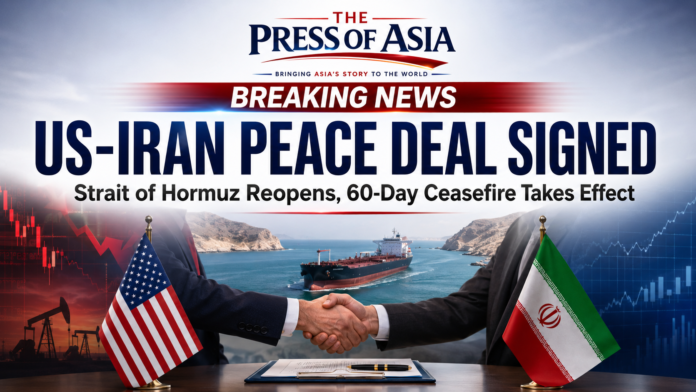

In a historic diplomatic breakthrough, the United States and Iran on June 14, 2026 formally agreed to a comprehensive peace deal, ending 107 days of military conflict and reopening the strategically vital Strait of Hormuz. The deal, mediated by Pakistan and Qatar, was electronically signed by both nations and is set to be formally ratified in a signing ceremony in Switzerland on June 19, 2026. The agreement includes a 60-day ceasefire across all fronts — including Lebanon — and lays the groundwork for fresh nuclear negotiations between Washington and Tehran.
Key Terms of the US-Iran Peace Agreement
The landmark peace deal includes several critical provisions. The United States has agreed to lift its naval blockade of Iranian ports, while Iran has committed to ensuring unimpeded passage through the Strait of Hormuz. The US will suspend sanctions on Iranian oil, allowing nations to immediately purchase Iranian crude at market rates. Iran will receive access to approximately $12 billion in previously frozen assets, with an additional $300 billion reconstruction commitment from the US and its allies to be disbursed in phases based on compliance. The 14-point Memorandum of Understanding also mandates a 60-day window during which both sides will negotiate the future of Iran’s nuclear enrichment program, including limits on highly enriched uranium stockpiles. Crucially, Iran’s ballistic missile program and its support for proxy groups such as Hezbollah were not included in the current deal, leaving key security concerns unresolved for the future.
Role of Pakistan and Qatar as Mediators
The deal’s success was largely attributed to behind-the-scenes diplomacy by Pakistan and Qatar, both of which served as trusted intermediaries between the warring parties. Pakistani Prime Minister Shehbaz Sharif announced the framework agreement via social media, declaring that both sides had agreed to an “immediate and permanent cessation of military operations on all fronts.” Qatar, which hosts a significant US military presence and maintains diplomatic channels with Tehran, played an equally pivotal role in bridging the trust deficit between Washington and Iran. The formal signing ceremony is scheduled for June 19, 2026 in Zurich, Switzerland, to be witnessed by senior diplomats from both nations and the mediating countries.
Global Reaction: Oil Markets, Stock Exchanges, and World Leaders Respond
The announcement of the US-Iran peace deal triggered immediate and dramatic shifts across global financial markets. Brent crude oil prices dropped sharply by over 9% within hours of the announcement, falling from approximately $94 per barrel to around $85, as traders priced in the imminent reopening of the Strait of Hormuz — a critical chokepoint through which nearly 20% of global oil supply passes daily. The easing of Iranian oil sanctions is expected to add an estimated 1.5 to 2 million barrels per day back to global supply in the coming months.
Stock markets around the world responded positively. The Dow Jones Industrial Average gained over 400 points in early trading, while European indices including the FTSE 100 and DAX posted gains of over 1.5%. Asian markets, particularly in energy-importing nations like Japan, South Korea, and India, surged on expectations of lower fuel import costs. The Indian Sensex and Nifty 50 both climbed over 2%, reflecting investor relief over reduced geopolitical risk in the Middle East.
World leaders were swift in welcoming the deal. UN Secretary-General António Guterres called it “a triumph of dialogue over destruction,” urging both sides to implement the terms in good faith. European Union foreign policy chief Josep Borrell expressed hope that the ceasefire would pave the way for a revived nuclear framework. China, a major buyer of Iranian oil, expressed its support through a Foreign Ministry statement, saying Beijing “welcomes any development that contributes to regional stability and peace.” Russia, meanwhile, called the deal “a step in the right direction” while urging caution over implementation timelines.
What the Deal Means for India and the Asia-Pacific Region
For India, the US-Iran peace deal carries both economic and strategic significance. India had been one of the top importers of Iranian crude oil before US sanctions forced New Delhi to halt purchases in 2019. The lifting of sanctions now reopens a critical and cost-effective energy corridor for India, which imports over 80% of its oil needs. Indian officials are expected to resume negotiations with Tehran for long-term supply contracts at preferential rates under the new framework.
India also has a strategic interest in the Chabahar Port project in southeastern Iran, a key infrastructure investment that provides India with an alternative trade route to Afghanistan and Central Asia, bypassing Pakistan. The peace deal removes a major diplomatic hurdle, potentially accelerating Indian investment in the port. Indian External Affairs Minister S. Jaishankar welcomed the ceasefire, describing it as “a positive development for regional stability and global energy security.”
For the broader Asia-Pacific region, the deal is expected to ease inflationary pressures caused by elevated oil prices, particularly in import-dependent economies like Japan, South Korea, Thailand, and Vietnam. Analysts note that energy cost relief could give central banks in the region more flexibility to manage monetary policy without the risk of fuel-driven inflation spikes.
Challenges Ahead: Nuclear Talks, Proxy Groups, and Regional Skeptics
Despite the historic nature of the deal, significant challenges remain before lasting peace can be declared. Chief among them is the unresolved question of Iran’s nuclear program. The 60-day window for nuclear negotiations is considered extremely tight, given the complexity of issues such as uranium enrichment levels, IAEA inspection rights, and the fate of Iran’s existing stockpile of enriched uranium. Previous attempts at nuclear diplomacy, including the 2015 JCPOA, collapsed under the weight of political pressure and lack of trust.
Iran’s continued support for regional proxy groups, including Hezbollah in Lebanon and various militias in Iraq and Syria, was deliberately excluded from the current agreement. Critics, particularly from Israel and Saudi Arabia, warn that a peace deal that does not address Iran’s proxy network could embolden Tehran to expand its regional influence under the cover of diplomatic legitimacy. Israeli Prime Minister Benjamin Netanyahu expressed cautious skepticism, stating that Israel “will not be bound by any deal that does not permanently dismantle Iran’s nuclear ambitions.”
Furthermore, hardliners within Iran’s domestic political establishment have questioned whether the concessions made — particularly the freeze on ballistic missile development discussions — go too far. The Iranian parliament is expected to debate the deal’s terms, and opposition from the Islamic Revolutionary Guard Corps (IRGC) could complicate ratification. Analysts from the International Crisis Group warn that both sides must take concrete confidence-building steps quickly to prevent the deal from unraveling before the formal signing on June 19.
Conclusion: A New Chapter in US-Iran Relations
The US-Iran peace deal of June 14, 2026 marks the most significant diplomatic development in Middle Eastern geopolitics in decades. After more than three months of military conflict that rattled global energy markets and threatened broader regional instability, the ceasefire and accompanying framework offer a genuine, if fragile, path toward peace. The reopening of the Strait of Hormuz alone signals a significant de-escalation with far-reaching economic consequences for the world.
Yet history offers sobering lessons. The road from ceasefire to durable peace is long, littered with failed agreements and broken promises. The coming 60-day nuclear negotiation window will be the true test of whether both Washington and Tehran are prepared to make the deeper compromises necessary for lasting stability. The eyes of the world will be on Zurich on June 19, as the leaders of two long-adversarial nations prepare to sign a document that could reshape the geopolitical order of the 21st century.
For now, the guns have gone silent. The tankers can move. And after 107 days of conflict, the world allows itself — carefully — to hope.