
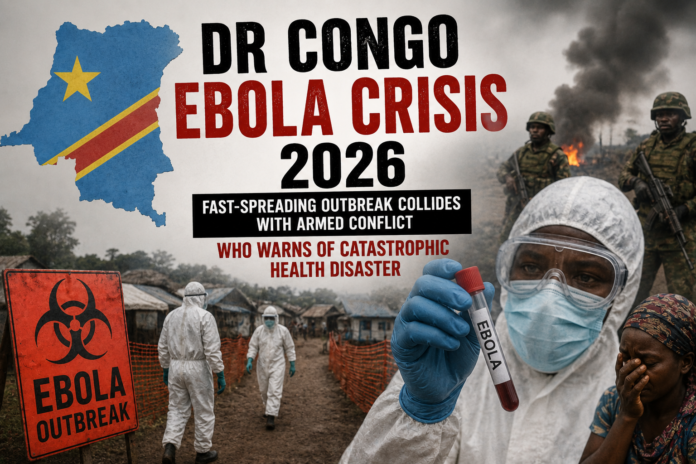

The World Health Organization has issued an urgent warning about a fast-spreading Ebola outbreak in eastern Democratic Republic of the Congo that is rapidly outpacing containment efforts while colliding with armed conflict, mass displacement, and severe hunger in what WHO officials are calling a catastrophic collision of disease and humanitarian crises.
Since May 16, 2026, there has been a significant and alarming increase in laboratory-confirmed and suspected Ebola cases across the DRC, primarily concentrated in Ituri Province. Additional unrelated cases have been identified as far as Kampala, Uganda, raising international concerns about cross-border transmission. WHO Chief Tedros Adhanom Ghebreyesus has called on neighboring countries to take immediate action as the number of suspected deaths from the outbreak has reached 220.
The Crisis Unfolds in Conflict Zones
Eastern DRC faces what UN World Health Organization has described as a catastrophic collision of disease and conflict. The Ebola outbreak is spreading faster than public health workers can respond, primarily affecting regions already battered by armed violence, mass displacement, and acute hunger. The outbreak has remained largely confined to Ituri Province but has been heavily linked to areas affected by insecurity, civilian displacement, and mining-related migration.
Health experts worldwide are expressing grave concerns that without effective monitoring and response efforts, the outbreak could spread beyond current containment zones. The challenging security situation in eastern DRC has severely hampereddisease surveillance, vaccination campaigns, and treatment access for affected communities.
Scale of the Health Emergency
The current outbreak represents one of the most serious public health challenges facing central Africa in 2026. With 220 suspected deaths and cases continuing to rise, the outbreak is spreading at an alarming rate that outpaces previous Ebola emergencies in the region. Health workers on the ground report that the combination of conflict-related barriers and population movements is creating perfect conditions for viral transmission.
The Ebola virus causes severe hemorrhagic fever with fatality rates that can exceed 50% without proper medical intervention. Early symptoms include fever, severe headache, muscle pain, and weakness, followed by vomiting, diarrhea, and in severe cases, internal and external bleeding. The highly contagious nature of the virus, particularly through contact with bodily fluids of infected individuals, makes containment in conflict zones extraordinarily challenging.
Humanitarian Crisis Compounds Medical Emergency
The outbreak is unfolding against a backdrop of one of the world’s most complex humanitarian crises. Eastern DRC has been plagued by decades of armed conflict involving numerous militia groups, resulting in mass displacement of civilians, destruction of health infrastructure, and severe disruptions to basic services. Millions of people in the affected regions lack access to clean water, adequate nutrition, and healthcare even during normal circumstances.
This humanitarian catastrophe has created conditions where disease can flourish. Displaced populations living in overcrowded camps with poor sanitation are particularly vulnerable to infection. The ongoing violence makes it extremely difficult for health teams to reach affected communities, deliver vaccines and treatments, or conduct critical contact tracing to identifypotential new cases.
Cross-Border Transmission Concerns
The identification of Ebola cases in Kampala, Uganda, has heightened concerns about international spread. Uganda shares a porous border with the DRC, and high levels of cross-border movement for trade, family connections, and displacement make containment particularly difficult. WHO has urged neighboring countries including Uganda, Rwanda, Burundi, and Tanzania to strengthen surveillance at border points and prepare their health systems for potential cases.
Previous Ebola outbreaks in the region have demonstrated how quickly the virus can spread across international boundaries when not contained effectively. The 2018-2020 Kivu Ebola epidemic, the second-largest outbreak in history, saw cases exported to Uganda despite intensive containment efforts. Health authorities are working to prevent a similar scenario in 2026.
Mining Communities as Transmission Hotspots
The outbreak has been particularly concentrated in areas with active mining operations. Eastern DRC is rich in minerals including gold, coltan, and other valuable resources, attracting both artisanal miners and larger operations. Mining communities often involve workers moving between different sites, creating networks for disease transmission. The mobile nature of mining populations, combined with often rudimentary living conditions in mining camps, presents unique challenges for outbreak control.
Health officials report that some mining areas affected by the outbreak are controlled by armed groups, making access for medical teams dangerous or impossible. This has created blind spots in the response effort where the virus may be spreading undetected.
International Response and Challenges
The World Health Organization has mobilized international support for the outbreak response, but significant obstacles remain. Limited funding, insecurity in affected areas, and the sheer scale of the humanitarian crisis are stretching responsecapacities to their limits. Vaccination campaigns using proven Ebola vaccines have been initiated, but reaching all at-risk populations remains difficult.
Medical teams face daily risks operating in conflict zones, with health workers sometimes caught in crossfire or unable to access communities due to active fighting. The DRC’s health infrastructure, already weakened by years of conflict and limited resources, is struggling to cope with the dual burden of Ebola and ongoing conflict-related injuries and diseases.
Vaccination and Treatment Efforts
Two licensed Ebola vaccines – Ervebo and a two-dose regimen – have proven effective in previous outbreaks and are being deployed in the current crisis. However, the cold-chain requirements for vaccine storage and the need to reach dispersed populations in insecure areas present major logistical challenges. Vaccination teams must work under armed escort in many locations, and some communities remain completely inaccessible.
For those who do contract Ebola, early treatment significantly improves survival chances. Therapeutic treatments including monoclonal antibody therapies have shown promise, but again, delivering these treatments in conflict-affected areas proves extremely difficult. Many patients may be dying without ever reaching treatment facilities due to distance, insecurity, or fear.
Looking Ahead
As the outbreak continues to evolve, the international community faces difficult questions about how to effectively respond to health emergencies in active conflict zones. The DRC Ebola crisis of 2026 demonstrates that disease control cannot be separated from broader efforts to address conflict, displacement, and humanitarian needs.
Without sustained international support, improved security conditions, and coordinated efforts addressing both health and humanitarian dimensions of the crisis, experts warn the outbreak could persist for months or even years, potentially spreading towider regions of Africa and beyond. The stakes are extraordinarily high, both for the millions of people directly affected in eastern DRC and for global health security.
The world is watching to see whether lessons learned from previous Ebola outbreaks can be applied effectively in this uniquely challenging environment, where war and disease create a catastrophic collision that threatens to overwhelm even the most robust international response efforts.